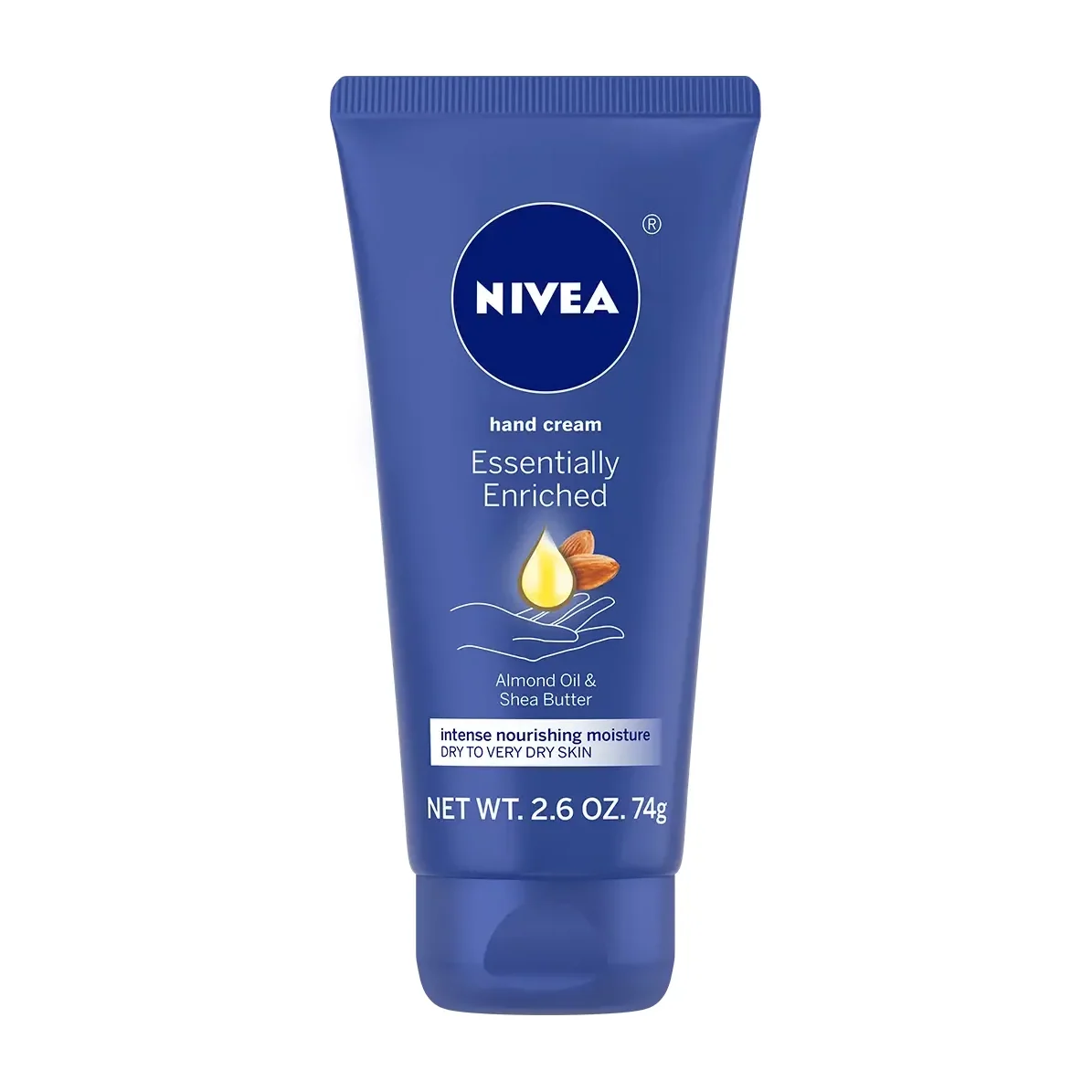
Turn the tube over and the last seven ingredients read like a patch-test tray: linalool, limonene, geraniol, benzyl alcohol, citronellol, alpha-isomethyl ionone, fragrance. That is not a confession. It is the European labelling convention that Beiersdorf carries onto its US packaging, under which any of twenty-six named fragrance allergens above a trace threshold has to be listed separately, and almost no American-made hand cream does the same, not because they contain less but because nobody makes them say. The Nivea tube is therefore both more honest than most of its shelf-mates and more obviously a fragrance product, and both facts are worth holding onto while judging what is, underneath the perfume, a very competently built hand cream.
The build is the part that impresses. Glycerin sits second, the humectant that keeps knuckles from cracking between applications. Dimethicone sits fifth, unusually high for a Nivea formula, forming the light water-resistant film that lets the cream survive a hand wash or two, which is the single property that separates a hand cream from a body lotion in a tube. Distarch phosphate at seventh, a modified starch, absorbs surface oil and gives the finish its fast, faintly powdery dry-down; a minute after applying, a keyboard or a phone screen shows nothing. Then the lipids, a light triglyceride at sixth, shea butter at eighth and the labelled sweet almond oil at eleventh, dosed to soften rough skin over a few days rather than to leave a coat. It is the German hand-cream template, humectant, silicone, starch, a little fat, and it works exactly as designed: hands feel protected rather than greasy, chapped knuckles improve within two or three days of applying after washes, and the film holds through the sink.
What it does not do is last twenty-four hours on a working hand, whatever the front says. That number comes from corneometer readings on unwashed skin in a laboratory, and no hand that makes dinner and washes afterwards has met those conditions. The realistic promise is a wash or two before reapplying, which is why the tube is sized to live by the sink or in a bag, and why the 2.6 ounces last four to six weeks rather than months.
Then the scent, which is the review's fork in the road. It is the classic Nivea Creme perfume, powdery, rosy, faintly soapy, arriving before the cream has been rubbed in and lingering an hour or two, and it is stronger than nearly any hand cream sold at an American drugstore. For the people who grew up with the blue tin it is the entire point, and their reviews say so. For hands with any history of fragrance allergy or eczema it is a problem, because hands are the most common site of fragrance contact dermatitis and this formula declares six of the usual suspects; the gentle almond oil and shea butter do not change that arithmetic. Nivea sells this cream on comfort and familiarity, and it should be bought on those terms by people whose hands tolerate perfume and avoided by people whose hands do not.
Against cracked, fissured or eczematous hands it is also simply the wrong tool, not because it is bad but because its lipid content is moderate and its film is light. That skin wants a fragrance-free cream or a plain ointment under cotton gloves at night, and this tube is at best the daytime layer on top. For ordinary winter dryness, office hands, gardeners' hands and the general chapping of a cold month, it is well matched.
The tube itself arrived in the US only around 2023, the hand-care extension of Nivea's best-selling Essentially Enriched body lotion, and it shows in the numbers: twenty Amazon ratings at 4.6 stars, a Walmart and Walgreens presence at around seven dollars, and not yet a place on every chain's shelf. That is thin evidence for a brand with more than a century of hand-care history in Europe, and the assessment here leans on the fully disclosed formula and on the European record rather than on American reviews.
A note on the starch, because it is the least-known part of the trick. Distarch phosphate is the same kind of modified starch that mattifying face creams and dry shampoos use, and in a hand cream it does two jobs: it soaks up the surface oil that would otherwise smear a phone screen, and it gives the skin a soft, slightly powdered feel that reads as clean rather than coated. The cost is that the finish can seem to vanish, which some people mistake for the cream not having done anything; the glycerin and silicone are still there under the powder, and hands that are compared side by side a few hours later show the difference clearly.
So take the allergen list as the gift it is. It tells you exactly what is in the perfume, which most competitors will not, and it tells you before you buy whether this is a hand cream for you. If it is, the cream underneath is fast, wash-resistant, softening and fairly priced, from a brand that has made this product category longer than almost anyone. If it is not, the same honesty has just saved your hands a week of itching, and a fragrance-free tube from the next shelf will do the same job without the rose.