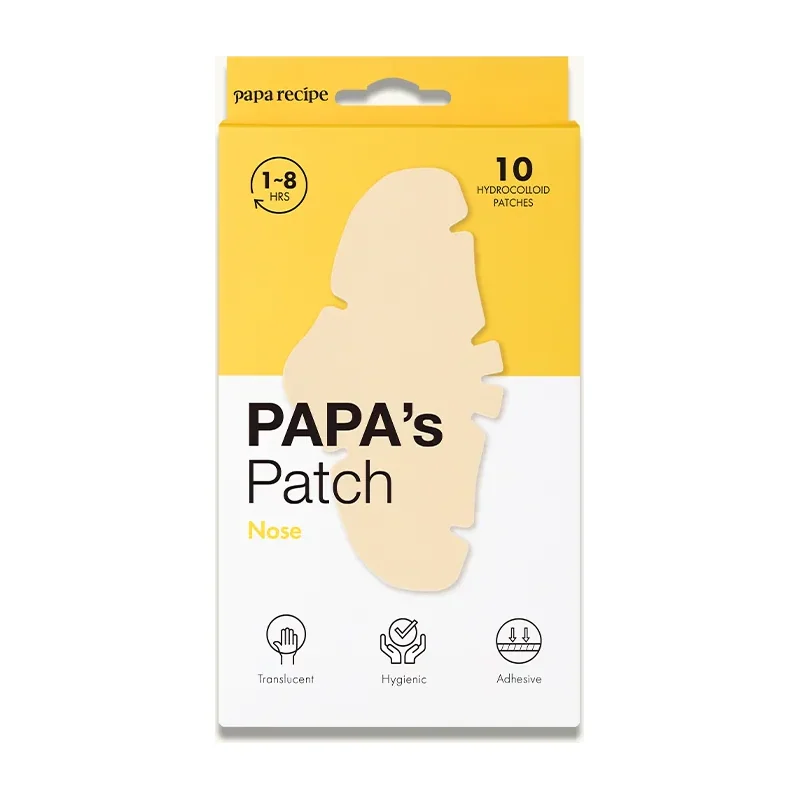
The nose is where many people fight their skin battles, and most of those battles are with blackheads: tiny plugs of oxidised oil and dead skin sitting in wide pores. So a patch designed to cover the entire nose naturally invites the question of whether it can help with them. The answer is no — and that is not a failing of this particular product, but a matter of what hydrocolloid does. Understanding that makes it much easier to use Papa's Patch Nose well.
Hydrocolloid patches were developed from wound dressings. The material, here cellulose gum held in a polyisobutene adhesive, absorbs fluid from the skin and swells into a soft gel. On an open, weeping spot — a pimple that has come to a head or been picked — that is genuinely useful. The patch draws out fluid, keeps the area moist, which supports healing, and forms a barrier against fingers, pillowcases and bacteria. Spots often look flatter and less angry after a few hours of wear. That is the job hydrocolloid does well, and this patch does it.
What hydrocolloid cannot do is reach into a closed pore and pull out a blackhead. Blackheads are firm plugs, not fluid, and a patch that absorbs moisture has nothing to absorb there. Pore strips work differently, adhering to the tops of the plugs and ripping them out, and even they offer only temporary results. For blackheads, the most effective long-term approaches are leave-on salicylic acid and retinoids, which keep pores clearer over time. So if your nose problem is blackheads, this patch is the wrong tool.
If your problem is breakouts on and around the nose, however, the design makes sense. Individual dot patches are hard to place in the crease beside the nostril or along the bridge, and they tend to peel off on the curved surface. A single patch cut to the shape of the nose covers several spots at once, including the awkward areas, and stays in place for up to eight hours. It is thin and translucent, so it is fairly discreet, though makeup does not sit well on top.
The ingredient list is short. After cellulose gum and polyisobutene come tea tree leaf oil and salicylic acid, the last two in small amounts. They give the patch a blemish-care theme, but in a hydrocolloid, with no declared concentration and at the end of the list, their contribution is minor. The real work is the hydrocolloid. That simplicity is a strength for sensitive skin: there is no fragrance, and fewer ingredients mean fewer potential irritants, although tea tree oil can occasionally cause reactions.
Using it well is straightforward. Apply it to clean, completely dry skin — any serum, cream or oil underneath will stop it sticking — and press it smooth over the nose. Leave it on for one to eight hours, or overnight. When it has turned cloudy or white over the spots, it has absorbed fluid and can be removed. Peel it off slowly, starting from the edge, and support the skin with a finger to avoid pulling.
A few practical points help the patches earn their keep. They work best on spots that have come to a head or are weeping; on a deep, painful bump that has not surfaced, there is little fluid for the hydrocolloid to absorb, and a patch mainly serves as a reminder not to squeeze. Applying one straight after a shower, once the skin is thoroughly dried, gives the best adhesion, as the skin is clean and free of oils. If you are using a benzoyl peroxide or adapalene treatment, apply it to the surrounding skin rather than under the patch, since trapping actives under an occlusive dressing can increase irritation. And if the patch keeps lifting at the tip of the nose, trimming a small notch with clean scissors can help it follow the curve. Finally, resist the temptation to reuse a patch: once it has absorbed fluid, its capacity is spent and its adhesion weakens, so a fresh one each time is both more effective and more hygienic.
Patches are best used as part of a broader acne routine rather than on their own. Hydrocolloid helps individual spots heal but does not prevent new ones. For recurring breakouts, a cleanser and a leave-on treatment such as benzoyl peroxide or adapalene, used on the surrounding skin, address the cause.
At sixteen dollars for ten patches on the brand's store, each patch costs about one dollar sixty, which is more than individual dot patches but fair for a larger, shaped patch covering several spots at once. Verifiable product-specific reviews are scarce.
Who should buy it? People who get clusters of breakouts on and around the nose and want a single, well-fitting patch to protect and flatten them, especially overnight. It is simple, fragrance-free and easy to use. Those whose main nose concern is blackheads or enlarged pores should look to salicylic acid or retinoid products instead. The shape is clever; just be clear about which nose problem it is designed to solve.