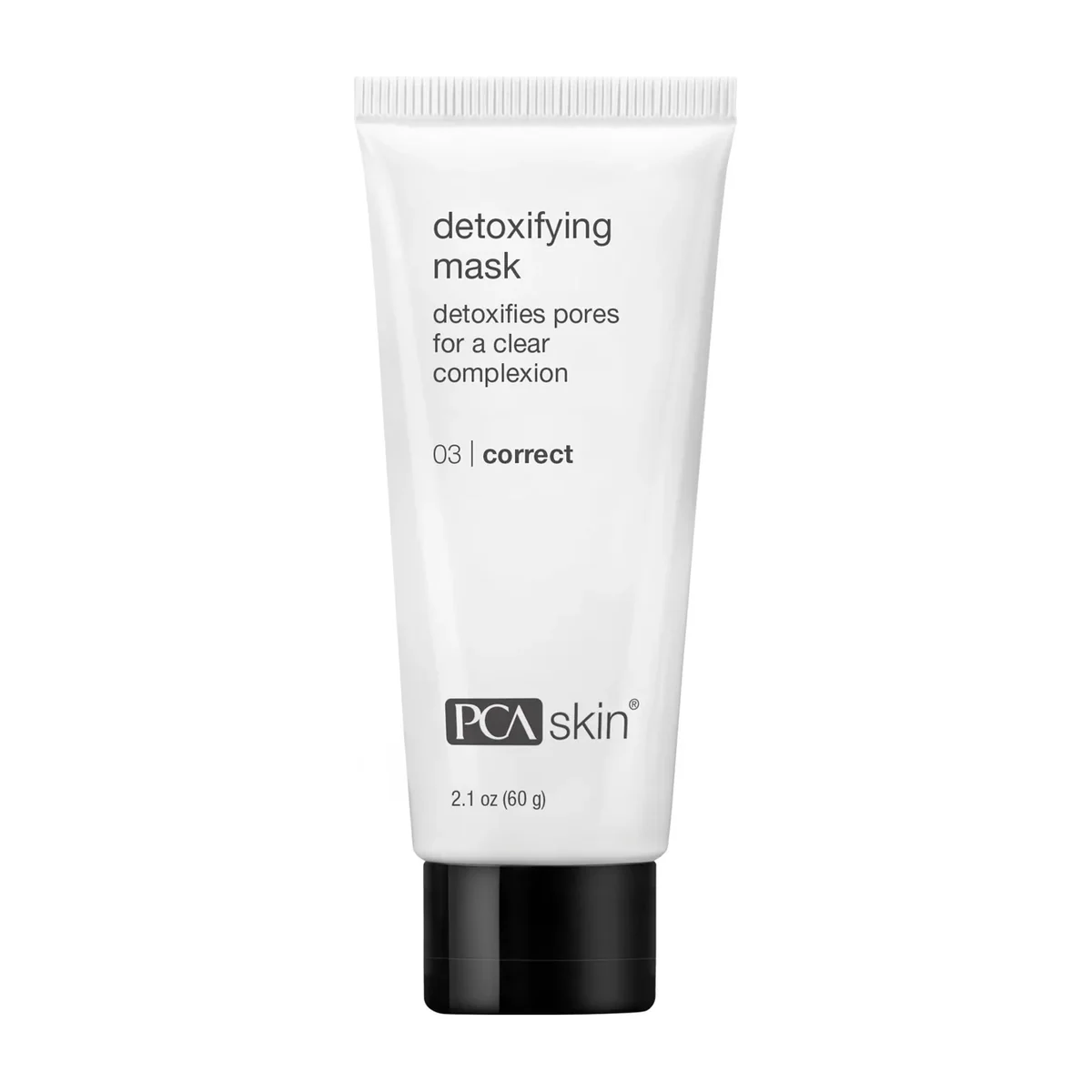
The ingredient list on PCA Skin's Detoxifying Mask has ten entries, and five of them are the preservative and stabiliser system. Water, kaolin, charcoal powder, glycerin and magnesium aluminum silicate are the whole formula; phenoxyethanol, xanthan gum, citric acid, disodium EDTA and ethylhexylglycerin keep it stable and safe. There is no active, no acid, no botanical, no oil, no fragrance. That minimalism is, in one sense, a virtue, and it is worth crediting before anything else: the mask is oil-free, fragrance-free, alcohol-free and safe for fungal-acne-prone skin by construction rather than by design, and it is about as unlikely to cause an allergic reaction as anything a person could put on their face. In the other sense, it is a two-ounce tube of clay and charcoal for seventy-two dollars, and the brand knows it, which is why the marketing leads with Japanese white charcoal rather than with the list.
The clay does the work. Kaolin, second on the label, is the mildest of the cosmetic clays, a soft white silicate that absorbs sebum and contracts as it dries, which is what tightens the skin and makes pores look smaller for an evening. Magnesium aluminum silicate is a second, smectite-type clay giving body and a little extra absorbency. Glycerin sits between them holding water in the paste so it dries more slowly and cracks less, and it is the single reason this mask leaves skin merely matte rather than papery. Charcoal powder, third on the list, colours the paste grey, adds a modestly stronger drying pull, and supplies the story: binchotan, the Japanese hardwood charcoal fired at high temperature and prized for its porosity, whose adsorptive talent is real in a water filter and a metaphor on a face. Skin stores no toxins for a mask to draw out. What the reviewers see when they say their pores 'vanished' after one use is kaolin emptying the pore opening of oil; what they see a day later is the pore refilling.
Used as intended, once a week, a thin layer, ten minutes, rinsed with warm water, the mask does what a kaolin mask does, and does it cleanly. Oily and combination skin comes out matte, smooth and visibly less congested for the evening and part of the next day, without stinging, staining or the crumbling mess of a jarred clay. Surface blackheads look lighter because the oil around them is gone; established blackheads, the oxidised plugs deeper in the follicle, are largely unmoved, and the reviews that complain of 'no difference' are describing that limit accurately. Drier and combination skin notices tightness, sometimes flaking, and learns to keep the mask to the T-zone. None of this is a criticism of the formula. It is a description of what any well-made clay mask does, and this is a well-made clay mask. The tube deserves a sentence of its own, because it is the one packaging decision that matters for a clay product: jarred clay masks dry out and crack from the edges within a couple of months, while a squeeze tube with a screw cap keeps the paste at the same consistency from the first use to the last, which is part of why a two-ounce tube stretches to half a year.
PCA Skin's reputation was built somewhere else entirely. The company created the modified Jessner's peel in the early 1990s and remains the peel brand estheticians train on, and its retail line borrows that clinical credibility for products that range from genuinely sophisticated, its retinoids and peptide serums, to this. The credibility is real; it is just not doing anything inside this tube. The brand publishes no testing on the mask, and none is needed to understand it. The publicly countable reviews number a couple of dozen on the retailers that show them, averaging around 4.6 and split predictably between oily-skinned enthusiasts and drier-skinned disappointment.
Which leaves the price, and there is no way around it. Seventy-two dollars for 2.1 ounces is about thirty-four dollars an ounce for a formula whose raw materials are among the cheapest in cosmetics; the same kaolin, charcoal and glycerin can be had in a tube for a tenth of the money, sometimes with actives added. The honest defence is that a thin layer goes a very long way, that the tube lasts six months to a year of weekly use, and that for a client already buying PCA's cleanser, serum and retinoid from their esthetician the mask completes a set without introducing an unknown. Those are reasonable things to pay for. They are not chemistry. It is also fair to say the mask is well judged in its proportions; the glycerin-to-clay balance is the difference between a mask that tightens and one that hurts, and a lot of cheap clay masks get that wrong in the direction of pain.
So the recommendation is narrow and unresentful. Oily or combination skin that wants a clean, fragrance-free, once-a-week mattifying mask and is already inside PCA's professional routine will find this one does its job without fuss. Anyone shopping on the merits of the formula should notice that the formula is ten ingredients long, five of them preservatives, and spend the seventy-two dollars on something with an active in it.