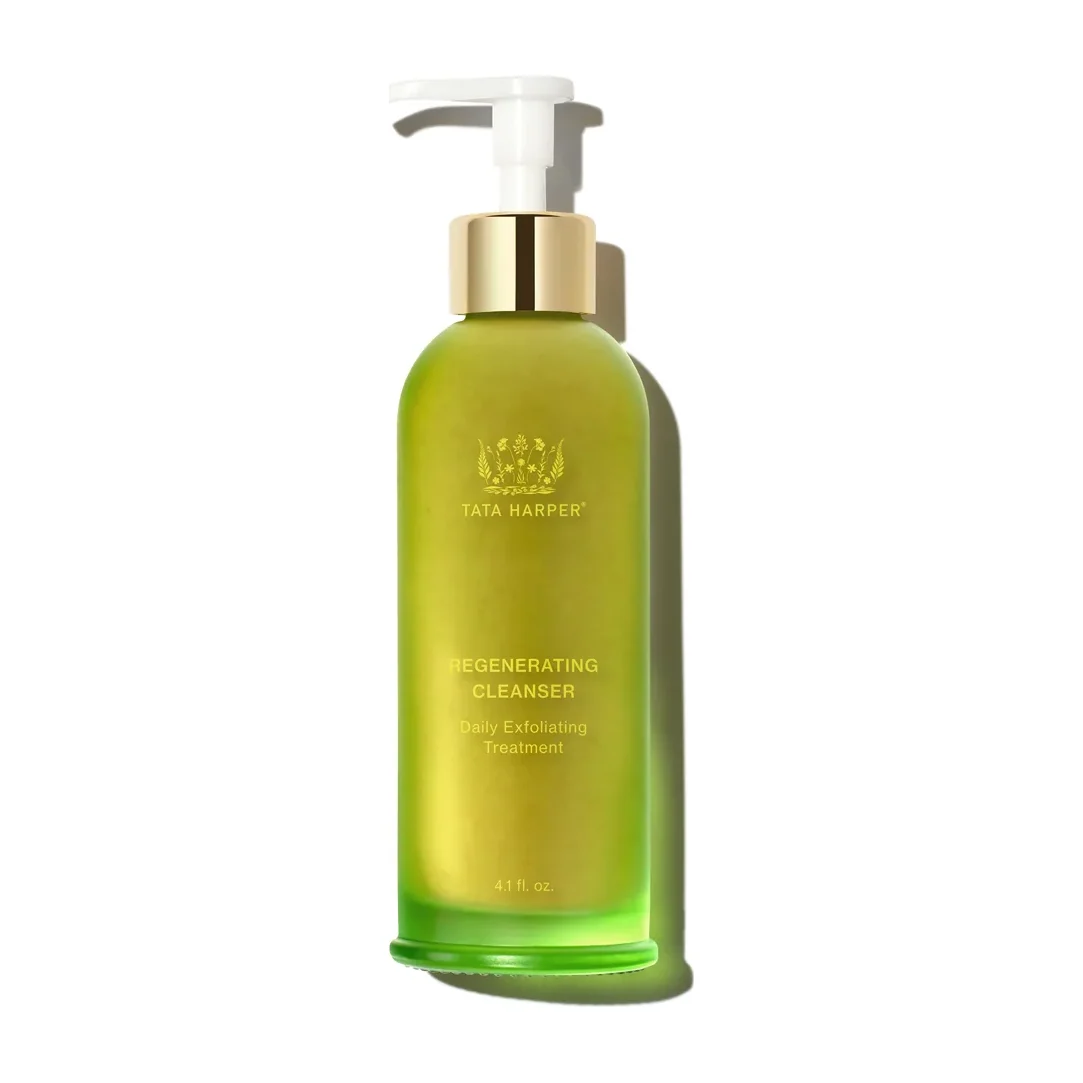
Tata Harper Regenerating Cleanser frosted green glass pump bottle
Not yet assessed for Dullness
What makes this different

It combines a cushioning olivate-and-fatty-alcohol cream cleanser with finely milled apricot seed, a pomegranate enzyme ferment and willow bark, so one wash leaves skin polished and soft in a way a plain cleanser cannot. It is COSMOS-certified, farm-made and beautifully scented with grapefruit, and it is the product that made the brand's name; it is also a daily scrub with essential oils, and that combination is why it divides faces.

Tata Harper

Tata Harper Regenerating Cleanser Review

Cream Scrub in Luxury Clothes Cleansers cream clean beauty Paraben free Cruelty free Vegan

The cleanser that built the brand: a cushioning olivate cream with finely milled apricot seed, a grapefruit-and-bergamot scent and a glow after one wash that three thousand reviews describe accurately. It is also a scrub sold as a daily cleanser, with two citrus oils and three declared allergens on freshly buffed skin, at $88 for 125 ml; used two or three evenings a week on resilient skin it is a genuine luxury, and used as directed on most faces it is a slow route to a tight, flushed one.

Price $88.00 125 ml / 4.1 fl oz · more sizes
Shopper rating 4.9 ★★★★★ 8,000 reviews
Buy at Amazon ♥
Verdicts

How well it fits each concern

No concern verdicts yet.

The scaleRecommendedGoodSupportingEarly evidenceNot for thisAvoidhow it works

Listed for Dullness, Rough Texture and Dehydration — the actives here (Fatty Alcohols, Coco-Glucoside, Apricot Kernel Oil, Enzymes) are in our research queue for those concerns; there is no verdict until their evidence rows are written. That is a gap in our table, not a mark against the product.

Does the jobDoes what a cleanser is for: surfactant mildness, rinses clean without stripping. Not measured from the label: pH match to skin.

A verdict is Dermington’s assessment of how well a product’s ingredients fit a concern — never a claim about what the product treats. Evidence dots and collected reviews sit beside it and are never blended in. Rules 0.5.1 · evidence table ev-2026.10-r231 · engine 5.2.0 · how we decide · this product’s receipt

Reader poll · Town SquareQuestion 1 of up to 3

Have you used Regenerating Cleanser?

One tap counts. A couple of optional follow-ups come next.

No account neededOne answer each, change it any timeCounted only in anonymous totalsHow the Square counts →
Assessment

Pros & cons

What it does well 7

  • Cushioning olivate-and-fatty-alcohol cream that polishes without stripping
  • Finely milled apricot seed gives an even, non-scratchy polish
  • Skin rinses visibly smoother and brighter after a single wash
  • Removes sunscreen and light makeup cleanly
  • Bright grapefruit-bergamot scent that reviewers adore
  • COSMOS-certified natural, certified vegan and cruelty-free
  • Available in 30, 125 and 315 ml, with a glass pump bottle

Where it falls short 6

  • A scrub sold as a twice-daily cleanser; most faces should use it two or three times a week
  • Grapefruit and bergamot oils with limonene, linalool and pinene declared, plus arnica and alcohol
  • Willow bark and pomegranate ferment add no real chemical exfoliation
  • Unsuitable for sensitive, rosacea-prone, eczema-prone or acne-prone skin
  • $88 for 125 ml is among the highest cleanser prices sold
  • Grit migrates into the eyes and the pump over-dispenses
Review

The full review

Tata Harper's Regenerating Cleanser has more than three thousand reviews on the brand's site, nearly all of them five stars, and reading a few hundred of them turns up a pattern that the brand's own instructions do not acknowledge: people love it, and a noticeable share of them love it two or three times a week rather than the twice a day the pump bottle suggests, because that is the cadence at which the glow stays and the tightness never arrives. The cleanser is a cream scrub. It is a very good cream scrub, luxuriously made and beautifully scented, and a cream scrub used daily is a cream scrub used too often for most faces.

The formula explains both the pleasure and the limit. Barley leaf juice leads, then cetearyl alcohol and cetearyl olivate, the fatty alcohol and olive-derived emulsifier that make this a rich cream rather than a foam; propanediol for humectancy; sunflower oil for slip; and then, sixth, finely milled organic apricot seed powder, the grit. Grapefruit oil is seventh, ahead of every botanical, and a pomegranate enzyme ferment, willow bark, elderberry and the brand's arnica-borage-calendula-alfalfa-meadowsweet set follow, with olive oil, vitamin E, two mild sugar surfactants, white kaolin, a fermented gum, bergamot peel oil, and a trace of alcohol before the declared limonene, linalool and pinene. It is COSMOS-certified, vegan, silicone-free and made on the brand's farm.

In use it is lovely, and the one-use claim is honest. Massaged over damp skin, the cream loosens into a light lather, the apricot seed gives a fine, even polish that never feels like sand, the grapefruit fills the bathroom, and the face rinses smoother, brighter and faintly glowing without the tightness a foaming cleanser leaves, because the olivate cream and the oils have kept the barrier fed. The brand's panel found that skin looked brighter and smoother after a single wash, and it does. Sunscreen and light makeup come off cleanly; heavy makeup wants an oil cleanser first, which the brand also sells.

The chemical half of the exfoliating story is decoration. Willow bark supplies salicin, which becomes salicylic acid in the liver and not on the face; meadowsweet is a similar trace salicylate; the pomegranate ferment is marketed as an enzyme and has no time to work in a thirty-second rinse-off. The smoothing is the apricot powder, full stop, and the apricot powder is the reason the instructions matter. Fine, cushioned grit is gentler than a coarse scrub, and it is still friction, and friction twice daily with grapefruit and bergamot oils, limonene and linalool, arnica and a trace of alcohol on top of it is a load that resilient, oily skin may carry and that normal, combination and dry skin usually cannot for long. The reviewers who mention tightness, flushing or fine flaking in week two are describing over-exfoliation, and the reviewers who use it a few evenings a week are describing the product at its best.

Sensitive, rosacea-prone, eczema-prone and acne-prone skin should treat it as off-limits. Grit spreads active breakouts, citrus oils and arnica are among the more common facial sensitisers, and COSMOS certification governs sourcing rather than tolerance. Bergamot peel oil is a phototoxicity concern in leave-on products and a small one in a rinse-off; morning users with a sunny commute should still wear sunscreen, which they should anyway. The grit finds its way into the eyes if the cleanser is worked too close to them, and the pump dispenses more than a wash needs, which at this price is a small daily irritation of its own; a half-pump is plenty for a face, and the bottle lasts markedly longer once the habit is learned.

The price is the other honest note, and it is a large one. Eighty-eight dollars for 125 millilitres is roughly $21 an ounce for a cleanser, among the highest prices in the category, and the 315 ml at $188 is the economical size for devotees; used a pump every other evening the 125 ml lasts three to four months, used twice daily it is gone in six to eight weeks, which is another argument for the slower cadence. The functional chemistry, a fatty-alcohol cream with fine grit, mild glucosides and citrus oils, is not rare; the certification, the farm, the scent and the glass bottle are what the money buys, and for the brand's audience they are the point.

So the recommendation is a warm one with a firm condition. For normal, combination or resilient skin that wants a polishing evening cleanse two or three times a week, a scent that is a small pleasure, and a glow that shows up in the mirror at once, this is one of the best cream scrubs money can buy, and money is what it takes. Ignore the daily instruction, keep a plain cleanser for the other nights, patch test if citrus oils have ever bothered you, and for sensitive or breakout-prone skin choose the brand's oil cleanser and leave the apricot seed to someone else.

The science

The Regenerating Cleanser is a physically exfoliating cream cleanser, and its effects follow from three components: a mild emulsion base, a fine particulate abrasive and an essential-oil fragrance. The base is built on cetearyl alcohol with cetearyl and sorbitan olivate, olive-derived non-ionic emulsifiers with low irritation potential, propanediol as a humectant, sunflower and olive oils for emollience, and coco-glucoside and cetearyl glucoside as mild sugar surfactants at low levels, producing a cream that cleanses with limited lipid stripping and leaves an emollient residue; this is the mechanism behind the softness after rinsing. Prunus armeniaca (apricot) seed powder is the abrasive, milled to a fine particle size and suspended in the cream, which reduces the scoring associated with coarse, angular shell fragments; nonetheless, controlled work on physical exfoliation shows that frequency and pressure, more than particle refinement, govern barrier disruption, and daily use of any particulate scrub increases transepidermal water loss and irritation in a meaningful fraction of users, which corresponds to the tightness and flushing some reviewers report. Kaolin adds mild oil absorption.

The botanical exfoliants are not functionally active. Salix alba bark extract contains salicin, which is metabolised to salicylic acid systemically after ingestion but is not converted in the skin to a keratolytic degree; Spiraea ulmaria (meadowsweet) is a similar trace salicylate source; Lactobacillus/Punica granatum fruit ferment extract is marketed as an enzymatic exfoliant, and proteolytic activity in a thirty-second rinse-off is negligible. The soothing and antioxidant set, arnica, borage, calendula, alfalfa, elderberry, magnolia bark and tocopherol, contributes at minor levels, with Arnica montana a recognised sesquiterpene lactone sensitiser.

The tolerance considerations are the abrasive on inflamed, acneic, atopic or rosacea-prone skin; Citrus paradisi (grapefruit) oil at the seventh position and Citrus aurantium (bergamot) peel oil lower down, with limonene, linalool and pinene declared, essential oils whose oxidation products are frequent contact sensitisers and whose phototoxic potential, chiefly bergamot's, is largely mitigated by rinsing; and a trace of alcohol as a solubiliser. The formula is COSMOS-certified, vegan, silicone-free and free of acids and retinoids, and is suitable in pregnancy subject to essential-oil tolerance. The brand's single-use self-assessment panel supports the immediate brightening and smoothing claim; no independent or longer-term study exists.

The clinical view

Physical exfoliating cleansers occupy a cautious place in dermatological advice: acceptable for resilient, non-inflamed skin used a few times a week, and discouraged for daily use and for anyone with acne, rosacea, eczema or a compromised barrier, where friction reliably makes things worse. On that basis clinicians would regard this cleanser as well made within its category, with a fine abrasive in a genuinely gentle cream base, and would nonetheless disagree with the daily instruction for most patients and steer sensitive or breakout-prone patients elsewhere entirely. The essential oil load would be the second concern, since grapefruit and bergamot oils, limonene, linalool and arnica are recurring causes of facial contact dermatitis, and natural certification does not change that. The willow bark and enzyme claims would be regarded as inert in a rinse-off. For a patient with resilient skin who enjoys a polishing cleanse two or three evenings a week, there is no clinical objection beyond cost.

Formula

Key ingredients

  1. Apricot Seed Powder

    Sixth in the list, the physical exfoliant: finely milled organic apricot seed, the ingredient that gives the cleanser its fine, buffing grit and its instant-smoothness result. Milled fine and suspended in a rich cream it polishes rather than scratches, but it is still a daily scrub, and that is the product's central tension.

    Not yet assessed
  2. Cetearyl Alcohol with Olivate Emulsifiers and Sunflower Oil

    Second, third and fifth: the fatty alcohol and olive-derived emulsifiers that make this a cream rather than a foam, with sunflower oil for slip. They cushion the grit and leave skin soft after rinsing, and they are why the cleanser feels like a treatment rather than a wash.

    Not yet assessed
  3. Pomegranate Enzyme Ferment with Willow Bark and Meadowsweet

    The 'chemical' half of the exfoliating claim: a fermented pomegranate extract marketed as an enzyme, plus willow bark and meadowsweet as botanical salicylate sources. In a cleanser rinsed off in under a minute their contribution is negligible; the apricot powder does the smoothing.

    Not yet assessed
  4. Coco-Glucoside and Cetearyl Glucoside

    The mild sugar surfactants, well down the list, that give the cream a light lather and let it lift sunscreen and grime; gentle by any standard and low enough in dose that the cleanser does not strip.

    Not yet assessed
  5. Grapefruit and Bergamot Oils

    Grapefruit oil seventh, ahead of every extract, and bergamot peel oil lower down, with limonene, linalool and pinene declared: the source of the bright citrus scent and the tolerance issue in a product meant to be used daily on freshly buffed skin.

    Not yet assessed
Full ingredient list 35 ingredients ShowHide

Hordeum Vulgare Leaf Juice, Cetearyl Alcohol, Cetearyl Olivate, Propanediol, Helianthus Annuus (Sunflower) Seed Oil, Prunus Armeniaca (Apricot) Seed Powder, Citrus Paradisi (Grapefruit) Oil, Sorbitan Olivate, Lactobacillus/Punica Granatum Fruit Ferment Extract, Salix Alba (Willow) Bark Extract, Sambucus Nigra Fruit Extract, Arnica Montana (Arnica) Extract, Borago Officinalis (Borage) Leaf Extract, Calendula Officinalis (Calendula) Flower Extract, Medicago Sativa (Alfalfa) Extract, Spiraea Ulmaria (Meadowsweet) Extract, Olea Europaea (Olive) Oil, Tocopherol, Coco-Glucoside, Cetearyl Glucoside, Caprylyl Glycol, Kaolin (White Clay), Sclerotium Gum, Citrus Aurantium (Bergamot) Peel Oil, Cetyl Palmitate, Magnolia Officinalis Bark Extract, Sorbitan Palmitate, Glyceryl Caprylate, Aqua/Water/Eau, Sodium Phytate, CI 77491 (Red Iron Oxide), Alcohol, Limonene, Linalool, Pinene

Safety & formulation facts

  • Pregnancy safe
  • Not fragrance free
  • Not alcohol free
  • Not oil free
  • Silicone free
  • Paraben free
  • Sulfate free
  • Cruelty free
  • Vegan
  • Not fungal-acne safe
Pore-clogging (comedogenic) olive oil
Potential irritants apricot seed powdergrapefruit oilbergamot peel oillimonenelinaloolarnicaalcohol
Common allergens limonenelinaloolarnicaessential oils
Compatibility

Skin types & routine

Routine step cleanser
Time of day Morning & night
Best season All year
Finish velvety, non-greasy

Layering

Massage a small amount over damp skin in light circles for thirty seconds and rinse; the brand says daily, and resilient skin can, but most faces do better with it as the evening cleanse two or three times a week and a plain cleanser otherwise. Skip it on retinoid or acid nights and never on irritated skin.

When to expect results

Immediate: smoother, brighter, faintly polished skin after a single wash, which is the brand's one-use claim. Short-term (1-2 weeks): dullness and rough patches lift with regular use. Long-term: maintained polish; daily use on most skin risks over-exfoliation, and no lasting change to texture or tone should be expected from a rinse-off.

Pairs well with the brand's Nourishing Oil Cleanser as a first cleansea hydrating essence or serum afterwardsa plain cream cleanser on off days
Don't combine with retinoid or acid nights on the same skinother physical or chemical exfoliants in the same dayactive breakouts, which grit spreads

A routine built around it

Morning

  1. THIS PRODUCT (resilient skin) or plain cleanser
  2. Essence
  3. Serum
  4. Moisturizer
  5. Sunscreen

Night

  1. Oil cleanser
  2. THIS PRODUCT (2-3x weekly)
  3. Essence
  4. Serum
  5. Moisturizer
Guidance

How to use it, and who it's for

How to use

Wet the face, pump a small amount into the palm and massage it over damp skin in light circles for about thirty seconds, keeping the grit away from the eye area and off any active breakouts, then rinse thoroughly with warm water and follow with essence, serum and moisturiser. Use it as the evening cleanse two or three times a week on most skin, and daily only if oily, resilient skin stays comfortable after the first fortnight; keep a plain cleanser for the other washes, and use an oil cleanser first on heavy-makeup days. Skip it on nights you use a retinoid or an acid, never use it on irritated or freshly treated skin, wear sunscreen by day, and patch test on the jaw if citrus essential oils have caused reactions before.

Is it worth the price?

Eighty-eight dollars for 125 ml is about $21 an ounce, placing this among the most expensive cleansers sold, and the sensible cadence, a pump every other evening, stretches the bottle to three to four months, roughly $6 a week; used twice daily as the brand suggests it costs twice that and is gone in six to eight weeks. The money buys COSMOS certification, farm manufacturing, a grapefruit scent people describe as the best part of their routine, a glass pump bottle and an immediate polish; the functional chemistry, a fatty-alcohol cream with fine grit and mild glucosides, exists at a fraction of the price. The 30 ml at $28 is the way to decide, and the 315 ml at $188 is the way to commit.

Who should buy it

People with normal, combination or resilient skin who want a polishing evening cleanse a few times a week that leaves the face visibly smoother and brighter, smells of grapefruit, and comes with COSMOS certification and farm provenance they are happy to pay for. It suits fans of the brand's ritual and anyone whose skin has always tolerated fine scrubs.

Who should skip it

Sensitive, rosacea-prone, eczema-prone or acne-prone skin, for whom grit plus citrus oils and arnica is the wrong combination regardless of certification, and anyone who intends to follow the daily instruction on ordinary skin. Shoppers comparing cleansers on value will find the same chemistry for far less.

Ready to try it?Tata Harper Regenerating Cleanser · $88.00 · 125 ml / 4.1 fl oz
Details

The product, in detail

Texture
A thick, pale apricot cream studded with fine grit that softens with water into a light, cushioned lather and rinses clean
Scent
Bright grapefruit with a bergamot lift, fresh and citrusy, strong in the shower and gone once rinsed
Packaging
A frosted green glass pump bottle, in 30, 125 and 315 ml
How long it lasts
About 3 to 4 months for the 125 ml at a pump every other evening; 6 to 8 weeks at twice daily
Once opened
Use within 12 months · track your toss-by date →
Size
125 ml / 4.1 fl oz · other sizes available
Made in
United States
Certifications
COSMOS Natural (Ecocert) · PETA Cruelty-Free · Certified Vegan (AVA)

What the first two weeks feel like

The first wash delivers the brand's one-use claim exactly: a fine polish, a grapefruit cloud, and skin that rinses smoother and brighter than it went in, with no tightness thanks to the cream base. The first week tells the rest. Used daily as directed, many faces begin to feel tight, warm or flushed by day four or five, which is the grit and the citrus together; used two or three times a week, the glow stays and the irritation does not arrive.

The story behind it

Why it exists

The Regenerating Cleanser was among the products Tata Harper launched from her Vermont farm in 2010, and it became the brand's best-seller and the entry point for most of its customers, a cleanser that felt like a treatment and smelled like a citrus grove. Its success established the brand's model of natural, in-house-made skincare with active-sounding names, and it remains the top-rated product on the brand's site fifteen years on.

About Tata Harper Established Brand (5–20 years)

Tata Harper launched in 2010 from a Vermont farm and manufactures in-house under COSMOS natural certification; the Regenerating Cleanser is its best-selling cleanser and one of the brand's founding products. The brand supports it with a single-use self-assessment panel and publishes no independent trials.

Brand founded 2010

Myth vs. reality

What people get wrong about it

MythA fine natural scrub is gentle enough to use twice a day

RealityThe apricot seed is milled fine and cushioned in cream, which makes it gentler than a coarse scrub, but daily friction plus grapefruit and bergamot oils is more than most faces tolerate for long. The brand says daily; the reviews and the barrier say two or three times a week.

MythThe willow bark and pomegranate enzyme give it chemical exfoliation

RealityWillow bark does not become salicylic acid on the skin, and a pomegranate ferment in a thirty-second rinse-off has no time to act. The smoothing is the apricot powder and the polish it gives; the botanicals are the label's story.

FAQ

Questions people ask

Can I use the Tata Harper Regenerating Cleanser every day?

The brand says yes, and resilient, oily skin sometimes can. Most faces do better with it two or three times a week as the evening cleanse, because finely milled apricot seed is still friction and the grapefruit and bergamot oils add up on freshly buffed skin. If skin feels tight or flushed by the end of the first week, that is the signal.

Is the Regenerating Cleanser too harsh for sensitive skin?

Usually, yes. Physical grit, two citrus essential oils, limonene and linalool declared, arnica and a trace of alcohol is a demanding combination for sensitive, rosacea-prone or eczema-prone skin, whatever the natural certification says. The brand's Nourishing Oil Cleanser is the gentler pick in its range.

Does the Tata Harper Regenerating Cleanser exfoliate chemically as well as physically?

Not meaningfully. The willow bark, meadowsweet and pomegranate ferment are marketed as natural acids and enzymes, but willow bark does not convert to salicylic acid on skin and a thirty-second rinse-off gives a ferment no time to work. The polish comes from the apricot seed powder.

What makes the Regenerating Cleanser worth $88?

Judged on function, little: it is a cream cleanser with fine grit and citrus oils, and cheaper versions exist. Judged as a luxury, it delivers COSMOS certification, farm manufacturing, a glorious grapefruit scent, a glass pump bottle and an immediate glow, and the 125 ml lasts three to four months at every-other-evening use. The 30 ml at $28 is the way to decide.

Which Tata Harper cleanser should I choose?

The Regenerating Cleanser is the polishing cream scrub for dull, rough, resilient skin; the Clarifying Cleanser is the foaming gel for oily, breakout-prone skin; the Nourishing Oil Cleanser is the makeup-melting balm-oil for dry or sensitive skin. Many customers use the oil first and this second a few times a week.

Is the Tata Harper Regenerating Cleanser safe in pregnancy?

Yes in formula: it contains no retinoids, acids or hydroquinone, and its salicylate botanicals are traces in a rinse-off. The essential oils are the only practical caution, since scent sensitivity often rises in pregnancy.

Reviews

What shoppers tend to say

Recurring themes our editors read across retailer reviews — summaries in our words, not quotations, and not a substitute for a patch test.

Common praise

  • skin glows after one wash
  • fine grit that feels like a polish
  • grapefruit scent
  • creamy, not stripping
  • a little goes a long way

Common complaints

  • too abrasive for daily use
  • irritates sensitive skin
  • very expensive for a cleanser
  • grit gets in the eyes
  • citrus oils sting
Notable endorsementsTata Harper's best-selling cleanserCOSMOS natural certified by EcocertPETA cruelty-free and vegan certified
Next stepCheck it against what you already useClashes, spacing and the right order, with everything on your shelf.