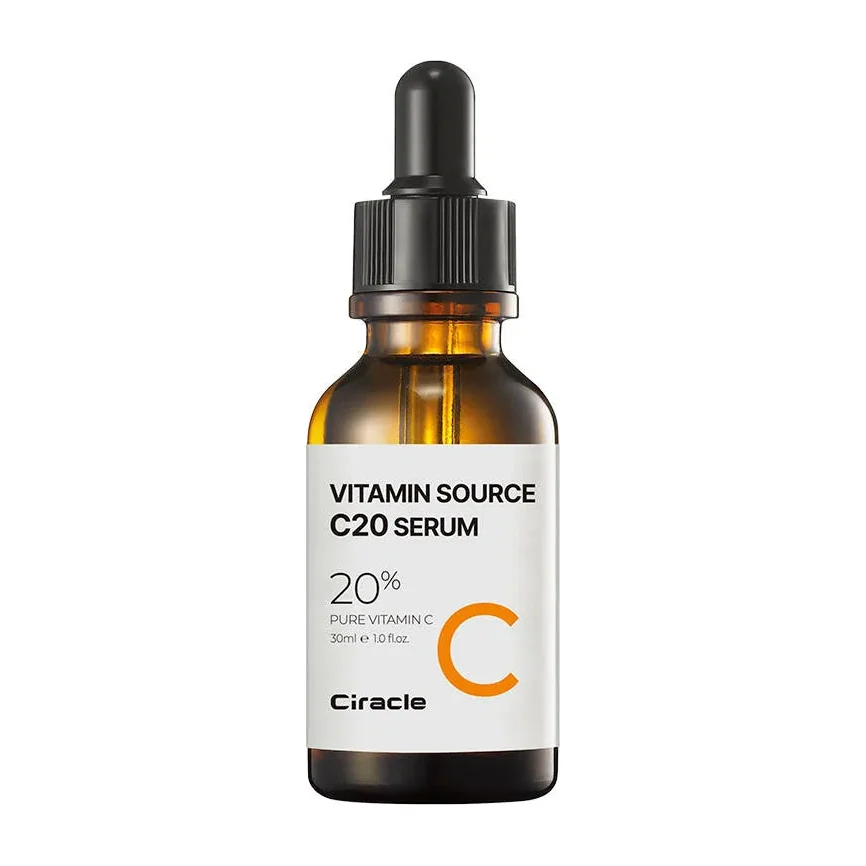
Tia'm My Signature C Source dropper bottle, Korean 20% L-ascorbic acid vitamin C serum with niacinamide, CoQ10, vitamin E, and zinc PCA
Not yet assessed for Dullness
What makes this different

It surrounds a high 20% L-ascorbic acid dose with a lipid-and-water-soluble antioxidant network — CoQ10, vitamin E, green tea — plus niacinamide and zinc PCA for tone and oil control, so it does more than a single-active vitamin C serum. That multi-antioxidant approach at a budget price is the original 'C Source' formula that made the brand.

Tia'm

Tia'm My Signature C Source Review

Antioxidant Vitamin C Staple Serums serum k beauty Paraben free Cruelty free Vegan

The serum that built Tia'm's name: a potent 20% L-ascorbic acid surrounded by a genuine antioxidant network of CoQ10, vitamin E, and green tea, plus niacinamide and zinc PCA for tone and oil control. Affordable and effective for brightening, with the usual high-dose vitamin C caveats around stinging, oxidation, and sensitive skin.

Price $20.00 1.01 fl oz / 30ml
Shopper rating 4.3 ★★★★★ 4,000 reviews
On the market 2017 Made in South Korea
Buy at Amazon ♥
Verdicts

How well it fits each concern

One verdict per concern. Open a row for the reasoning; the receipt has every source.

The scaleRecommendedGoodSupportingEarly evidenceNot for thisAvoidhow it works

Good choicefor HyperpigmentationNiacinamide is a trial-supported active for hyperpigmentation; this serum carries it, though the concentration is not declared.Receipt10 sources on the row · rule R5, same reading on 9,843 products · open the receipt

The case for it

  1. Niacinamide + Zinc PCA has trial-supported standing for this concern.
  2. It is plausibly present at a working level, though the concentration is not declared.
  3. The formula carries no trigger this concern is sensitive to, with the cautions noted.

Moderate evidenceStandard tolerabilityNo reviews read yet

Cautions: a photosensitising active — use sun protection.

What would change this: A declared concentration would move this to a firmer reading of the dose.

Same rule for everyone. “Good choice” is the verdict on 10,340 of 45,446 concern verdicts across the catalog; rule R5 decided 9,843 of them. As of October 13, 2026, engine 5.2.0.

Brand or formulator? Disclose a concentration or correct a fact →

The full receipt: rule, row, sources, dates →All hyperpigmentation products →How hyperpigmentation is treated →

Promisingfor Dark SpotsVitamin C has trial-level evidence for dark spots but no guideline or regulatory standing yet — promising, short of a recommendation; the other actives here are not yet assessed for it.Receipt7 sources on the row · 20% declared · rule R9p, same reading on 4,872 products · open the receipt

The case for it

  1. L-Ascorbic Acid has at least one trial behind it for this concern but no guideline or regulatory standing yet.
  2. It is present at an effective concentration, declared or high in the ingredient list.
  3. The formula carries no trigger this concern is sensitive to, with the cautions noted.

Moderate evidenceStandard tolerabilityNo reviews read yet

Cautions: a photosensitising active — use sun protection.

What would change this: Guideline or regulatory standing for the active on this concern would move this from a promising bet to a recommendation.

Same rule for everyone. “Promising” is the verdict on 4,872 of 45,446 concern verdicts across the catalog; rule R9p decided 4,872 of them. Unchanged since September 5, 2026, engine 5.2.0.

Brand or formulator? Disclose a concentration or correct a fact →

The full receipt: rule, row, sources, dates →All dark spots products →How dark spots is treated →

Promisingfor AgingVitamin C has trial-level evidence for aging but no guideline or regulatory standing yet — promising, short of a recommendation; the other actives here are not yet assessed for it.Receipt7 sources on the row · 20% declared · rule R9p, same reading on 4,872 products · open the receipt

The case for it

  1. L-Ascorbic Acid has at least one trial behind it for this concern but no guideline or regulatory standing yet.
  2. It is present at an effective concentration, declared or high in the ingredient list.
  3. The formula carries no trigger this concern is sensitive to, with the cautions noted.

Moderate evidenceStandard tolerabilityNo reviews read yet

Cautions: a photosensitising active — use sun protection.

What would change this: Guideline or regulatory standing for the active on this concern would move this from a promising bet to a recommendation.

Same rule for everyone. “Promising” is the verdict on 4,872 of 45,446 concern verdicts across the catalog; rule R9p decided 4,872 of them. Unchanged since September 5, 2026, engine 5.2.0.

Brand or formulator? Disclose a concentration or correct a fact →

The full receipt: rule, row, sources, dates →All aging products →

Promisingfor Sun DamageVitamin C has trial-level evidence for sun damage but no guideline or regulatory standing yet — promising, short of a recommendation; the other actives here are not yet assessed for it.Receipt5 sources on the row · 20% declared · row checked Jul 17, 2026 · rule R9p, same reading on 4,872 products · open the receipt

The case for it

  1. L-Ascorbic Acid has at least one trial behind it for this concern but no guideline or regulatory standing yet.
  2. It is present at an effective concentration, declared or high in the ingredient list.
  3. The formula carries no trigger this concern is sensitive to, with the cautions noted.

Moderate evidenceStandard tolerabilityNo reviews read yet

Cautions: a photosensitising active — use sun protection.

What would change this: Guideline or regulatory standing for the active on this concern would move this from a promising bet to a recommendation.

Same rule for everyone. “Promising” is the verdict on 4,872 of 45,446 concern verdicts across the catalog; rule R9p decided 4,872 of them. Unchanged since September 5, 2026, engine 5.2.0.

Brand or formulator? Disclose a concentration or correct a fact →

The full receipt: rule, row, sources, dates →All sun damage products →

Promisingfor Excess OilinessGreen Tea Extract has trial-level evidence for excess oiliness but no guideline or regulatory standing yet — promising, short of a recommendation; the other actives here are not yet assessed for it.Receipt4 sources on the row · concentration not declared; studied range 3–5% · row checked Jul 17, 2026 · rule R9p, same reading on 4,872 products · open the receipt

The case for it

  1. Green Tea + Beta-Glucan + Panthenol has at least one trial behind it for this concern but no guideline or regulatory standing yet.
  2. It is plausibly present at a working level, though the concentration is not declared.
  3. The formula carries no trigger this concern is sensitive to, with the cautions noted.

Moderate evidenceStandard tolerabilityNo reviews read yet

What would change this: A declared concentration would move this to a firmer reading of the dose.

Same rule for everyone. “Promising” is the verdict on 4,872 of 45,446 concern verdicts across the catalog; rule R9p decided 4,872 of them. Unchanged since September 5, 2026, engine 5.2.0.

Brand or formulator? Disclose a concentration or correct a fact →

The full receipt: rule, row, sources, dates →All excess oiliness products →

Also listed for Dullness — the actives here (Niacinamide, Vitamin C, Coenzyme Q10 (Ubiquinone) are in our research queue for that concern; there is no verdict until their evidence rows are written. That is a gap in our table, not a mark against the product.

Where our review and the verdict differ. The review below was written on the formulation and the published trials; the verdicts above apply the stricter standing test in our methodology — an active earns a recommendation only with guideline or regulatory standing for the concern. Where the two disagree, the verdict is Dermington’s position.

A verdict is Dermington’s assessment of how well a product’s ingredients fit a concern — never a claim about what the product treats. Evidence dots and collected reviews sit beside it and are never blended in. Rules 0.5.1 · evidence table ev-2026.10-r231 · engine 5.2.0 · how we decide · this product’s receipt

Reader poll · Town SquareQuestion 1 of up to 3

Have you used My Signature C Source?

One tap counts. A couple of optional follow-ups come next.

No account neededOne answer each, change it any timeCounted only in anonymous totalsHow the Square counts →
Assessment

Pros & cons

What it does well 6

  • Effective 20% L-ascorbic acid at the optimal ceiling
  • Lipid- and water-soluble antioxidant network (CoQ10, vitamin E, green tea)
  • Niacinamide and zinc PCA add tone and oil control
  • Soothing green tea and beta-glucan improve tolerability
  • Affordable, long-trusted K-beauty staple
  • Vegan, cruelty-free, light-protective packaging

Where it falls short 5

  • Potent 20% acid can sting, not for sensitive skin
  • Contains alcohol and orange peel oil
  • Oxidizes and darkens within a couple of months
  • Not fragrance-free or fungal-acne safe
  • Morning-only and must be paired with sunscreen
Review

The full review

Before affordable 20% vitamin C serums were a dime a dozen, the phrase was practically a contradiction in terms. High-percentage L-ascorbic acid lived in expensive Western prestige bottles, and the budget end of the shelf meant weak, hedged derivatives that asked you to lower your expectations along with your spending. Tia'm's My Signature C Source was one of the serums that broke that arrangement, arriving around 2017 with a full 20% dose of pure vitamin C at a price that didn't require a second thought. It's the product that built the brand's name, and years on, as a long-running and well-followed K-beauty staple from an established mid-size indie, it still holds up as a smartly constructed, value-driven antioxidant serum.

The core is a high 20% L-ascorbic acid, the most evidence-backed form of topical vitamin C, with the deepest research base for brightening, antioxidant defense, and supporting collagen synthesis. The important thing to understand is that 20% sits right at the effective ceiling: absorption plateaus around there, and pushing the number higher mostly buys irritation rather than results. So the intelligent move in a vitamin C serum isn't a bigger headline figure but a better supporting cast, and that's precisely where the C Source earns its keep. It wraps the water-soluble vitamin C in a lipid-soluble antioxidant network, coenzyme Q10 and vitamin E, which extends free-radical protection into the skin's oil layers where water-soluble actives can't reach, a complementary and partially synergistic strategy with real literature behind it. Green tea polyphenols and beta-glucan add further antioxidant and soothing support in the water phase. Then it layers in niacinamide, well-established for tone-evening through melanosome-transfer inhibition and barrier reinforcement, and zinc PCA for oil control. That combination broadens the benefit well beyond vitamin C alone and makes the serum particularly friendly to oilier, congested skin.

In practice it behaves the way a well-made high-dose vitamin C should. It's a thin, slightly tacky serum that absorbs with a faint citrus note from orange peel oil, and a mild tingle on the first few applications is normal, settling as skin acclimates. Brightening and a fresher overall look show up across the first week or two, with dark-spot fading and more even, firmer-looking tone building across the usual eight-to-twelve-week window of consistent morning use. Because the niacinamide and the antioxidant network are doing real work, it pulls more weight than a bare single-active serum, and the green tea and beta-glucan keep it more comfortable than a plain L-ascorbic solution would be.

The qualifications are the standard high-dose vitamin C ones, and they're worth taking seriously rather than glossing over. At 20% on an alcohol base with orange peel oil, this is potent, and it's not the right pick for sensitive, reactive, or rosacea-prone skin; it's also neither fragrance-free nor fungal-acne-safe, so two more groups should look elsewhere. L-ascorbic acid oxidizes, which means the serum will darken and lose potency over a couple of months. That's chemistry, not a defect, but it does mean cool, dark storage and timely replacement are part of the deal, and the light-protective packaging only buys you so much time once the bottle is opened. And like all vitamin C, it belongs in the morning routine under sunscreen, never as a stand-in for it; the antioxidant protection complements SPF, it doesn't replace it.

Where it lands is as a value benchmark in the vitamin C category. For a genuinely budget price you get an effective 20% L-ascorbic dose, a real multi-pathway antioxidant network, and tone-and-oil-balancing extras, all in reasonable packaging, which is why the value and ingredient-quality scores both run high. If you have normal, combination, or oily skin that tolerates actives and you want proven brightening without overspending, the C Source is an easy, long-trusted recommendation. Ease in slowly over the first couple of weeks, store it well, wear your SPF without exception, and replace the bottle once it browns. The people who should skip it are the genuinely sensitive, anyone who needs fragrance-free formulas, and those who'd rather not babysit an oxidation-prone active. For everyone else who wants the brightening payoff of high-percentage vitamin C without the prestige markup, this is a serum that has spent years quietly earning its following, and it continues to deliver the kind of honest, well-rounded performance that made it the original 'Source' of the brand's reputation in the first place.

A word on expectations is worth adding, because vitamin C inspires a lot of hope and a fair amount of disappointment. This is a maintenance and prevention active far more than a dramatic corrector; its real job is steady antioxidant defense against daily oxidative stress and a gradual, cumulative evening of tone, not the overnight transformation that marketing imagery sometimes implies. The faint stinging some users report on the first few uses is the high acid concentration making itself known, and it typically fades as the skin builds tolerance over a week or two; if it doesn't settle, that's a signal to scale back to every other morning rather than to push through. Pairing it sensibly matters too, since stacking it under heavy exfoliating acids or strong retinoids in the same routine can tip tolerant skin into irritation, and the smarter approach is to let the vitamin C own the morning while reserving aggressive actives for the evening. Stored cool and dark and replaced when it browns, this serum rewards patience and consistency, and for the budget-conscious actives user that combination of evidence-backed formula and forgiving price is exactly what makes it such a durable, sensible staple.

The science

The C Source is anchored by 20% L-ascorbic acid, the most evidence-backed topical vitamin C, supported by controlled studies for inhibiting melanogenesis, scavenging free radicals, and serving as a cofactor in collagen synthesis; efficacy is established up to roughly 20%, the concentration used here, beyond which absorption plateaus and irritation increases. What distinguishes the formula is its multi-antioxidant network: ubiquinone (CoQ10) and tocopheryl acetate (vitamin E) are lipid-soluble antioxidants that protect membrane lipids and regenerate alongside vitamin C, while green tea polyphenols (EGCG) add water-phase free-radical scavenging — a complementary, partially synergistic antioxidant strategy supported in the literature. Niacinamide contributes melanosome-transfer inhibition and barrier support, and zinc PCA offers sebum regulation, broadening the serum's tone-and-oil benefits. Panthenol and beta-glucan mitigate the irritation and dryness associated with high-dose L-ascorbic acid and the alcohol vehicle. The honest read is a well-rounded, high-dose vitamin C serum whose antioxidant breadth and added actives meaningfully exceed a single-ingredient solution, subject to the inherent instability and irritation potential of L-ascorbic acid.

The clinical view

L-ascorbic acid is the form of vitamin C dermatologists most often point to for antioxidant protection, brightening, and collagen support, and 20% is at the effective upper end. Clinicians generally recommend morning use under sunscreen, as vitamin C augments photoprotection, and combining it with antioxidants like vitamin E and CoQ10 is a recognized, complementary approach. Dermatologists would caution that high-dose L-ascorbic acid plus alcohol and citrus oil can irritate sensitive and rosacea-prone skin, that the serum should be introduced gradually, and that it must be stored to limit oxidation and replaced when degraded. For tolerant skin, it is regarded as an effective, evidence-aligned brightening and antioxidant serum.

Formula

Key ingredients

  1. L-Ascorbic Acid (20%) 20%

    The 20% pure L-ascorbic acid is the brightening and antioxidant engine of the serum, driving the tone-evening, free-radical defense, and collagen-supporting claims at a high, effective concentration — the original 'Source' of the brand's reputation.

    Limited for Hyperpigmentation
  2. Niacinamide + Zinc PCA

    A brightening-and-balancing pair layered under the vitamin C — niacinamide reinforces tone-evening and barrier support while zinc PCA helps control oil, broadening the serum's benefit beyond vitamin C alone and suiting oilier skin.

    Emerging for Hyperpigmentation
  3. Coenzyme Q10 (Ubiquinone) + Vitamin E (Tocopheryl Acetate)

    Lipid-soluble antioxidants that complement the water-soluble vitamin C, extending free-radical protection into the skin's lipid layers — the antioxidant network that differentiates this from a bare L-ascorbic solution.

    Limited for Aging
  4. Green Tea + Beta-Glucan + Panthenol

    A soothing-and-antioxidant trio that buffers the sting of 20% L-ascorbic acid and the alcohol base, adding polyphenol protection and hydration so the potent serum stays comfortable across more skin types.

    Limited for Excess Oiliness
Full ingredient list 29 ingredients ShowHide

Water, Ascorbic Acid, Alcohol, Sodium Lactate, Butylene Glycol, Glucose, PEG-60 Hydrogenated Castor Oil, 1,2-Hexanediol, Phenoxyethanol, Sodium Hyaluronate, Bis-PEG-18 Methyl Ether Dimethyl Silane, Xanthan Gum, Diethoxyethyl Succinate, Ammonium Acryloyldimethyltaurate/VP Copolymer, Carthamus Tinctorius (Safflower) Flower Extract, Citrus Aurantium Dulcis (Orange) Peel Oil, Glycerin, Zinc PCA, Panthenol, Niacinamide, T-Butyl Alcohol, Camellia Sinensis Leaf Extract, Beta-Glucan, Tocopheryl Acetate, Lecithin, Caprylic/Capric Triglyceride, Ubiquinone, Diisopropyl Adipate

Safety & formulation facts

  • Pregnancy safe
  • Not fragrance free
  • Not alcohol free
  • Oil free
  • Silicone free
  • Paraben free
  • Sulfate free
  • Cruelty free
  • Vegan
  • Not fungal-acne safe
Potential irritants L-Ascorbic Acid (20%)AlcoholOrange Peel OilLimonene
Common allergens Limonene
Compatibility

Skin types & routine

Routine step serum
Time of day Morning
Best season All year
Finish lightweight, fast-absorbing

Layering

Use in the morning after toner and before moisturizer, always finishing with sunscreen; start every other day to build tolerance to the 20% acid, and store in a cool, dark place to slow oxidation.

When to expect results

Brighter, fresher skin within 1-2 weeks; fading of dark spots and more even, firmer-looking tone over 8-12 weeks of consistent morning use.

Pairs well with moisturizersunscreen
Don't combine with exfoliantretinoid

A routine built around it

Morning

  1. Cleanser
  2. Toner
  3. Tia'm My Signature C Sourcethis product
  4. Moisturizer
  5. SPF

Night

  1. Cleanser
  2. Toner
  3. Treatment
  4. Moisturizer
Guidance

How to use it, and who it's for

How to use

In the morning, after cleansing and toning, apply a few drops to dry skin and pat in, then follow with moisturizer and broad-spectrum sunscreen. Introduce it gradually — every other day at first — to build tolerance to the 20% acid, and avoid pairing it in the same routine with strong exfoliants or retinoids. Store it in a cool, dark place with the cap closed, and replace it once it darkens noticeably toward brown.

Is it worth the price?

At around $20 for 30ml, the C Source is a long-standing value benchmark for high-dose vitamin C. You get a full 20% L-ascorbic dose plus a genuine antioxidant network and tone-and-oil actives for a fraction of what comparable Western serums charge. The inherent caveat is shelf life: L-ascorbic acid oxidizes within a couple of months of opening, so the cost per usable day is higher than the sticker suggests, and there's no larger size to offset it. Even so, for proven brightening and antioxidant protection on a budget, it remains one of the strongest value picks in the category and an easy serum to keep in rotation.

Who should buy it

This is for normal, combination, or oily skin that tolerates active serums and wants effective, affordable brightening with antioxidant protection and a touch of oil control. It suits vitamin C users who like the added niacinamide, CoQ10, and zinc, and anyone wanting a proven, budget-friendly 20% L-ascorbic staple.

Who should skip it

Sensitive, reactive, and rosacea-prone skin should skip it, since 20% L-ascorbic acid with alcohol and orange peel oil is demanding. Anyone wanting a fragrance-free or fungal-acne-safe vitamin C, or a stable derivative serum that won't oxidize, should choose a gentler option instead.

Ready to try it?Tia'm My Signature C Source · $20.00 · 1.01 fl oz / 30ml
Details

The product, in detail

Texture
Lightweight, slightly tacky serum
Scent
Faint citrus from orange peel oil
Packaging
Dropper bottle (light-protective)
How long it lasts
About 1.5-2 months at daily morning use before oxidation becomes noticeable
Once opened
Use within 6 months · track your toss-by date →
Size
1.01 fl oz / 30ml
Made in
South Korea
Launched
2017
Certifications
vegan · cruelty-free

What the first two weeks feel like

Applies thin with a slight tack as it dries and a faint citrus note; a mild tingle is normal at first for a 20% L-ascorbic serum and settles with use, while a brighter, more even look develops over the first couple of weeks.

The story behind it

Why it exists

The C Source is the serum that launched Tia'm's reputation, arriving as an affordable 20% pure vitamin C option at a time when high-percentage L-ascorbic serums were typically expensive; its antioxidant-and-niacinamide network made it a long-running K-beauty staple and the template the later Red C version built on.

About Tia'm Established Brand (5–20 years)

Tia'm, established around 2016, built its reputation on this 20% pure vitamin C serum and its siblings; the C Source remains a long-running K-beauty staple with a large following, though the brand is a mid-size indie without large-scale independent clinical studies of its own.

Brand founded 2016 · This product since 2017

Myth vs. reality

What people get wrong about it

MythHigher vitamin C percentages always work better.

RealityL-ascorbic acid absorption plateaus around 20%, and going higher mainly increases irritation without added benefit. This serum's 20% sits at that effective ceiling, which is why the supporting antioxidants and niacinamide matter more than chasing a bigger number.

FAQ

Questions people ask

What is the difference between C Source and the Red C Serum?

Both use 20% L-ascorbic acid, but the C Source pairs it with niacinamide, zinc PCA, CoQ10, and vitamin E, while the newer Red C Serum swaps in glutathione, vitamin B12, and a different antioxidant mix. The C Source leans more toward tone-and-oil balance; both are strong, affordable vitamin C serums.

How strong is the C Source and will it sting?

It contains a potent 20% L-ascorbic acid, so a mild tingle on application is normal, particularly at first. The niacinamide, green tea, and beta-glucan soothe it, but sensitive skin should ease in every other day to build tolerance.

Does Tia'm C Source contain niacinamide and vitamin C together?

Yes — and that's fine. The old myth that niacinamide and vitamin C cancel each other out has been debunked; here they work together, with niacinamide adding tone-evening and barrier support alongside the brightening vitamin C.

When should I apply the C Source serum?

Use it in the morning after toner and before moisturizer, then always finish with sunscreen. Vitamin C boosts your SPF's antioxidant defense against daytime free radicals, so the morning slot maximizes the benefit — but it never replaces sunscreen.

Why does my C Source serum turn darker?

L-ascorbic acid oxidizes with light, air, and time, darkening and losing potency, and oxidized vitamin C can irritate. Store it cool and dark, keep the cap closed, and replace it once it turns noticeably brown, typically within a couple of months of opening.

Is the C Source safe to use during pregnancy?

Vitamin C, niacinamide, and the antioxidants here are generally considered pregnancy-friendly, and it contains no retinoids. The alcohol and orange peel oil are worth noting if you're sensitive, so check with your doctor, but the actives themselves aren't commonly restricted.

Reviews

What shoppers tend to say

Recurring themes our editors read across retailer reviews — summaries in our words, not quotations, and not a substitute for a patch test.

Common praise

  • Visible brightening and glow
  • Fades dark spots over time
  • Niacinamide and antioxidants rounded out
  • Affordable 20% vitamin C
  • Lightweight feel

Common complaints

  • Can sting on application
  • Oxidizes and darkens over time
  • Contains alcohol and orange oil
  • Not for sensitive skin
Notable endorsements20% L-ascorbic acid with antioxidant networkLong-running K-beauty stapleVegan and cruelty-free
Next stepCheck it against what you already useClashes, spacing and the right order, with everything on your shelf.