Male Skin Ages on a Cliff, and Fifty Is Roughly Where the Ground Goes
Women get a biological alarm bell at menopause. Men get a straight line down from their twenties, which is why so many arrive at fifty-five with thirty-five years of unopposed decline and no routine.
Read the preview
How do men end up at fifty-five with no skincare routine at all? Women get a menopause alarm. Men get a quiet straight line down from their twenties. By sixty, a man makes about half the oil he did at thirty — still calling himself oily. Retinoids still work at that age, but tolerance sets the limit. Start it right with the Dermington Gazette.
The decline that never had a moment
There is a reason women's skincare has a vocabulary for a specific date and men's does not. When Shuster and colleagues measured forearm skin thickness, collagen content and collagen density across a large group of ordinary people in 1975, they found a pattern that has held up for fifty years: in men, skin collagen falls in a steady line from early adulthood onward. In women it holds far more stubbornly through the reproductive years and then drops off a shelf, with subsequent work putting the loss at roughly a third of dermal collagen in the first five post-menopausal years.
At any single point in life the male number looks better. Men start with thicker dermis and more collagen per unit area, and they hold that lead for decades. What they do not get is an event. Menopause is unmissable, and it functions — for all the reasons it is also unwelcome — as a biological appointment reminder. A man crossing the same territory experiences nothing. There is no week in which his face visibly changes, no symptom that sends him looking for answers, and so no moment at which starting a routine feels urgent rather than vain.
The consequence is arithmetic. By fifty-five, a man has typically accumulated thirty-five years of linear structural decline layered on top of a lifetime of outdoor exposure that was, statistically, less protected than his sister's. None of it announced itself. Then one summer he notices the vertical lines above his lip, the crepe at the outer eye, the way a shaving nick takes eleven days instead of four — and it reads as a cliff, because everything he failed to notice arrives in perception at once. The ground did not give way. He simply looked down.
Your skin did not stop being oily. It stopped being hydrated.
The single most common routine error in this decade is treating shine as the enemy it was in 1988. It is worth knowing what actually happens to sebum, because the real curve is steeper than most men assume and flatter than the marketing implies.
Jacobsen and colleagues measured sustainable wax ester secretion on the foreheads of 276 people aged fifteen to ninety-seven and fitted the decline: about 23% per decade in men, 32% per decade in women. Compound that. A man of sixty is producing roughly half the sebum he produced at thirty. He is not, however, producing none — and because male output starts so much higher, his forehead can still read greasy at 4 p.m. while his cheeks are flaking. Comparative measurement across three hundred adults found sebum content consistently higher in men than in women at every age band studied, alongside no male advantage at all in stratum corneum hydration.
That gap is the whole problem. Oil and water are separate systems, and they decouple with age. The barrier's ability to hold water declines on its own schedule, which means a man in his fifties can be simultaneously oily and dehydrated — and the routine he built at twenty-five is optimised entirely against the first condition. Menthol, clay, a foaming cleanser used twice daily, an astringent toner because it feels like it is doing something. Every one of those choices strips a barrier that is no longer producing enough lipid to rebuild itself overnight.
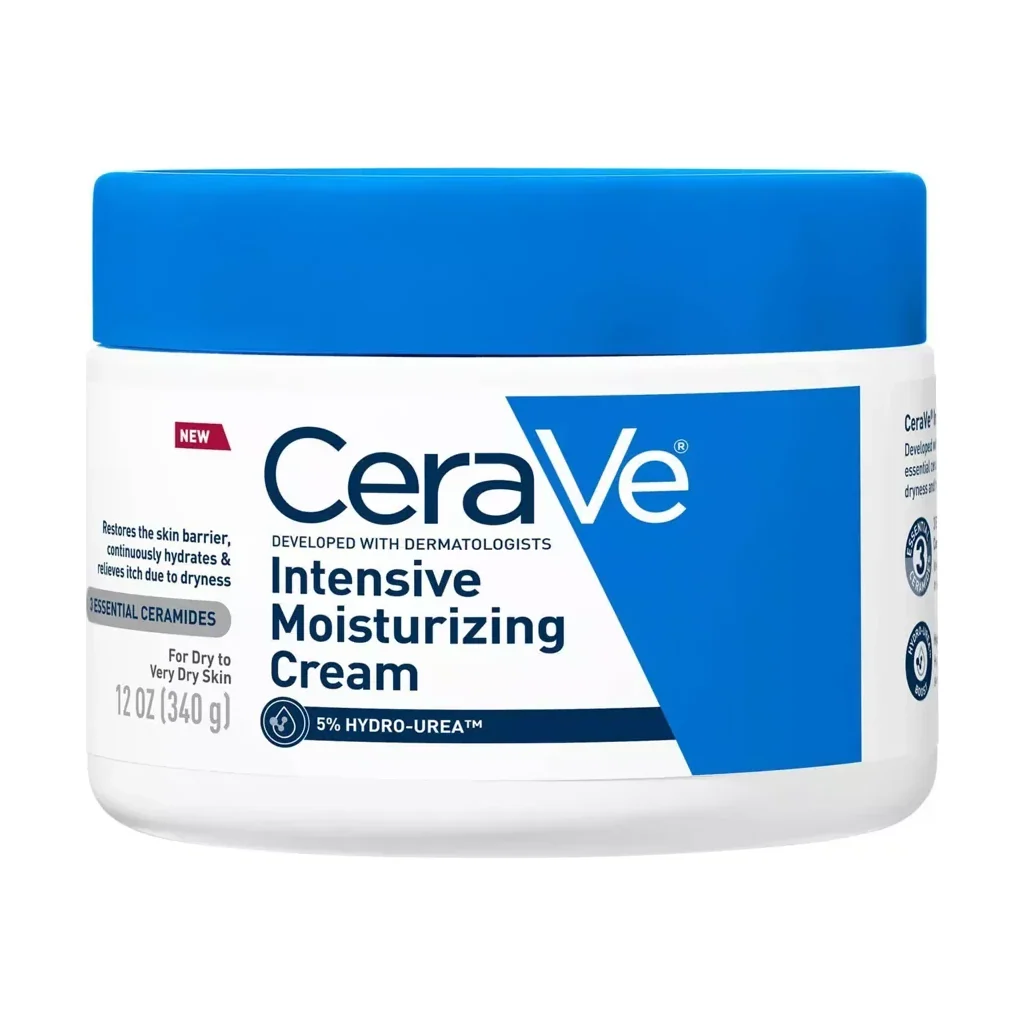
The correction is unglamorous. Swap the stripping cleanser for something that leaves the face feeling neutral rather than squeaky, and put a real occlusive-humectant cream on top rather than a lotion chosen for how fast it disappears. If the skin has moved past dry into genuinely rough — flaking at the beard line, scaly shins, sandpaper on the backs of the arms — urea earns its place here in a way glycerin cannot, because it both binds water and loosens the corneocytes that dryness has cemented together. A urea-containing cream like CeraVe Intensive Moisturizing Cream does two jobs at once; a ceramide-and-niacinamide barrier cream like La Roche-Posay Toleriane Double Repair is the gentler version for a face that is drier than it used to be but not yet scaling. If you want the shortest version of the whole reset, the men's routine template is four steps and no toner.
The scalp, the ears, and the parts of you that you cannot see
This is the section that matters most and gets read least, so here is the number first. In the Rotterdam Study, full-body skin examinations of 2,061 adults aged 45 and over found actinic keratoses in 49% of men and 28% of women. Nearly one in five of the whole cohort had four or more. And the risk factor that dominated the multivariate analysis was not occupation or holidays or skin type alone — it was baldness. Bald men carried an adjusted odds ratio of 7.0 for extensive actinic damage.
The mechanism is embarrassingly simple. Hair is a physical sunscreen with excellent compliance, and losing it exposes a horizontal plane of skin to the highest-dose UV geometry available on the human body, continuously, for decades. A 2025 cross-sectional analysis of AK distribution found exactly the pattern you would predict: men accumulate them on the scalp and ears, women on the chest, back, abdomen, arms and legs. The male sites are the two places a man never inspects and rarely protects.
Layer the behaviour on top. CDC survey data from 2020 found that 12.3% of American men always use sunscreen when outdoors for more than an hour on a sunny day, against 29.0% of women — and the gap does not close with age or with wisdom. Among men 65 and over, the figure was 13.6%. Six decades of sun and roughly one man in seven reaching for the bottle.
So: learn what an actinic keratosis feels like, because it is easier to feel than to see. It is a rough, dry, persistently scaly patch — often better identified with a fingertip than a mirror — that does not resolve when you moisturise it, and comes back in the same spot after it flakes off. That last detail is the tell, and it is the difference between a dry patch and a lesion; the question of whether moisturiser should fix it is the cheapest diagnostic you have. If it does not, stop treating it and get it looked at — the actinic keratosis pathway sets out what the escalation actually involves, including field treatments for scalps carrying more damage than any single lesion can represent. For anything pigmented rather than scaly, the ABCDE check and the mole map tools are a better use of ten minutes than another search-engine spiral, and a mole map matters more here than usual precisely because you cannot see your own scalp. Ask whoever cuts your hair. They have a better view of your risk than you do.
And wear sunscreen on the head. A non-greasy face formula like Jack Black Oil-Free Sun Guard SPF 45 goes on a scalp perfectly well; the reason men skip it is texture, not principle, which means texture is the problem to solve.
What a retinoid still buys at fifty-five
There is a persistent idea that retinoids are a preventive drug and that starting one after fifty is closing the barn door. The trial data says otherwise. In two 48-week double-blind multicentre studies of tretinoin emollient cream in photodamaged facial skin, 86% of patients on the 0.05% strength were rated as having an excellent, good or fair response, against 44% on vehicle — with fine wrinkling, mottled pigmentation, roughness and laxity showing the largest gains. Forty-eight weeks is the relevant detail: this is a slow drug, and the studies that show the biggest effects are the ones that ran longest.
What changes with age is not the ceiling. It is the runway. Thinner stratum corneum, lower lipid output and a barrier already working at its limit mean that the dose which merely stung at thirty produces visible retinoid dermatitis at fifty-five — flaking around the nose, a tight red band along the jaw, and a man who concludes after nine days that his skin cannot tolerate the stuff. Almost nobody's skin cannot tolerate it. What they cannot tolerate is the schedule they chose.
Start twice a week, at night, on completely dry skin, over moisturiser rather than under it, and hold that frequency for a month before adding a third night. An encapsulated or buffered over-the-counter option such as Naturium Retinol Complex Serum is a sane entry point; retinol and prescription tretinoin differ in potency and conversion steps rather than in mechanism, so the ramp is the same shape either way. The retinoid ramp tool exists to put that schedule on a calendar instead of in your head, which is where good intentions go to die. If your skin has been dry for years and you have never used an exfoliating active, expect the first six weeks to be the worst six weeks, and judge nothing until week twelve.
Where topicals stop, and the honest version of the sentence
It would be easy to end here with a promise, and it would be a lie. Topicals in this decade do a specific and worthwhile set of things: they improve surface texture, they fade mottled pigment, they soften fine lines, they restore a barrier that has been mishandled for years, and — for anyone with meaningful sun damage — they meaningfully reduce the pipeline of new precancerous lesions. That is a real return and it compounds.
What they do not do is restore volume, tighten established laxity, erase deep static folds, or clear the fat-pad descent and bone remodelling that make a sixty-year-old face read as a sixty-year-old face. Nothing in a jar addresses those. If those are the things that bother you, the honest answer is that the interventions which work on them are procedural, and being told this plainly by a piece of writing that is not selling you a procedure is worth more than another cream. The corollary is also true: an established actinic keratosis is not a skincare problem. Cryotherapy, field treatment and biopsy are the tools, and delaying them in favour of a serum is the only genuinely bad decision available in this article.
The reasonable expectation, then, is not reversal. It is that the next twenty years of decline run at a slower gradient than the last twenty, with better texture, fewer rough patches, and a substantially lower chance of a squamous cell carcinoma on the top of your head. That is a good deal. It is just not the deal the advertising describes.
The four-step version, because you will not do eight
Every routine written for this reader fails for the same reason: it has too many steps and no ranking, so the first busy week takes out the middle of it and the rest collapses. So here it is in priority order, and if you only ever do the first two, you will still be ahead of most of your contemporaries.
One: sunscreen, daily, on the face, the ears and the scalp if the scalp is exposed. This is not a cosmetic step at your age — it is the intervention with actual cancer data behind it, and the ears are where men lose. Two: a moisturiser that suits the skin you have now rather than the skin you had in 1996 — barrier-repairing, applied to damp skin, morning and night. Our mature-skin moisturiser ranking is sorted by that criterion rather than by texture preference. Three: a retinoid, ramped slowly, indefinitely. Four: a cleanser that does less than the one you own. If you want a single low-friction lotion to anchor the habit before you optimise anything, something like Every Man Jack Daily Hydrating Face Lotion is a perfectly reasonable place to start — the routine you actually perform beats the routine you admire.
And once a year, ask someone to look at the top of your head.
Each shelf lists every product in the catalogue built on the ingredient, graded live against your profile — the shelf stays current when a single pick would not.
- 198 products on the shelf Urea (Carbamide) Binds water and loosens cemented corneocytes — the reason it beats glycerin on genuinely rough skin.
- 447 products on the shelf Retinol The over-the-counter side of the retinoid ramp.
- 1 product on the shelf Tretinoin (All-Trans Retinoic Acid) The prescription comparison — same mechanism, different potency and conversion steps.
- 3,339 products on the shelf Niacinamide (Vitamin B3)
- 2,407 products on the shelf Glycerin
Products named in this piece
Independently reviewed, with a verdict per concern — the real products behind this piece.


- Therapy guide Actinic keratosis What escalation actually involves once a rough patch stops behaving like dry skin.
- Routine The Men's Skincare Routine That Actually Sticks The four-step reset for a routine built against oiliness that is no longer the problem.
- Ranked list Best Moisturizers for Mature Skin Ranked on barrier repair rather than texture preference.
- Question What moisturiser makes a rough patch feel better while I wait? The cheapest at-home distinction between a dry patch and a lesion.
References
- The influence of age and sex on skin thickness, skin collagen and density — British Journal of Dermatology, 1975
- Age-related changes in sebaceous wax ester secretion rates in men and women — Journal of Investigative Dermatology, 1985
- Skin physiology in men and women: in vivo evaluation of 300 people including TEWL, SC hydration, sebum content and skin surface pH — International Journal of Cosmetic Science, 2013
- Prevalence of actinic keratosis and its risk factors in the general population: the Rotterdam Study — Journal of Investigative Dermatology, 2013
- Differences by sex in actinic keratosis distribution: a cross-sectional study — Archives of Dermatological Research, 2025
- Tretinoin emollient cream for photodamaged skin: results of 48-week, multicenter, double-blind studies — Journal of the American Academy of Dermatology, 1997
- QuickStats: Percentage of Adults Aged >=18 Years Who Always Use Sunscreen When Outside for >1 Hour on a Sunny Day, by Sex and Age Group - National Health Interview Survey, United States, 2020 — MMWR Morbidity and Mortality Weekly Report, 2022
Every cited link is verified to resolve to the paper named. Where a source could not be independently confirmed, it is listed without a link rather than pointing you somewhere wrong.
Frequently asked
Is it too late to start a retinoid at fifty-eight?
No. The 48-week tretinoin trials in photodamaged skin recruited adults well into later life and still showed large gains in roughness, mottled pigment and fine wrinkling over vehicle. What changes with age is tolerance, not responsiveness — thinner, drier skin reacts harder to the same dose, so the correct adjustment is a slower ramp and a moisturiser underneath, not a lower ambition.
My forehead is still shiny at sixty. Why would I need a heavier moisturiser?
Because sebum and hydration are separate systems that come apart with age. Male sebum output falls roughly 23% per decade but starts from a high enough baseline that visible shine persists, while the barrier's capacity to hold water declines independently. You can be oily and dehydrated at the same time, and a routine built only against shine strips a barrier that no longer rebuilds itself overnight.
How do I tell an actinic keratosis from an ordinary dry patch on my scalp?
Feel rather than look — actinic keratoses are usually easier to detect with a fingertip than in a mirror. The distinguishing behaviour is persistence: a dry patch resolves with a few days of moisturiser, while an actinic keratosis flakes off and returns in exactly the same spot. Anything that keeps coming back in one location should be examined rather than treated at home.
Does male-pattern baldness really change my skin cancer risk that much?
In the Rotterdam Study, bald men had an adjusted odds ratio of 7.0 for extensive actinic damage — the strongest single risk factor in the analysis. Hair is a highly compliant physical sunscreen, and losing it exposes a horizontal surface to the most intense UV geometry on the body, continuously. Sunscreen on the scalp and a hat are not optional once the hair is gone.
Will any of this improve sagging along my jaw?
Not meaningfully. Topicals improve surface texture, pigment, fine lines and barrier function, and they reduce the ongoing production of precancerous lesions. They do not restore volume, tighten established laxity, or reverse the fat-pad descent and bone remodelling that drive jawline change. Those respond to procedures, and anyone telling you a cream will handle them is selling something.