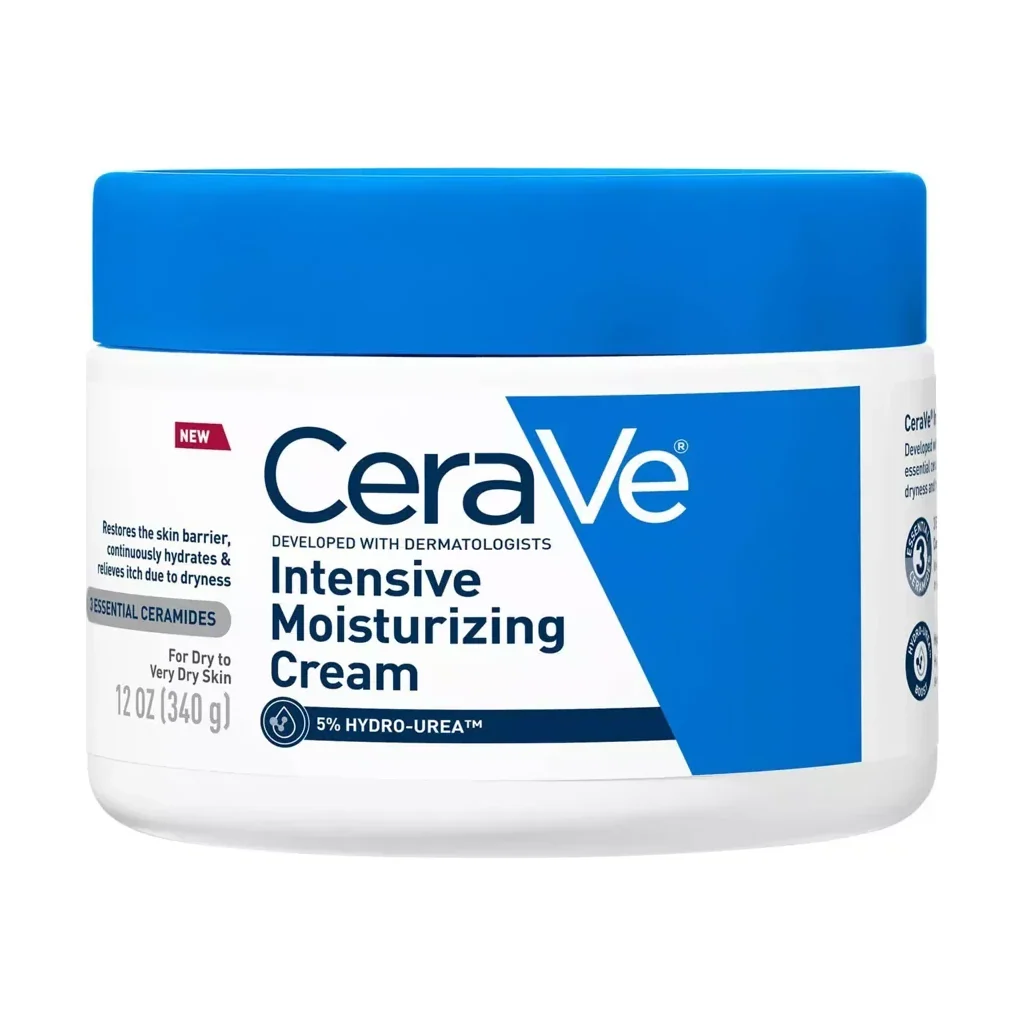
Every skincare brand has its flagship moisturizer and then, eventually, the heavier-duty version for the people the flagship could not fully help. CeraVe's original Moisturizing Cream is arguably the most successful drugstore moisturizer of the twenty-first century — a ceramide-rich, barrier-repairing cream that handles the vast majority of dry skin concerns with quiet efficiency. The Intensive Moisturizing Cream exists because a meaningful number of people tried that cream, appreciated it, and still woke up with tight, flaking skin.
The key differentiator is hydroxyethyl urea at 5%, marketed under CeraVe's proprietary name Hydro-Urea. Urea has a long history in dermatology — it has been used in prescription formulations for decades to treat everything from xerosis to keratosis pilaris to psoriatic scaling. But traditional urea has drawbacks: it can sting on application, it has a distinctive odor, and at higher concentrations it acts as a keratolytic, actively exfoliating the skin. Hydroxyethyl urea is a gentler derivative that retains urea's exceptional humectant properties — its ability to draw water deep into the stratum corneum — without the exfoliating action, the sting, or the smell. At 5%, it is potent enough to measurably improve hydration while remaining comfortable enough for facial use on sensitive skin.
The formulation strategy here is multi-depth hydration. Glycerin works at the surface, drawing water from the environment into the upper stratum corneum. Sodium hyaluronate binds and holds moisture in the mid-layers. Hydroxyethyl urea reaches deeper, pulling water into the corneocytes themselves. And the amino acid complex — glycine, serine, alanine, and sodium PCA — mimics the skin's own natural moisturizing factor, restoring the hygroscopic compounds that severely dry skin has depleted. It is a four-tiered approach to hydration, each tier operating at a different depth, and the result is the 72-hour hydration claim that CeraVe backs with clinical study data.
Shea butter, positioned third in the INCI list, is present in significant concentration. It provides a rich emollient layer of fatty acids, vitamins A and E, and anti-inflammatory triterpenes that soften and smooth rough, flaking skin. Unlike petrolatum, which the standard CeraVe Moisturizing Cream relies on for occlusion, shea butter has its own biological activity — it is not merely a barrier but an active contributor to skin conditioning. The practical difference is that this cream feels luxurious, almost buttery, without the petroleum-jelly heaviness that some users find off-putting.
The ceramide complex — NP, AP, and EOP — works alongside cholesterol and phytosphingosine in their standard barrier-repair role, but in this formula they are positioned downstream of the more intensive humectant system. The logic is clear: there is no point pulling moisture into the skin if the barrier cannot keep it there. The hydroxyethyl urea and amino acids do the pulling. The ceramides seal the exits.
Clinical testing on 89 subjects over one week produced impressive numbers: 96% improvement in skin radiance, 96% reduction in roughness, 98% elimination of flaking, 99% relief from dryness-related itchiness, and a 59% increase in barrier strength. These are manufacturer-sponsored results and should be interpreted with the usual caveats about study design and measurement methodology, but the consistency of the numbers — nearly everything above 95% — suggests a formula that genuinely delivers rapid relief for severely dry skin.
In daily use, the cream applies thicker and richer than the standard CeraVe Moisturizing Cream. The shea butter gives the initial application a dense, almost balm-like quality that transitions over two to three minutes to a smooth, absorbed finish. For daytime facial use, a thin layer is essential to avoid the cream sitting heavily under sunscreen. For nighttime use, a generous application can substitute for both a moisturizer and a sleeping mask, providing intensive repair through the overnight hours.
The formula is paraben-free, fragrance-free, and preservative-wise relies on a combination of hydroxyacetophenone, caprylyl glycol, and benzoic acid — a modern preservation system that avoids the parabens present in some of CeraVe's older formulations. This is a meaningful evolution for the brand and may sway paraben-averse consumers who previously looked elsewhere.
Limitations center on the cream's richness. Oily and acne-prone skin types will find this formula too heavy, and the presence of isopropyl palmitate and myristyl myristate — both moderate on the comedogenicity scale — adds a real breakout risk for sensitive, clog-prone skin. This is explicitly not an every-skin-type product. It is a specialist tool for a specific problem — severe, persistent dryness that resists conventional moisturizers — and it should be selected with that specificity in mind.
At $17.99 for twelve ounces, the value is excellent for an intensive-level moisturizer containing hydroxyethyl urea, shea butter, ceramides, amino acids, and hyaluronic acid. Comparable formulations from dermatological brands can cost three to five times as much for less than half the volume. For anyone who has exhausted basic moisturizers and needs something with genuine clinical-grade hydration technology, this cream delivers that capability at a price point that makes consistent use entirely practical.
The CeraVe Intensive Moisturizing Cream does not replace the original Moisturizing Cream — it exists for the people the original could not fully serve. If your skin is moderately dry and well-maintained, the classic version remains the smarter daily choice. But if you know what truly dry skin feels like — the kind that flakes, tightens, itches, and resists every cream you throw at it — this formula was built to end that conversation.