The oily skin market has a specific failure mode. Most products designed to control surface oil reach first for the obvious tools — alcohol, clay, salicylic acid at high concentrations, harsh astringents. They produce a satisfying short-term result, the skin looks matte and tight, and then over hours or days the skin overproduces sebum to compensate for what was stripped, the barrier weakens, and the user ends up oilier than they started. For skin that's both oily and sensitive — a substantial portion of the acne-prone population, particularly women with hormonal acne layered over reactive or rosacea-prone skin — this cycle is not just suboptimal but actively harmful. Strong oil-control products trigger flare reactions, and the user gets stuck between oily congestion and red sensitivity.
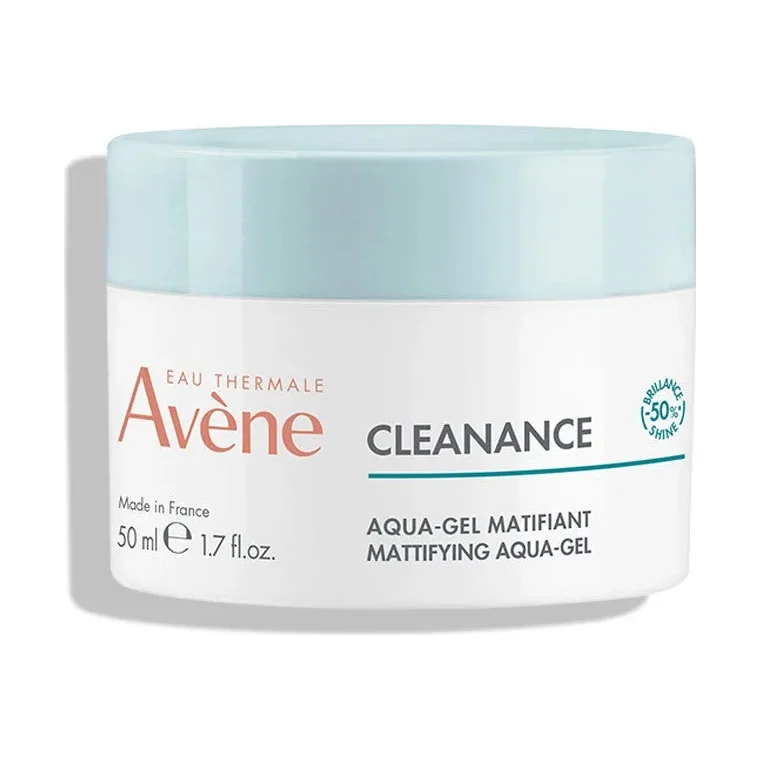
Avène Cleanance Mattifying Aqua-Gel is built specifically for that niche. The formula sets aside alcohol and harsh astringents entirely. The mattifying work gets split between three different actives, each handling a different aspect of the oil problem without compounding sensitivity. Niacinamide, sitting seventh on the INCI at working concentration, addresses sebum production at the source — published research supports its ability to modulate sebocyte activity over weeks of consistent use. Hydroxypropyl starch phosphate, the modified starch derivative midway through the INCI, absorbs surface oils as the gel sits on skin and contributes to the immediate matte finish without the irritation potential of clay or alcohol. Lens esculenta (lentil) seed extract — Pierre Fabre's proprietary research ingredient — adds pore-appearance and sebum-oxidation effects through a peptide mechanism distinct from the other two. The combination is layered intentionally.
What takes this beyond a typical oil-control formula is the recognition that oily skin still needs hydration. Glycerin sits fourth on the INCI, an unusually high position for a mattifying product. Propanediol and pentylene glycol round out the humectant base. The Avène thermal spring water — the brand's signature first ingredient — anchors the soothing foundation. This is a formula that understands the feedback loop most oil-control products create: strip the skin, the skin dehydrates, dehydrated skin overproduces sebum, the cycle repeats. By keeping the hydration load high alongside the oil work, the gel breaks that cycle rather than amplifying it.
The texture is excellent. A cushioned aqua-gel that breaks into a water-fluid on contact and sets to a matte finish within ten minutes. The blue Blue 1 dye that gives the gel its eye-catching color in the tube vanishes immediately on application — purely an aesthetic choice that has no effect on the finish. Pilling resistance under makeup is reliably reported as one of the gel's strongest practical features, which matters for an oily-skin moisturizer that has to coexist with foundation, concealer, and frequently a mineral or chemical SPF on top.
A few caveats are predictable for a French pharmacy product. Fragrance is present at a low INCI position — restrained, fading within minutes, but detectable on application and a deal-breaker for the fragrance-reactive end of the sensitive-skin spectrum. For users who can tolerate light pharmacy fragrance, it isn't an issue. For users who can't, Avène's unfragranced Tolerance Control line is the safer entry point even if it lacks the oil-control specificity here. The 50 mL size at $42 puts the per-mL cost above drugstore alternatives — La Roche-Posay Effaclar Mat at $25 for similar volume is the obvious budget comparison, with a slightly stronger matte effect but less sensitive-skin tuning.
The glyceryl laurate inclusion is the one ingredient that gives fungal-acne-prone users pause — it's a flagged ingredient on the malassezia-safe lists. For users with confirmed fungal acne, this isn't the product. For oily users with bacterial acne or hormonal acne without fungal involvement, it's fine. The distinction matters because fungal acne and bacterial acne look similar but require different approaches, and a gel with this ingredient profile will worsen one and help the other.
The user data from approximately 2,700 reviews across US and European pharmacy retailers maps cleanly to what the formulation would predict. The dominant positives are the all-day mattifying effect, the lightweight non-pilling texture under makeup, effective oil control without dryness, and visible reduction in mid-day shine over weeks. The dominant negatives are the fragrance, the price relative to drugstore alternatives, and the gel being too mattifying for some combination users in winter when their skin runs drier. The pattern matches a well-targeted product serving its intended audience and being mistargeted by users outside that audience.
For the specific demographic — oily, blemish-prone, sensitive or reactive skin where harsher products trigger flares — this is among the better French pharmacy moisturizers currently available. The formulation respects the biology, the supporting active cast is well-chosen, and the texture lands in the practical zone for daily use under makeup and sunscreen. For users outside that demographic, lighter or richer moisturizers will serve better; for users without the sensitivity concern, equivalent or stronger oil-control products at lower price points are available. The case for paying the Cleanance premium specifically is the sensitive-skin tuning.
Where this lands: the answer to 'I have oily skin but everything that controls the oil makes my face angry.' The Avène brand context — three decades of sensitive-skin research, the thermal-water positioning, the proprietary lentil-extract development — is part of what the price is buying. The formula it delivers is genuinely thoughtful for the niche it serves, even if it isn't the right choice for users on either side of that niche.