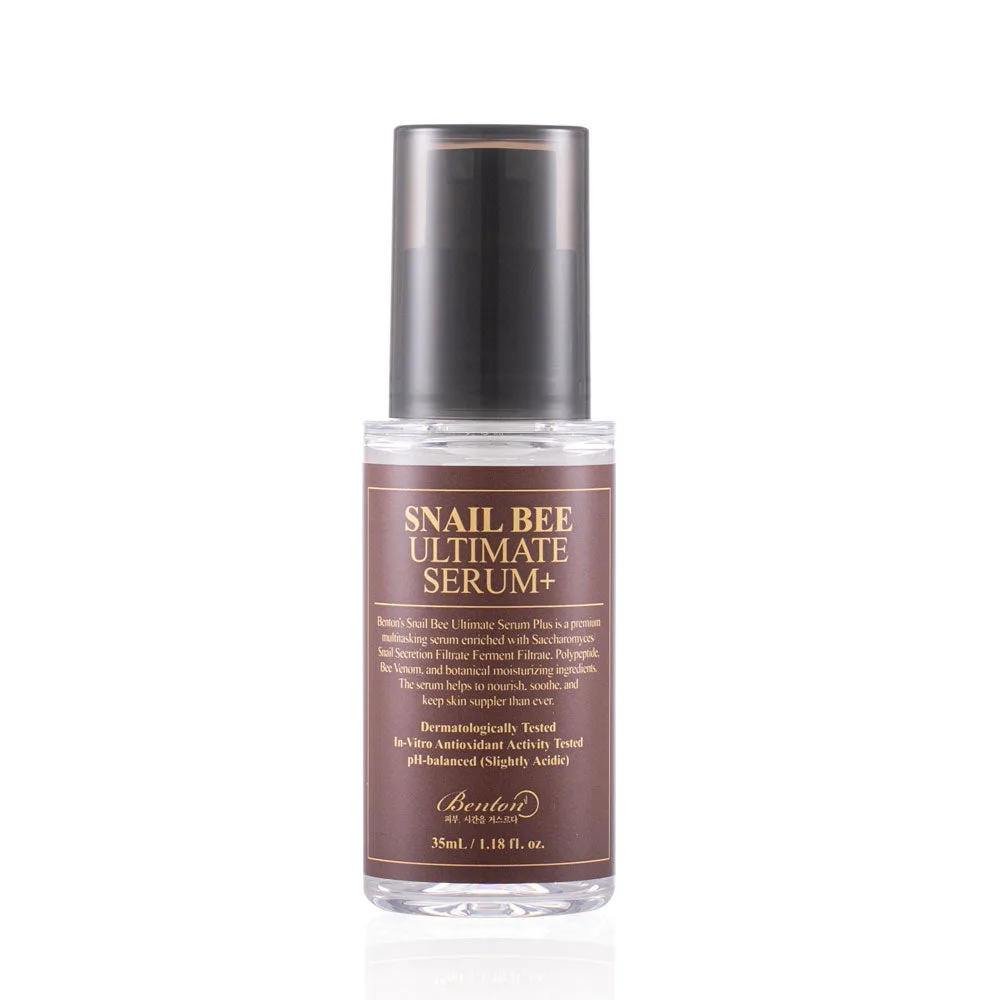
Sequels to beloved formulas face a structural honesty problem. The classic earned its cult on specific, checkable virtues — a first-position material, a price, an arc the forums documented for a decade — and the premium version must promise more while changing nothing that built the trust. Most brands solve this with vocabulary: the sequel gets 'advanced,' 'intensive,' a peptide roster, and a price that quietly forgets the original's covenant. Benton's Snail Bee Ultimate Serum+ is the rare sequel built by a brand constitutionally incapable of the vocabulary move — the indie that taught forums to read labels could hardly bury its own — and grading it fairly means using the only standard sequels deserve: better where checkable, harmless where speculative, and priced like the original still matters. It passes, with the asterisks printed where Benton always prints them.
The checkable changes first. The founding material gets a second process — the snail secretion filtrate is itself yeast-fermented before formulation, at a disclosed seventy percent of the deck — and the verifiable consequence is textural: the classic essence's famous slime refined to a watery-elastic snap that absorbs faster, layers cleaner, and reads, in the review base's recurring phrase, like the original after finishing school. The supplier-tier claims around the ferment (smaller fractions, better bioavailability) ride the same promising-tier evidence the material class has always carried — refinement, not new pharmacology, and the formula doesn't pretend otherwise. Niacinamide holds seventh position with leave-on residence, anchoring the deck's documented work: the tone arc and post-mark fading that built the franchise's reputation, on the week-three-to-six schedule a decade of receipts confirms. The base swaps water for tea tree and green tea leaf waters — a blemish-adjacent gesture with a tea-tree-reactive footnote — and the conditioning floor (beta-glucan, betaine, panthenol, allantoin, aloe) is the brand's standing architecture, fragrance-free and alcohol-free as constitutional law.
The speculative tier is the sequel's actual thesis: six peptides, stacked. Copper tripeptide-1 — GHK-Cu, the repair-literature celebrity — headlines a roster spanning the matrixyl family (palmitoyl pentapeptide-4, palmitoyl tripeptide-1) and the hexapeptide supporting cast, all at the undisclosed doses peptide vocabulary always keeps. The class literature is real at studied concentrations; whether this deck meets them is faith-and-forum territory, and the honest framing — which Benton's own restrained copy roughly keeps — is upside stacked atop a floor that works regardless. Five lactobacillus-and-saccharomyces ferments chorus the fermentation theme; bee venom carries the franchise signature at trace, and with it the franchise's one absolute exclusion: sting-allergic users do not patch-test this, they pass, full stop. The willow bark and tea-tree base notes pencil the reactive-skin margin; vegans decline the namesakes as ever; the fungal-acne audit hesitates at the ferment density.
What lands, per the renewal-era review base: the classic's arc, slightly faster and considerably more elegant. Calm and elastic hydration inside two weeks, mark-fading on franchise schedule, and the peptide ambitions running silent underneath — months-tier, modest-tier, exactly as the class behaves when it behaves. Upgraders from the classic report the texture as the purchase justification; first-timers report the same conversion the essence has run since 2013. Nobody reports revolution, which is the sequel standard met: incremental, checkable, harmless, priced. A franchise-architecture note for routine planners: the Ultimate tier was designed to nest, not replace. The serum's watery-elastic weight slots between the classic toner and the High Content lotion without redundancy — mucin density rising through the stack — and the full-franchise routine the brand quietly intends (toner, this serum, lotion) runs about sixty-five dollars for a season of the most ingredient-dense gentle routine in indie K-beauty. Few brands can sell their own three-product stack with a straight face; this one's stack is the rare case where each tier's first-position material genuinely differs in preparation, and the arithmetic still undercuts one Western peptide serum. (The stack's order also settles itself by feel — each layer absorbs faster than the one beneath it, which is the kind of formulation choreography that doesn't happen by accident.) Sequel grading, like skincare, rewards the brands that show their work.
And the price is the verdict's spine. Twenty-seven dollars for seventy-percent fermented mucin under a six-peptide stack is arithmetic Western peptide serums refuse — GHK-Cu vocabulary alone opens at sixty dollars in the indie-clinical aisle, before anyone ferments a snail — and the founding covenant (flagship chemistry, forum pricing) survives the premium tier intact. The recommendation sorts accordingly: classic devotees upgrade for the texture and the peptide upside, knowing the gains are incremental; first-timers start with either, budget deciding; peptide shoppers get the category's best vocabulary-per-dollar with the standing dose caveat; and the sting-allergic, as across the entire franchise, were never invited. Sequels rarely deserve their originals. This one remembers whose name is on the bottle — and prices like the forums are still grading, because, twelve years on, they are.