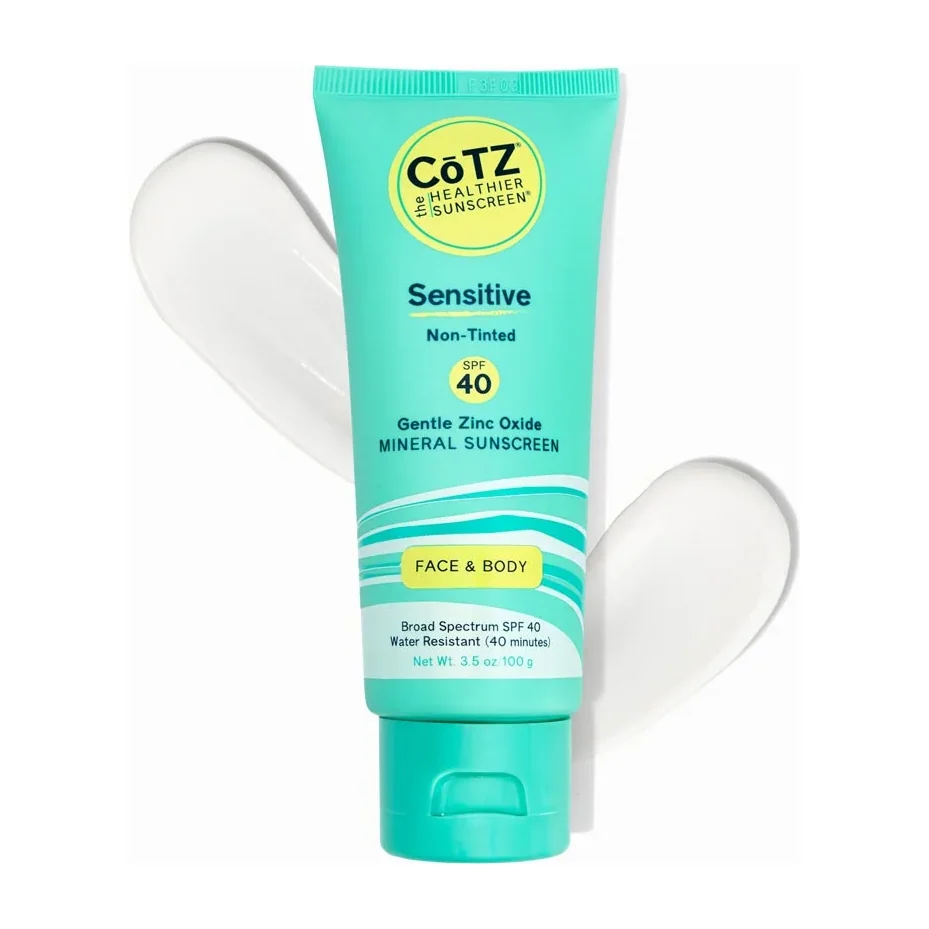
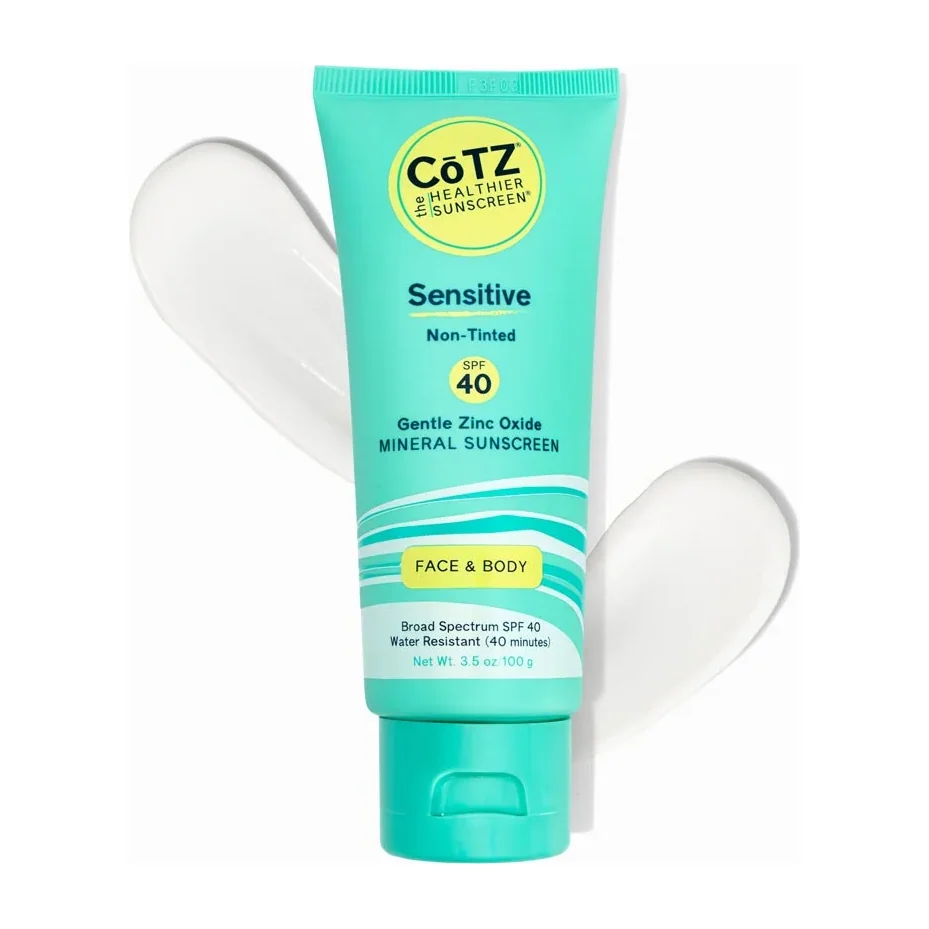
Most sunscreens are designed with cosmetic elegance as the primary goal and skin tolerance as the secondary consideration. The formulators start with a desired finish — weightless, invisible, glowy, whatever the current aesthetic trend demands — and then try to deliver UV protection inside those constraints. It works well for the average consumer with healthy, resilient skin. It doesn't work at all for the patients dermatologists see most often: people with rosacea whose skin reacts to fragrance and certain filters, people recovering from lasers or chemical peels whose barriers can't tolerate anything beyond pure zinc, kids whose thin skin absorbs chemical filters more readily than adults, and patients with photosensitive conditions who need maximum UV blocking at all costs.
Cotz was built for that second group. The brand name — an acronym for 'Contains Only Titanium and Zinc' — tells you everything about the original design brief, and the Sensitive SPF 40 formulation is the most disciplined product in the line. It uses 20% zinc oxide, the maximum allowable concentration under FDA regulations, with no titanium dioxide and no chemical filters. There is literally nothing else in the sunscreen actives profile. That simplicity is the entire value proposition.
Twenty percent zinc oxide is as much broad-spectrum protection as any mineral sunscreen commercially available, and the absence of any chemical filters or blended titanium means there's nothing in the active profile that can trigger a photosensitive or sensitive-skin reaction. For patients recovering from ablative lasers, chemical peels, or Mohs surgery, this is exactly the protection their dermatologists want them wearing. For rosacea patients whose skin flares with even mild irritants, it's one of the few sunscreens they can reliably tolerate. For parents of young children, it's fragrance-free, chemical-filter-free, and safe for daily use from six months of age. It's also reef-safe and fungal-acne safe, two boxes a lot of 'gentle' sunscreens quietly fail to tick.
The inactive ingredients reflect the same discipline. The formula is built on a silicone emollient matrix — dimethicone, cyclomethicone, and silicone crosspolymers — that suspends the high zinc concentration evenly and prevents the clumping and patchiness that 20% zinc often creates in aqueous emulsion bases. Polyhydroxystearic acid and a silane surface coating help disperse the zinc particles so the finish stays smooth, and a little microcrystalline wax gives the film its water resistance. There's a trace of tetrahexyldecyl ascorbate (a stable fat-soluble vitamin C) and tocopheryl acetate (vitamin E) for supplemental antioxidant support, which is more than most pure mineral sunscreens bother including. No fragrance, no essential oils, no botanical extracts that could trigger allergic reactions. The ingredient list reads like a dermatologist's safe prescription rather than a marketing deck.
Two persistent misconceptions are worth clearing up here, because they scare people away from exactly the kind of formula that would suit them. The first is that mineral sunscreens are inherently less effective than chemical ones; at 20% zinc, this delivers true broad-spectrum coverage that meets or exceeds most chemical sunscreens, and the old efficacy gap closed once high-concentration zinc formulas became common — today's differences are aesthetic, not protective. The second is that non-nano zinc underperforms the nanoparticle kind; both protect equally at the same concentration, and particle size affects only appearance and spreadability. When you see white cast, you're seeing larger non-nano particles chosen for aesthetics or reassurance, not a weaker sunscreen.
The use experience is where the tradeoffs become visible, and Cotz doesn't pretend otherwise. This is a thick, opaque white lotion. It does not blend weightlessly. You dispense a genuinely generous amount — a quarter-teaspoon for the face alone, because that's what the SPF rating requires — warm it between your fingertips, and work it into skin in sections. On fair to light skin, the white cast fades to a soft matte finish after about a minute. On medium skin tones, you get a pale ghostiness that looks fine in daylight but can photograph oddly in flash. On deep skin tones, the white cast is significant, and a tinted alternative such as Cotz Face Natural Skin Tone, or a different brand's deep-tone mineral formula, is the better call. This is the honest limitation of high-percentage zinc oxide sunscreens.
The price is reasonable. At $31 for 100g, you're paying mid-market for a formulation that rivals dermatologist-office sunscreens costing twice as much. A single tube lasts about two months with face-only daily use, roughly $15 a month for maximum-zinc broad-spectrum protection — a genuinely good deal by prescription-adjacent sunscreen standards. Its roughly 2,200 reviews averaging 4.5, alongside a Skin Cancer Foundation seal and two decades of derm-office use, back that up: the praise is all about zero irritation and true broad-spectrum coverage, the complaints all about the cast and the effort to blend.
Overall, this is one of the sunscreens that earns the 'if you need it, you really need it' designation. It's not the most cosmetically elegant option on the market, and it's not the right pick if white cast is a dealbreaker for your daily routine. But for sensitive skin, post-procedure recovery, pediatric use, or anyone prioritizing maximum broad-spectrum protection over aesthetics, it's one of the best mineral sunscreens available — and it's earned its place in dermatology offices for two decades running.