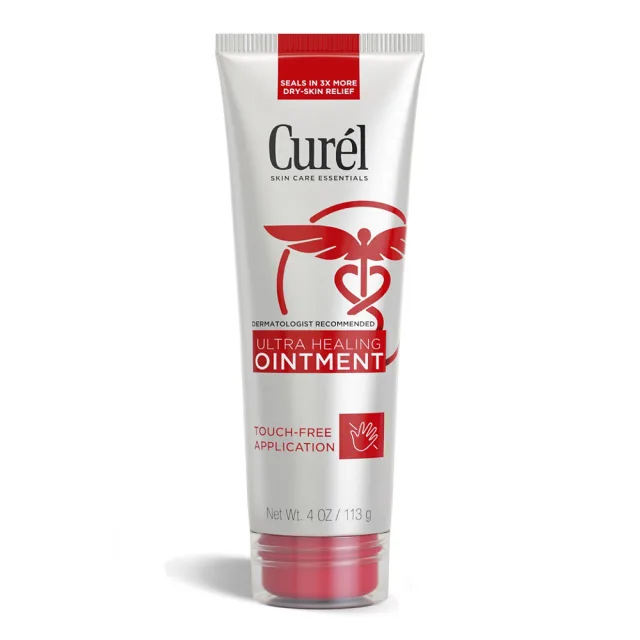
Healing ointments are the heavy artillery of dry-skin care — thick, occlusive, protective balms for the skin that's cracked, raw, or barrier-broken, the kind a light lotion can't touch. Most of them are built on petrolatum, which is, frankly, excellent: the gold-standard occlusive, extraordinarily effective, safe, and non-irritating. Curel's Ultra Healing Ointment takes a different route, building its occlusion from oils and waxes instead of petrolatum, and adding something most ointments don't bother with: real ceramides. The result is a genuinely good healing ointment with a couple of distinguishing features worth understanding clearly.
The ceramides are the standout, and they're the real thing. This ointment contains an actual ceramide — ceramide NP — alongside a ceramide-mimicking lipid, so it doesn't just seal the skin; it helps restore the depleted ceramide levels that underlie dry, cracked, barrier-compromised skin. That's a meaningful step up from the rest of Curel's lineup, where 'ceramide care' often means the eucalyptus 'ceramide function' concept rather than actual ceramides. Here, you get genuine ceramide replenishment in a rich occlusive base, which is a genuinely effective combination for barrier repair — seal the moisture in, and rebuild the barrier with real lipids at the same time.
The occlusive base does the sealing well, and it's where the 'petrolatum-free' angle comes in. Castor and coconut oils, shea butter, beeswax, and paraffin form a rich, protective layer that seals in moisture and shields cracked skin while it heals, much as a petrolatum ointment would. It's worth being clear-eyed here: petrolatum-free is a preference, not a clinical upgrade. Petrolatum isn't inferior — it's arguably the best occlusive there is — so this isn't 'healthier' than a petrolatum ointment. But for the many people who prefer to avoid petrolatum (texture preferences, sustainability views, or simply wanting an oil-and-wax base), this is an excellent, genuinely effective alternative, with the bonus of real ceramides that most petrolatum ointments lack.
The gentleness and thoughtful details round it out. It's fragrance-free and, notably, preservative-free (the high-oil, low-water formula doesn't need preservatives), which removes common irritants for sensitive and compromised skin, and it comes with a touch-free applicator — a genuinely smart touch for applying to cracked or broken skin without contaminating the product or your fingers. Soybean oil and vitamin E nourish and add antioxidant protection. For dermatologist-recommended dry-skin repair on reactive skin, it's a clean, kind formula.
The trade-offs are inherent to what it is. It's an ointment, so it's rich and greasy — that's the point for severe dryness, but it means you use it targeted (hands, feet, elbows, cracks, dry patches), not slathered over an oily face. It contains coconut oil and is not fungal-acne safe, so the malassezia-prone and oily-acne-prone should keep it off the face. And it contains soy, a consideration for the soy-allergic. None of these are flaws; they're just the correct scope — a rich barrier-repair ointment for dry, cracked skin and body use, not a facial moisturizer for oily skin.
The value is excellent, as is Curel's habit. Around nine dollars for a ceramide-rich, fragrance-free, preservative-free healing ointment with a touch-free applicator is a genuine bargain, especially one with real ceramides and a clean formula. It lasts a good while with targeted use, and it's a fraction of what some 'clean' or ceramide-marketed balms cost. For affordable, effective barrier repair, it's a standout.
Where it lands is an easy recommendation for dry, cracked, and sensitive skin. For anyone with severely dry hands, feet, elbows, body, or dry facial patches — especially those who prefer a petrolatum-free option and want real ceramides in their healing ointment — this is a genuinely good, gentle, affordable barrier-repair balm, and the most ceramide-substantive product Curel makes. Use it targeted, keep it off oily acne-prone facial areas, and let the real ceramides and rich occlusion do their repair work. Those who don't mind petrolatum have equally good (and equally cheap) options in classic petrolatum ointments, but this earns its place as the clean, ceramide-loaded alternative — another quietly excellent, well-targeted, affordable product in a lineup full of them. There's a small irony worth savoring in this product closing out a batch that opened with a three-hundred-dollar gold mask. The mask put inert metal on your face to make you feel rich for twenty minutes; this nine-dollar ointment puts real ceramides into cracked, painful skin and actually heals it. If you wanted a single image for the gap between what skincare sells and what skincare does, you could hardly improve on those two products sitting in the same batch — one pure signaling, the other pure function, separated by a factor of thirty-five in price and an even wider factor in usefulness. The ointment will never trend on social media. It will, however, fix your split winter knuckles, and it will do it whether or not anyone is impressed. The touch-free applicator deserves one last word of praise, because it's the kind of detail that reveals genuine care. Cracked, compromised skin is exactly the skin most vulnerable to infection, and dipping fingers into a communal tub is how ointments get contaminated. Letting you apply straight from a hygienic applicator is a small engineering choice that protects the very skin the product is meant to heal. It's unglamorous, practical, and quietly thoughtful — which is, by now, the most accurate three-word description of Curel as a whole. The brand keeps its promises small and keeps them completely, and at these prices, that's worth more than all the gold leaf in the batch combined.