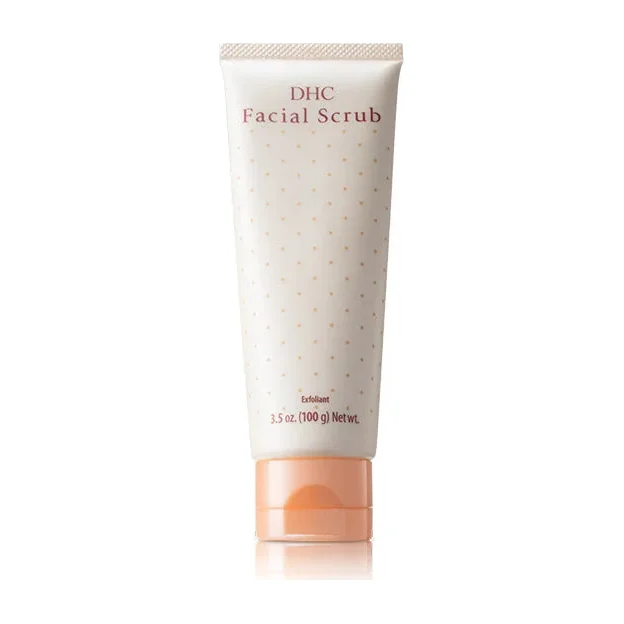
Few skincare products are as quietly divisive as the apricot-kernel face scrub. For decades they were the default way to exfoliate — that gritty, scrubbed-raw feeling read as 'deep clean' — but in recent years the consensus has shifted, with many dermatologists warning that coarse, jagged natural particles can cause microtears and irritation, and steering people toward gentle chemical exfoliants instead. DHC's Facial Scrub is a classic of the physical-scrub format, and reviewing it honestly means neither dismissing it as universally bad nor pretending it is as gentle as modern alternatives. It is a simple, effective scrub for the right skin used the right way, and a quick route to irritation for the wrong skin used the wrong way.
The formula is refreshingly short and unfussy. The exfoliation comes from finely milled apricot seed powder, which mechanically buffs away dead surface cells and debris as you massage. It sits in a soap base — stearic acid and potassium cocoate neutralized with potassium hydroxide — so the scrub lathers and cleanses while it exfoliates, doubling as an exfoliating wash. To its credit, DHC softens the abrasive approach with two thoughtful additions: urea, a humectant and mild keratolytic that chemically softens surface keratin and adds hydration, and a soothing pair of allantoin and licorice-derived dipotassium glycyrrhizate to calm the skin. These genuinely make the scrub kinder than a bare grit-in-soap formula, which is a point in its favor.
Used correctly, it works. Massaged gently onto damp skin with light pressure and rinsed, it leaves skin immediately smoother, cleaner, and matte, with the satisfying polished feel physical-scrub fans want. For resilient, oily, or combination skin that enjoys that sensation and tolerates physical exfoliation, it is a perfectly good, affordable way to keep texture and surface dullness in check. The urea assist means it is not purely abrasive, and being fragrance-free and simple, it appeals to minimalists.
But the caveats are real and important, because the failure mode here is easy to stumble into. The apricot-seed particles are noticeably coarse — a harsher scrubbant than the rounded synthetic beads or cellulose granules gentler exfoliants use — so the single most important rule is to use a light hand and resist the instinct to scrub harder. That scratchy, rough feel is abrasion, not better exfoliation, and pressing hard or using it too often can cause the very microtears and irritation the category is criticized for. Limit it to once or twice a week, never stack it with acids or retinoids the same day, and let restraint, not vigor, guide you.
The bigger limitation is suitability. It's not a scrub for sensitive, rosacea-prone, or active-acne skin. Coarse physical exfoliation can aggravate sensitive and reactive skin, and dragging abrasive particles across inflamed acne can spread bacteria and worsen breakouts — for those skin types, a gentle chemical exfoliant (a low-strength AHA or BHA) is both safer and more effective. The soap base is also somewhat alkaline and can be drying, which compounds the unsuitability for dry or sensitive skin. This scrub is squarely for resilient, oily-to-normal skin that genuinely tolerates and enjoys physical exfoliation.
It is worth situating the whole approach honestly: physical scrubbing is a legitimate but somewhat dated way to exfoliate, and even a well-softened apricot scrub like this is a blunter instrument than a formulated chemical exfoliant that dissolves dead-cell bonds evenly without abrasion. DHC's version is a good example of the format, made kinder with urea and soothers, but if you do not have a specific attachment to the scrubbed-clean feel, a gentle acid will usually give smoother, more even results with less risk. The scrub earns its place for people who want that tactile physical exfoliation specifically.
Value is reasonable. At around nineteen dollars (often discounted) for a 3.5-ounce tube used only once or twice a week, it lasts two to three months, so the cost per use is low. It is not doing anything technologically special, but it is a competent, simple, fairly-priced scrub from an established brand. You are paying drugstore-adjacent money for a no-frills physical exfoliant, which is fair.
One practical tip improves the experience and the safety margin considerably: use it on slightly damp rather than bone-dry skin, and let the lather and the particles glide rather than grind. The biggest mistake people make with apricot scrubs is treating them like sandpaper, scrubbing in firm circles to chase a deeper clean; that is exactly how the particles cause trouble. Applied with a feather-light touch, the same product that can leave aggressive users red and raw simply leaves gentle ones smooth — which tells you the formula is fine and the technique is the real variable.
Who should buy it: resilient, oily, or combination skin that likes a physical scrub and the matte, polished after-feel, used gently and infrequently. Who should skip it: sensitive, rosacea-prone, dry, or active-acne skin, and anyone who would do better with a gentle chemical exfoliant. For its specific niche — an affordable, simple, softened physical scrub for tough skin that enjoys scrubbing — it is a solid, honest product, as long as you use a light touch.