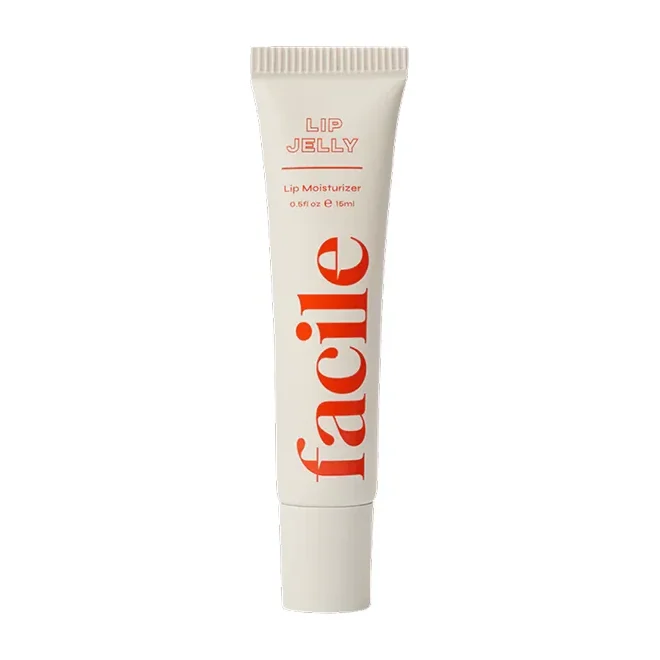
There is an open secret behind many plumping lip glosses: they work by mildly irritating your lips. Ingredients such as capsicum, cinnamon, menthol or ginger trigger a tingling, burning sensation and a temporary swelling that makes lips look fuller for an hour or two. For some people that's part of the fun. For anyone with sensitive lips, cheilitis or a tendency to react, it's a recipe for chapping and redness. facile, the dermatologist-founded brand launched in 2021 by Danielle Nadick Levy and Dr. Nancy Samolitis, built Lip Jelly around the opposite idea, and its tagline puts it plainly: visible plumping, without the burn.
The ingredient list is short and makes the approach clear. The base is hydrogenated polyisobutene, a glossy, cushiony hydrocarbon, gelled with two styrene copolymers to form the jelly texture. Octyldodecanol and a couple of light esters adjust the slip, and squalane, listed fourth, softens and conditions. Tocopheryl acetate, a stable form of vitamin E, appears unusually high for a lip product, and portulaca pilosa extract, a succulent extract, adds a botanical touch. At the very end sit two signalling peptides, palmitoyl tripeptide-1 and palmitoyl tripeptide-38, which provide the 'plumping' story in a non-irritating form.
It's worth being clear about those peptides. They are the last two ingredients, listed after water, lactic acid, sucrose cocoate and a small amount of alcohol (which is likely there as part of the peptide raw material). That places them at very low concentrations. Peptides like these have shown modest improvements in lip volume and texture in brand-sponsored studies of dedicated lip treatments, but at trace levels in a gloss, any effect will be subtle and slow. The real 'plumping' you see is optical: a glossy, hydrating film reflects light and smooths the surface, making lips look fuller and softer.
That optical effect is good. The jelly glides on easily and gives a clear, glassy shine that is noticeably less sticky than many traditional glosses, thanks to the gelled polymer base. It feels cushioned rather than tacky, and hair doesn't cling to it the way it does with heavier formulas. It wears for a couple of hours before needing a refresh, which is typical of a gloss rather than a balm. It works alone for a natural look, over lipstick as a shiny topcoat, or on top of a thicker balm when lips are cracked.
What makes it especially appealing for sensitive lips is what it leaves out. There is no fragrance, no flavour and no plumping irritant. Flavourings and fragrances are a leading cause of allergic contact cheilitis, so a product without them is a useful tool for people with reactive lips or those who've had problems with conventional glosses. The polymer and hydrocarbon base is also unlikely to cause irritation.
There are limitations. The jelly hydrates and conditions, but it's lighter and less occlusive than a petrolatum or lanolin balm, so badly chapped, cracked or peeling lips will need a heavier product, especially overnight. It also contains no sunscreen, so lips need an SPF balm underneath outdoors. And because the gloss wears off with eating and drinking, it needs reapplying through the day.
The brand's 96% hydration claim comes from a consumer perception study rather than instrumental measurements, and it hasn't been published. That is common for lip products and doesn't undermine the formula, but it's worth reading as user satisfaction rather than clinical proof.
On value, $15 for a 15ml tube is reasonable. That's more product than many glosses of the same price, and it lasts around three months of regular use. It sits above drugstore glosses but well below most prestige lip treatments. facile is a young brand without a long clinical track record, but this formula uses common, well-understood cosmetic ingredients, so there is little risk in trying it.
It also works well as part of a simple routine. A swipe in the morning after an SPF lip balm, another after lunch, and a thicker layer over balm at night keep lips comfortable and glossy without much thought, which is in keeping with the brand's minimalist approach. Many people use it as a substitute for both lip gloss and a light treatment.
It's also a sensible companion to skincare that dries the lips out. People on retinoids, benzoyl peroxide or isotretinoin often find that their usual glosses sting on already-stressed lips, because of fragrance, flavour or plumping agents. A gentle, unscented gloss like this can sit over a protective ointment and make the ointment more pleasant to wear in public, without adding anything likely to aggravate the irritation. The same applies in winter, when wind and indoor heating leave lips raw and the burn of a plumper is the last thing they need. In those moments the jelly is less a beauty product than a comfortable top layer that keeps the more protective balm underneath from wearing off as quickly.
The tints in the range use the same base with added colour, so the clear version reviewed here is the most neutral and suitable for the most sensitive lips.
Who should buy it? Anyone who wants glossy, fuller-looking lips without stinging, particularly people with sensitive lips or a history of reacting to fragranced or plumping glosses. It also suits makeup users who want a non-sticky topcoat. Who should skip it? People who want real volumising from a plumper, those with severely chapped lips who need a heavy ointment, and anyone looking for sun protection in their lip product. As a gentle, comfortable gloss with genuine conditioning ingredients, it is easy to recommend.