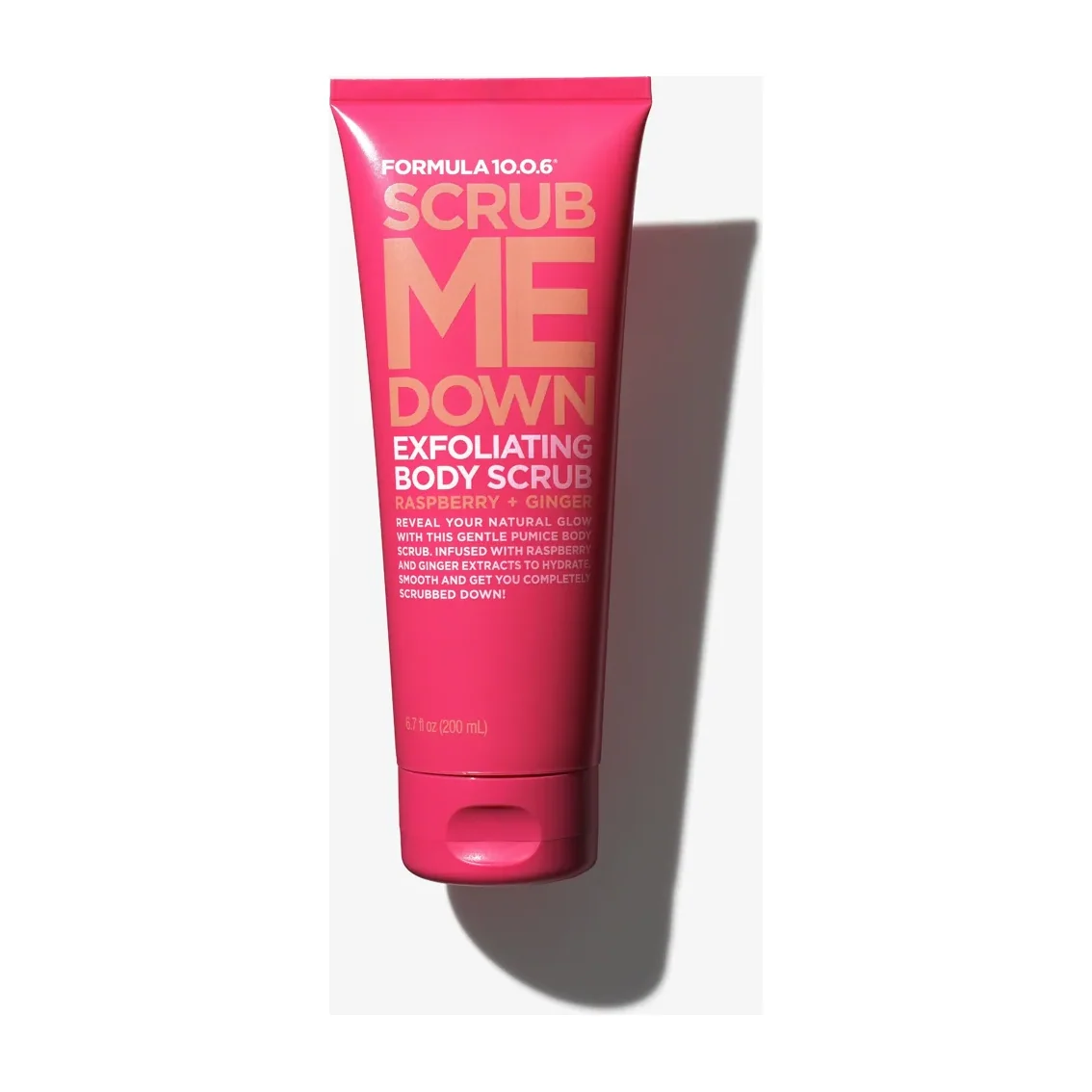
Every body scrub sold in the United States today is, whether it says so or not, a post-microbead product. When the plastic beads were banned from rinse-off cosmetics in the late 2010s, brands had to choose a replacement particle, and the choice they made decides everything about how the scrub feels. Sugar and salt dissolve as you use them and need an oil base to hold together, which leaves the tub slick. Crushed shells and seeds are sharp. Pumice, ground fine, is a natural, insoluble mineral that can be suspended in a water-based gel, which is the route Formula 10.0.6 took in late 2017 when it built Scrub Me Down, and it is the reason the product is at once the most sensible scrub on the shelf and the one most often accused of not scrubbing.
It launched in early 2019 as the exfoliating step of the brand's first body collection, alongside a wash, a butter and a dry oil, from a company that had made its name on pun-labelled face masks. Raspberry and ginger are the flavour, hot pink is the tube, eight dollars is the price, and the feedback over seven years on Amazon and Target has split cleanly. One group says it is gentle, smells wonderful and leaves skin soft with no redness. The other says it is a gel wash pretending to be an exfoliant. Both are describing the same product accurately, and which camp you fall into depends on what you think a scrub is for.
The formula explains the split. Water, then decyl glucoside, a sugar-derived, very mild surfactant, then pumice in third place. Glycerin, a glycol and cocamidopropyl betaine follow, then a gel thickener, hydrolyzed jojoba esters as the single emollient, apricot seed powder as a second softer particle, and the raspberry leaf and ginger extracts that give the front of the tube its story. Fragrance, benzyl alcohol and a modern preservative pair close the list. That is a body wash with grit in it, and a gentle body wash at that: glucoside surfactants are among the mildest available, there is no sulfate, no oil to leave a film, and the jojoba esters are water-dispersible, so the whole thing rinses clean.
In the shower it behaves as that architecture predicts. The gel foams lightly on wet skin, the particles give a soft, sandy resistance rather than a scratch, and it rinses away without a trace on the skin or the floor. The scent is a jammy raspberry with a warm ginger undertone, strong while you use it and reduced to a faint sweetness once dry. Skin comes out smooth, a little brighter, and not pink. The upper arms and thighs where keratosis pilaris lives feel less bumpy for a day or two, and over three or four weeks of twice-weekly use the roughness softens modestly. What it does not do is deliver the deep, slightly raw polish of a coarse salt scrub, and if that is the feeling you associate with exfoliation, this will disappoint.
Here is the case for the gentle side. The dead cells that exfoliation removes are the loose outer corneocytes, and they come away with very little force; the sandpaper sensation of a coarse scrub mostly signals micro-scratching of the layers beneath, which is why dermatologists are wary of the format. A fine pumice in a mild gel takes off what is ready to go and leaves the rest, which is the correct amount of work even when it feels like not much. Used once or twice a week with a lotion afterward, it does the job a body scrub should do, and it does it on a wider range of skin than a harsh one could.
Here is the case against. The raspberry and ginger are decoration; they sit low in a rinse-off list and any hydration comes from the glycerin and jojoba esters, not the fruit. The fragrance and benzyl alcohol, both recognised contact allergens, mean that reactive, eczema-prone or barrier-damaged skin should not be using it at all, gentleness of grit notwithstanding, and the tube's own caution against irritated or open skin applies. Keratosis pilaris and thick rough patches are not solved by any scrub; they want a urea or lactic acid lotion, with the scrub as the mechanical step before it. And a 200 millilitre tube used over the whole body is eight to ten sessions, which at twice a week is a couple of months.
Value is fair rather than remarkable. Eight dollars for 200 millilitres is standard drugstore scrub money, and what it buys is a thoughtful surfactant and particle choice rather than a lavish formula; the botanicals add nothing to the cost or the skin. A larger tub of an oil-based sugar scrub would last longer per dollar, at the price of a slippery shower and a heavier residue. The brand has no premium to charge and does not.
The honest recommendation follows the split. If you want a scrub that most skin can tolerate, that cleans as it polishes, smells like dessert and never leaves the tub dangerous, this is a good eight dollars, and its gentleness is a feature. If you want to feel sandblasted, it is not for you, and you should look at a coarse salt scrub and accept the trade-offs that come with it. Either way, keep it off reactive skin because of the fragrance, use it once or twice a week, and put a lotion on afterward, because that is where the lasting softness comes from.