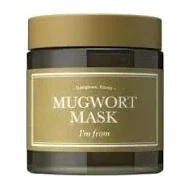
You can recognize this mask from across a room before you ever read the label: the dark, herbaceous green paste flecked with visible bits of mugwort is one of the most instantly identifiable textures in all of K-beauty. That paste, created by milling Artemisia princeps leaf into a powder rather than relying on a tidy, invisible extract, is the brand's signature and the reason this 2017 release became its single most iconic product. The look telegraphs the function, soothing, plant-forward, and unfussy, and the recognition has been earned slowly over years of word-of-mouth rather than manufactured overnight by a launch campaign. There is something honest about a mask that looks exactly like what it is.
The formulation backs up the aesthetic rather than relying on it. Mugwort leaf powder sits fourth on the INCI as the dominant active, which is high enough to deliver both the characteristic texture and a substantive concentration of Artemisia, a botanical with promising evidence for anti-inflammatory and antioxidant activity. Glycerin holds the third position, giving the wash-off format a genuine humectant backbone so the mask hydrates while it sits rather than merely depositing botanical matter on the surface and drying it out. Around the mugwort, the formula layers a deep botanical soothing pool, more than ten extracts including cordyceps, polygonum, scutellaria or Chinese skullcap, ligularia, rosa davurica, camellia, licorice, chamomile, rosemary, and centella, collectively contributing a broad spread of anti-inflammatory and barrier-supportive bioactives, though the evidence for a pool this wide sits at the emerging end and should be read as supportive rather than headline-grade. Panthenol and allantoin add well-established anti-inflammatory and barrier work, and dipotassium glycyrrhizate brings a licorice-derived calming active with documented soothing action. The whole thing is vegan, fragrance-free, and alcohol-free, which is exactly why it scores so well on suitability breadth and irritation risk and why it reads as a credible sensitive-skin option rather than a botanical novelty that looks the part but stings.
In practice, you smooth on a visible layer, leave it for ten to fifteen minutes, and rinse it away. The scent is unmistakably herbal, the natural aroma of the mugwort powder itself rather than any added fragrance, and whether you find it grounding or a little earthy is genuinely a matter of personal taste rather than a flaw. The soothing payoff is largely immediate, with visible calming of redness after a single session, while the broader improvements in overall skin feel build more gradually over four to eight weeks of consistent once- or twice-weekly use. It rewards being treated as a regular ritual rather than an occasional emergency measure.
The real caveats are mostly about format and price rather than formulation, which is a good sign for a product. At thirty-eight dollars this sits at the mid-premium end for a K-beauty wash-off mask, and while the iconic status and substantive ingredient list support that figure, it is not a budget pickup and people accustomed to cheaper clay masks will feel the difference. The natural mugwort scent that some find appealing will put others off, and there is no fragrance veil to soften it, so it is something of a love-it-or-leave-it experience. The ten-to-fifteen-minute dwell time asks for a slot of patience that fast morning routines simply do not have, making this a slower-paced product by nature. And by its very design a wash-off mask limits how much cumulative bioactive exposure your skin actually gets compared to a leave-on treatment; you rinse the great majority of it away, so it makes sense to think of this as a periodic reset rather than a daily active workhorse.
The value calculation favors it clearly for the right person. From an established brand with a large and genuinely enthusiastic following, backed by thousands of reviews that lend real weight to the soothing reputation, the price buys a category-defining mask with authentic ingredient depth rather than a single hero diluted in filler and propped up by packaging. This is for sensitive, reactive, or congested skin that wants a calming reset, for fans of mugwort and botanical-forward formulas who enjoy the ingredient on its own terms, and for anyone who finds genuine pleasure in the ritual of a visible wash-off mask. Skip it if strong natural plant scents bother you, if you want a quick rinse-and-go step rather than a fifteen-minute pause, or if you would rather direct your money toward leave-on actives that stay on the skin and keep working.
It helps to understand why mugwort, of all botanicals, anchored a product that became this widely recognized. Artemisia has a long history in traditional Korean skincare and bathing, valued for calming irritated, reactive skin, and the modern formulation essentially translates that folk reputation into a measurable, fragrance-free, vegan format that a dermatologist would not flinch at. The decision to use milled leaf powder rather than a refined extract is the formulation choice that ties the whole thing together: it keeps the botanical visible and substantive instead of reducing it to a token drop, and it is what gives the mask both its identity and its credibility. In a market full of soothing claims propped up by trace amounts of trendy plants, a product that puts its hero ingredient front and center, literally visible in the jar, has earned a measure of trust. That transparency, as much as the soothing payoff itself, is why it has held its place for the better part of a decade. For its intended purpose, it remains the benchmark mugwort mask, and the version most others in the category are quietly measured against.