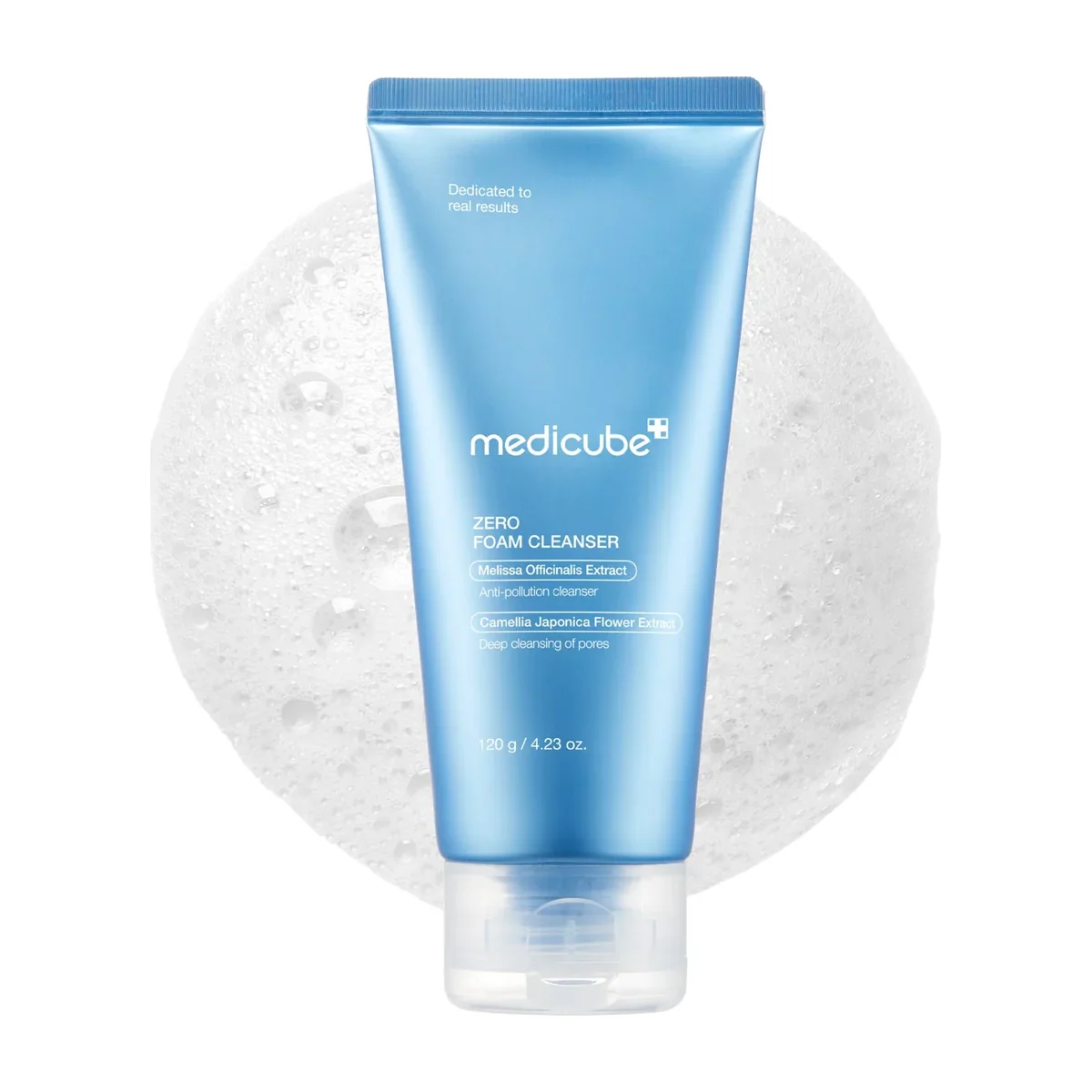
Medicube Zero Foam Cleanser 120g blue tube
Supporting role for Excess Oiliness
What makes this different

Where most modern Korean foams are amino-acid syndets, this is a true potassium soap built from four fatty acids and potassium hydroxide, then softened with glycinate and isethionate surfactants and a heavy glycerin load. The result is a lather far denser than a syndet can make, and an alkaline rinse that a syndet would never leave.

Medicube

Medicube Zero Foam Cleanser Review

Bouncy Soap For Oily Skin Cleansers foam k beauty Paraben free Cruelty free

A genuinely excellent bouncy soap for oily skin, and a soap is what it is: four fatty acids and potassium hydroxide, softened with mild co-surfactants and a lot of glycerin, perfumed, and alkaline. It cleans thoroughly, lathers absurdly, lasts months and costs little. It is not the sensitive-skin, all-types cleanser the tube describes, and the 'microdust' science is a test any foam would pass.

Price $20.00 120g / 4.23 oz
On the market 2020 Made in South Korea
Buy at Amazon ♥
Verdicts

How well it fits each concern

Six years on sale as the Zero line's founding cleanser have generated a deep pool of retailer and community commentary, but no per-product review tally could be confirmed this session, so user sentiment here is summarised rather than scored. The assessment rests on the published formula's soap chemistry, which is well characterised, and on the brand's single-use dust-removal test, which is the only performance data.

One verdict per concern. Open a row for the reasoning; the receipt has every source.

The scaleRecommendedGoodSupportingEarly evidenceNot for thisAvoidhow it works

Supporting rolefor Excess OilinessNothing here targets excess oiliness directly; sebum removal without stripping is the recognised companion to treating it, and this foam does that without known triggers.ReceiptGlycerin & Sorbitol: no evidence row for this concern yet · rule R8, same reading on 3,793 products · open the receipt

The case for it

  1. Glycerin & Sorbitol has no evidence row yet for this concern — it is in the research queue.
  2. The formula carries no trigger this concern is sensitive to, with the cautions noted.

Not from a trial rowStandard tolerabilityNo reviews read yet

Cautions: fungal-acne triggers.

What would change this: A researched evidence row for the lead active would replace this with a verdict.

Same rule for everyone. “Supporting role” is the verdict on 7,796 of 45,446 concern verdicts across the catalog; rule R8 decided 3,793 of them. Unchanged since September 25, 2026, engine 5.2.0.

Brand or formulator? Disclose a concentration or correct a fact →

The full receipt: rule, row, sources, dates →All excess oiliness products →

Supporting rolefor BlackheadsNothing here targets blackheads directly; gentle cleansing is the recognised companion to treating it, and this foam does that without known triggers.ReceiptGlycerin & Sorbitol: no evidence row for this concern yet · rule R8, same reading on 3,793 products · open the receipt

The case for it

  1. Glycerin & Sorbitol has no evidence row yet for this concern — it is in the research queue.
  2. The formula carries no trigger this concern is sensitive to, with the cautions noted.

Not from a trial rowStandard tolerabilityNo reviews read yet

Cautions: fungal-acne triggers.

What would change this: A researched evidence row for the lead active would replace this with a verdict.

Same rule for everyone. “Supporting role” is the verdict on 7,796 of 45,446 concern verdicts across the catalog; rule R8 decided 3,793 of them. Unchanged since September 25, 2026, engine 5.2.0.

Brand or formulator? Disclose a concentration or correct a fact →

The full receipt: rule, row, sources, dates →All blackheads products →How blackheads is treated →

Also listed for Large Pores — the actives here (Glycerin, Cleansing Surfactants, Sodium Cocoyl Isethionate (SCI) are in our research queue for that concern; there is no verdict until their evidence rows are written. That is a gap in our table, not a mark against the product.

Does the jobDoes what a cleanser is for: puts something back, surfactant mildness. Not measured from the label: pH match to skin.

A verdict is Dermington’s assessment of how well a product’s ingredients fit a concern — never a claim about what the product treats. Evidence dots and collected reviews sit beside it and are never blended in. Rules 0.5.1 · evidence table ev-2026.10-r231 · engine 5.2.0 · how we decide · this product’s receipt

Reader poll · Town SquareQuestion 1 of up to 3

Have you used Zero Foam Cleanser?

One tap counts. A couple of optional follow-ups come next.

No account neededOne answer each, change it any timeCounted only in anonymous totalsHow the Square counts →
Assessment

Pros & cons

What it does well 6

  • Dense, elastic lather from a pea-sized amount, unmatched by amino-acid foams
  • Thorough clean that leaves oily skin matte and fresh
  • Glycinate and isethionate co-surfactants soften the soap base noticeably
  • Heavy glycerin and sorbitol load takes the edge off the rinse
  • A 120g tube lasts three to four months at twice-daily use
  • Excellent second step of an evening double cleanse for oily skin

Where it falls short 6

  • True potassium soap base, so the wash is alkaline rather than pH-balanced
  • Fragrance with declared limonene and hydroxycitronellal in a 'sensitive skin' cleanser
  • Tight, squeaky after-feel on dry, normal and reactive skin
  • Microdust claim is a water-comparison test any foam would pass
  • Pore-tightening botanicals are the last three ingredients in a rinse-off
  • Stings sharply in the eyes
Review

The full review

Korean foam cleansers spent the 2010s converting en masse to amino-acid surfactants, the mild syndets that lather softly and rinse to a skin-neutral pH, and the switch became something close to a moral position: real soap, the story went, was for the barrier-careless past. Then in June 2020 Medicube launched its Zero line with a cleanser that reads like a bar of soap in a tube. Water, glycerin, then myristic acid, sorbitol, palmitic acid, potassium hydroxide, stearic acid, lauric acid: that is the classic in-situ saponification recipe, four fatty acids neutralised into potassium soaps by the hydroxide, and it is why the Zero Foam Cleanser makes a lather no amino-acid foam can touch. A pea of the dense white cream and a little water in the palms whips into a meringue, elastic and cushiony, that carries across the whole face and rinses away to a squeak. That squeak is the point and the problem. A month of using it draws the line clearly. On an oily week in summer it is a small pleasure twice a day, the kind of clean that makes a toner feel unnecessary even though it is not, and the tube barely moves. On a dry week in winter, or the morning after a retinoid, the same wash leaves the cheeks taut for ten minutes and the forehead faintly shiny by noon anyway, which is the rebound a soap is famous for. The eyes are the other lesson: the foam stings hard if it drifts up, more than most amino-acid cleansers, so rinsing with the eyes closed becomes a habit. It is a cleanser with a strong personality, and it does not adjust to the person using it. The formulation is smarter than a bar of soap, to be fair. After the soap base come cetearyl olivate, potassium cocoyl glycinate and sodium cocoyl isethionate, the mild co-surfactants that syndet cleansers are built on, plus sodium isethionate and potassium cocoate; they make the foam creamier and the after-feel less stripped than a straight potassium soap would leave, and the glycerin and sorbitol in the top four are a heavy humectant load for a rinse-off. Citric acid appears far down the list as a partial neutraliser. None of this changes the chemistry: a soap of this construction is alkaline, and the co-surfactants soften the blow without moving the pH to where the barrier prefers it. Oily, resilient skin does not mind, and often likes it; the thoroughness of the clean and the matte, fresh finish are exactly what a shiny T-zone wants at the end of a summer day, and the lather makes the second step of a double cleanse feel like an event. Dry, normal and reactive skin get the same clean and then the tight, taut minute afterward that tells them their lipids have left with the dirt, and twice a day that adds up. Medicube says it is safe for sensitive skin. The tube contains fragrance, with limonene and hydroxycitronellal declared as allergens behind it, an alkaline soap base and a wintergreen leaf extract, which is not a list anyone would assemble for a sensitive-skin cleanser. The other claim on the box is the one the cleanser launched on. Seoul's fine-dust seasons made 'microdust cleansing' a category in Korean beauty, and Medicube commissioned a contract lab to show that the foam removes applied dust particles better than plain water. It does. So does almost any surfactant cleanser, because particulates sit on the skin surface and wash away with ordinary cleansing; the chelating copolymer branded as Pollushield sits near the tail of the list and is not what is doing the work. It is a true statement engineered to sound like a discovery, and it has served Medicube well since 2020 in a market where fine-dust anxiety is a seasonal event. The pore-tightening quince, lemon balm and orange blossom extracts are the last three ingredients and have seconds of contact before the rinse, which is to say they are there for the label and the scent. What is left, once the marketing is set aside, is a very good cleanser for a specific person. Oily and combination skin that wants a deep, foamy, satisfying wash, does not react to fragrance, and follows with a toner and moisturizer will be happy for the three or four months a tube lasts, and at twenty dollars that is cheap per wash. As the second step after an oil cleanse at night, it is close to ideal for that skin. As a morning cleanser for anyone drier, it is a mistake that announces itself within a week, and as a sensitive-skin cleanser it is a mislabel. The Zero line has grown into pads, serums and creams that are more careful than this founding foam, and the brand's own newer capsule cleansing foam is aimed at the same oily customer with a slightly different pitch. This one remains the bouncy, unapologetic soap of the family, and it is worth buying as exactly that.
The science

The chemistry that defines this cleanser is saponification. Myristic, palmitic, stearic and lauric acids are listed with potassium hydroxide, which in the finished product means they exist largely as potassium soaps formed in situ; potassium myristate in particular is the workhorse of dense-lathering Asian foam cleansers, and its high foam volume, fast rinse and alkaline pH, typically well above 9, are all properties of the salt rather than of any additive. Alkaline washing transiently raises stratum corneum pH, and studies of soap versus synthetic detergent cleansers have repeatedly shown greater lipid removal, higher post-wash transepidermal water loss and slower barrier recovery with soaps, which is the mechanism behind the tightness that dry and reactive skin report and the reason dermatology guidance favours syndets for compromised or sensitive skin. The formula mitigates this in three recognised ways: potassium cocoyl glycinate and sodium cocoyl isethionate, both mild syndet surfactants, reduce the surfactant blend's irritation potential and improve after-feel; glycerin and sorbitol high in the list leave a small humectant residue; and cetearyl and sorbitan olivate add a trace of emollient. These reduce harshness without changing the soap's pH class. The Pollushield claim rests on an acrylic acid/acrylamidomethyl propane sulfonic acid copolymer, a chelating polymer, and on a contract-laboratory comparison of dust removal against water; since particulate matter is removed by ordinary surfactant action, the result is expected and does not distinguish this foam from other cleansers. Fragrance with limonene and hydroxycitronellal, plus wintergreen leaf extract, are the formula's sensitisation liabilities and are in tension with its sensitive-skin positioning; the quince, lemon balm and orange blossom extracts at the end of the list have no meaningful contact time in a rinse-off.

The clinical view

Dermatology guidance on cleansing distinguishes fairly sharply between true soaps and synthetic detergent cleansers, and this product belongs in the first group despite its modern surfactant additions. Soap-based foams clean effectively and are well tolerated by oily, resilient skin, but their alkaline pH and greater lipid removal make them a common contributor to dryness, stinging and flare-ups in patients with atopic dermatitis, rosacea, retinoid-treated skin or a compromised barrier, who are generally steered toward pH-balanced syndet cleansers. The added fragrance and declared allergens reinforce that recommendation for sensitised skin. For oily or acne-prone patients without barrier problems it is a reasonable evening cleanser, ideally after an oil or balm and followed promptly by a moisturizer, and its long-lasting, economical format is a practical advantage. The anti-pollution claim carries no clinical significance beyond what any cleansing achieves, and the sensitive-skin claim on the packaging should not be taken at face value.

Formula

Key ingredients

  1. Fatty acid soap base (Myristic, Palmitic, Stearic, Lauric Acid + Potassium Hydroxide)

    Positions three through eight are the recipe for a true soap: four fatty acids neutralised in situ by potassium hydroxide into potassium myristate and its cousins, which is what produces the dense, bouncy lather and the squeaky rinse, and what keeps the wash alkaline despite the citric acid further down.

    Not yet assessed
  2. Potassium Cocoyl Glycinate

    Tenth in the list, an amino-acid surfactant added to soften the soap base: it foams well at the soap's high pH and reduces the barrier-stripping harshness that pure potassium soaps are known for, which is the formula's main concession to the 'safe for sensitive skin' claim.

    Not yet assessed
  3. Sodium Cocoyl Isethionate

    Twelfth, the classic 'syndet' mild cleanser, paired here with sodium isethionate; together with the glycinate it makes the foam creamier and the after-feel less tight than a straight soap, though it cannot pull the pH down to skin-neutral on its own.

    Not yet assessed
  4. Glycerin & Sorbitol

    Second and fourth, a heavy humectant load for a foam, which is why the rinse feels less parched than the soap chemistry would predict; they are largely rinsed away, but the little that remains softens the first minute after washing.

    Not yet assessed
  5. Pollushield polymer (Acrylic Acid/Acrylamidomethyl Propane Sulfonic Acid Copolymer)

    The branded 'anti-microdust' technology is this chelating copolymer near the tail of the list, which binds metal-bearing particulates so they rinse away; the brand's lab test shows it removes applied dust better than water, which is true of most surfactant cleansers.

    Not yet assessed
  6. Quince, Lemon Balm & Orange Blossom Extracts

    The three last-listed extracts are the 'pore-tightening' botanicals on the label; in a rinse-off with seconds of contact they contribute scent and story, not astringency, and the orange blossom is part of why the cleanser is not fragrance-free.

    Not yet assessed
Full ingredient list 40 ingredients ShowHide

Water, Glycerin, Myristic Acid, Sorbitol, Palmitic Acid, Potassium Hydroxide, Stearic Acid, Lauric Acid, Cetearyl Olivate, Potassium Cocoyl Glycinate, Fragrance (Parfum), Sodium Cocoyl Isethionate, Sorbitan Olivate, Potassium Cocoate, Coconut Acid, Butylene Glycol, Sodium Isethionate, Sodium Polyacrylate, Portulaca Oleracea Extract, Gaultheria Procumbens (Wintergreen) Leaf Extract, Disodium EDTA, Camellia Japonica Flower Extract, Propanediol, Diisopropyl Adipate, Lecithin, 1,2-Hexanediol, Saponaria Officinalis Leaf Extract, Acrylic Acid/Acrylamidomethyl Propane Sulfonic Acid Copolymer, Dimethylmethoxy Chromanol, Glyceryl Caprylate, Citric Acid, Potassium Sorbate, Sodium Benzoate, Xanthan Gum, Chaenomeles Sinensis Fruit Extract, Citrus Aurantium Dulcis (Orange) Flower Extract, Melissa Officinalis Extract, Limonene, Hydroxycitronellal

Safety & formulation facts

  • Pregnancy safe
  • Not fragrance free
  • Alcohol free
  • Oil free
  • Silicone free
  • Paraben free
  • Sulfate free
  • Cruelty free
  • Not vegan
  • Not fungal-acne safe
Pore-clogging (comedogenic) myristic acidlauric acid
Potential irritants fragrancelimonenehydroxycitronellalalkaline soap base
Common allergens fragrancelimonenehydroxycitronellal
Compatibility

Skin types & routine

Routine step cleanser
Time of day Morning & night
Best season summer
Finish matte

Layering

Best as the second step of an evening double cleanse after an oil or balm, or alone in the morning for oily skin; follow within a minute with a hydrating toner, because a soap-based foam leaves the surface briefly alkaline and thirsty.

When to expect results

The squeaky-clean, matte feel is immediate; oily skin notices less midday shine within a week of twice-daily use, while anyone with a dry or reactive tendency will notice tightness in the same window, which is the signal to cut back to evenings only.

Pairs well with hyaluronic-acidniacinamideceramidespanthenol

A routine built around it

Morning

  1. Medicube Zero Foam Cleanserthis product
  2. Hydrating toner
  3. Serum
  4. Moisturizer
  5. Sunscreen SPF 50

Night

  1. Cleansing oil or balm
  2. Medicube Zero Foam Cleanserthis product
  3. Toner
  4. Treatment serum
  5. Moisturizer
Guidance

How to use it, and who it's for

How to use

Squeeze a pea-sized amount into wet palms and work it with a little water into a dense foam before it touches the face, then massage the lather over the skin for thirty seconds or so, keeping it away from the eyes, and rinse thoroughly with lukewarm water. In the evening use it as the second step after an oil or balm cleanser to remove sunscreen and makeup; in the morning, only if skin is oily enough to want it, otherwise rinse with water alone. Follow within a minute with a hydrating toner and moisturizer, since the soap base leaves the surface briefly alkaline and taut. If tightness lingers past a few minutes, drop to once a day.

Is it worth the price?

Twenty dollars for 120 grams that lasts three to four months at twice-daily use is inexpensive per wash, and for oily skin that enjoys a soap-style foam it is among the better-value cleansers in Medicube's range, undercutting the newer capsule foams on cost per month. The value depends entirely on skin type, because for dry or reactive skin the money buys a product that has to be replaced, and there is nothing in the list, beyond the co-surfactants and glycerin, that justifies a premium over a pharmacy bar. The brand's price reflects the Zero line's reputation and the Pollushield story rather than any evidence; there is one size and no refill, and the line's cleansing duo bundle is the only discount.

Who should buy it

Oily and combination skin that wants a deep, foamy, squeaky-clean wash, does not react to fragrance, and follows with proper hydration will get an economical, satisfying cleanser and an ideal second step for evening double cleansing. It suits people who find amino-acid foams too limp to feel effective.

Who should skip it

Anyone whose skin runs dry, dehydrated or reactive, including rosacea and eczema, and anyone on a retinoid or acid routine, should choose a pH-balanced syndet instead of an alkaline soap with fragrance and declared allergens. Anyone buying for the microdust or pore-tightening claims is paying for a story.

Ready to try it?Medicube Zero Foam Cleanser · $20.00 · 120g / 4.23 oz
Details

The product, in detail

Texture
A dense white cream that whips into a thick, elastic, meringue-like foam with a little water, more lather than a pea-sized amount seems capable of.
Scent
A soft, soapy floral with an orange-blossom note, clearly perfumed but not lingering once rinsed.
Packaging
A 120g squeeze tube with a small nozzle that meters the cream well; it stands on its cap and lasts three to four months at twice-daily use.
How long it lasts
Roughly three to four months at twice-daily use, since a pea-sized amount lathers a whole face.
Once opened
Use within 12 months · track your toss-by date →
Size
120g / 4.23 oz
Made in
South Korea
Launched
June 2020

What the first two weeks feel like

The first wash is the sales pitch: a mountain of cushiony foam, a thorough clean, and a distinctly squeaky rinse that oily skin reads as fresh and dry skin reads as a warning; there is no tingle unless it reaches the eyes, where it stings sharply.

The story behind it

Why it exists

Medicube launched the Zero Foam Cleanser in June 2020 alongside the Zero Pore pads as the founding pair of its Zero line, at a moment when Seoul's fine-dust seasons made 'microdust cleansing' a Korean marketing category in its own right. The Pollushield anti-pollution story was the launch hook; the pore-care positioning came later as the line grew, and the cleanser has stayed in the range unchanged.

About Medicube Established Brand (5–20 years)

Medicube has been APR Corporation's skincare brand since 2018, and the Zero line, launched around this cleanser and the Zero Pore pads in 2020, is its longest-running and best-known range. The brand commissions single-use tests from Korean contract labs, such as the P&K Skin Clinical Research Center microdust study it cites here, rather than publishing peer-reviewed work.

Brand founded 2018 · This product since 2020

Myth vs. reality

What people get wrong about it

MythA cleanser that is 'clinically proven against microdust' cleans more deeply than a normal foam.

RealityThe test compared the foam against plain water at removing applied dust particles, which almost any surfactant cleanser would win; particulates sit on the surface and rinse away with ordinary washing, and the chelating polymer adds little that the soap base was not already doing.

MythSoap-free' is the same as pH-balanced, and a rich lather means a gentle wash.

RealityThis foam is a potassium fatty-acid soap, which is alkaline by nature; the isethionate and glycinate surfactants soften it but cannot make it skin-neutral. The dense lather is a sign of soap chemistry, not gentleness, and the squeaky rinse is the barrier's lipids leaving with the dirt.

FAQ

Questions people ask

Is the Medicube Zero Foam Cleanser pH balanced?

No. It is a true soap built from myristic, palmitic, stearic and lauric acids neutralised with potassium hydroxide, which makes the wash alkaline; the glycinate and isethionate surfactants soften it but do not bring it to skin-neutral. Oily skin tolerates that well, dry and reactive skin often does not.

Is the Medicube Zero Foam Cleanser good for sensitive skin?

Despite the label, it is a poor match. An alkaline soap base plus fragrance with declared limonene and hydroxycitronellal is the opposite of what sensitised or rosacea-prone skin wants in a cleanser. It is a very good foam for oily, resilient skin.

Does the Medicube Zero Foam Cleanser remove makeup and sunscreen?

Light sunscreen and daily grime, yes; a full face of makeup or a water-resistant sunscreen needs an oil or balm first. Medicube itself positions it as the second step of a double cleanse, which is where it belongs at night.

What is the 'microdust cleansing' claim on the Medicube Zero Foam Cleanser?

A contract-lab test in which the foam removed applied dust particles better than plain water. That is true of virtually any surfactant cleanser; the chelating polymer branded as Pollushield sits near the end of the list and is not why the wash works.

How much Medicube Zero Foam Cleanser should I use?

A pea-sized amount, worked with water in the palms into a dense foam before it touches the face; the lather is far bigger than the dose suggests. Using more just makes the rinse squeakier and the tube emptier.

Why does my skin feel tight after the Medicube Zero Foam Cleanser?

That is the soap base removing surface lipids and leaving the skin briefly alkaline. Follow within a minute with a hydrating toner and moisturizer, drop to evening-only use, or, if the tightness persists, switch to a syndet foam; the tightness is information, not a sign the cleanser is working harder.

Reviews

What shoppers tend to say

Recurring themes our editors read across retailer reviews — summaries in our words, not quotations, and not a substitute for a patch test.

Common praise

  • Dense, bouncy lather from a small amount
  • Skin feels thoroughly clean and matte
  • Rinses without residue
  • A tube lasts months

Common complaints

  • Tight, squeaky feeling on dry or normal skin
  • Fragrance
  • Too stripping for twice-daily use on sensitive skin
  • Stings the eyes
Next stepCheck it against what you already useClashes, spacing and the right order, with everything on your shelf.