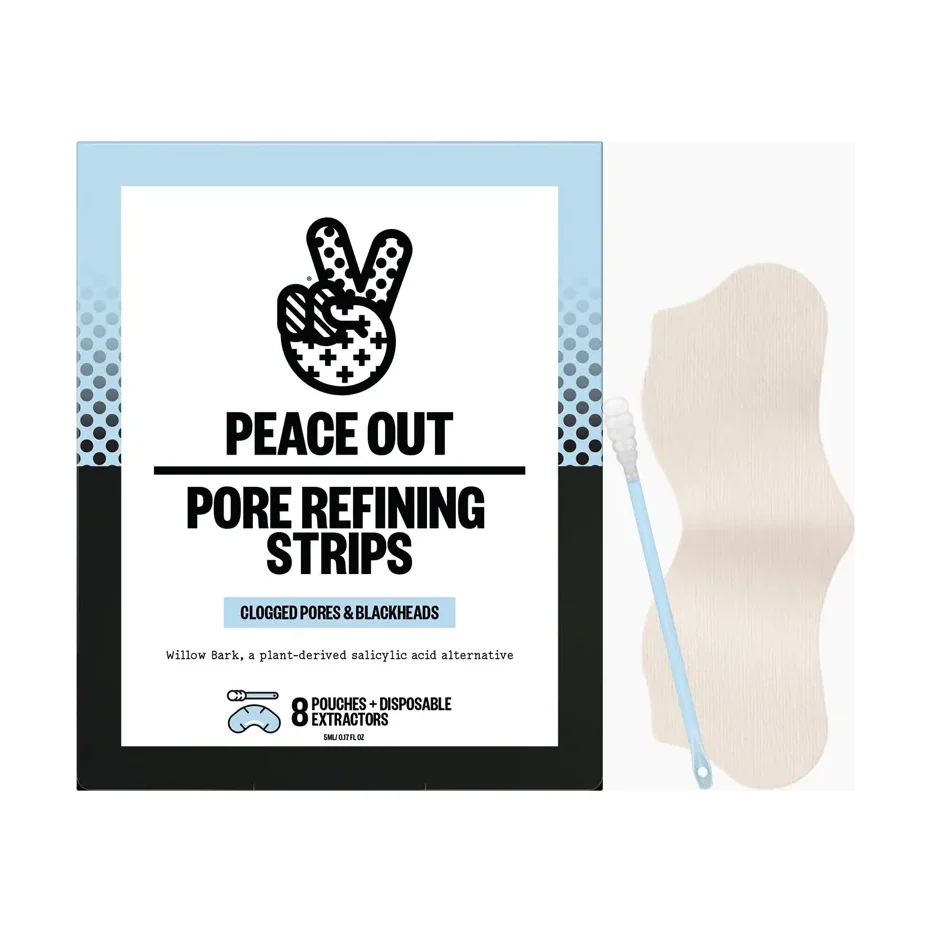
Peace Out makes two pore strips, and they represent the two philosophies of the format. The Pore Minimizing Strips are the gentle, modern, hydrocolloid kind. These Pore Refining Strips are the classic kind — the wet-it, dry-it, pull-it-off nose strip your teenage self knew — dressed up with a removal tool and a willow-bark garnish. They deliver the more dramatic, satisfying result of the two, and they carry the more honest need for a reality check about what a nose strip can and can't do.
Start with how they work, because the method defines the experience. These are classic-style wet strips: you wet your nose (or chin), apply the strip, and let it dry over five to ten minutes, during which it bonds firmly to the sebum plugs and debris at your skin's surface. Then you remove it — and here's Peace Out's twist — using an included disposable extractor tool designed to lift the loosened buildup away without the harsh, skin-stressing yank of an old-school strip. The payoff is immediate and gratifying: real sebum plugs and blackhead content pulled out and visible on the strip, leaving your nose looking instantly clearer. For the satisfying drama of the classic pore strip, these deliver.
But the name demands the same honest reckoning every pore strip does, and it's worth stating plainly: no strip refines or shrinks pores. Pore size is largely set by genetics, oil production, and age, and physically pulling debris out of a pore doesn't change the pore's size or 'refine' it in any lasting way. What these strips remove is the sebum and — mostly — sebaceous filaments, which are a normal, continuous feature of everyone's skin, not a defect to be permanently eliminated. So the pore looks clearer for a day or two, then refills, and the pore itself is unchanged. 'Pore refining' is marketing language for a temporary decongestion, not a treatment. Repeated use gives repeated temporary results, not cumulative refinement.
The added ingredients don't change that. The 'pore refining complex' is a vague marketing term, and the willow bark included for 'gentle exfoliation' is the same weakly-effective ingredient often dressed up as 'natural salicylic acid' — it contains salicylates in a form and amount too low to meaningfully exfoliate, so it contributes little beyond a nicer-sounding label. As with the brand's strips and patches generally, the actual mechanism is physical (here, the pull), not the listed actives.
How do they compare to their hydrocolloid sibling? It's a genuine trade-off worth understanding. These Refining Strips give a quicker, more dramatic pull, physically extracting the plugs in ten minutes — more instantly satisfying. The Minimizing Strips absorb gunk gradually over hours via hydrocolloid, gentler but less dramatic. The cost of the drama here is that the wet-and-remove method is inherently a bit rougher on skin than gentle hydrocolloid absorption, even with the extractor tool softening the removal. So if you love the classic strip's immediate gratification, these are your pick; if your skin is sensitive or you prefer gentleness, the hydrocolloid version is kinder. Neither, again, actually refines pores.
On safety, classic-style strips warrant a little more care than hydrocolloid ones. The bonding-and-removing method can irritate skin, cause redness, or with frequent aggressive use stress the skin around pores, and they're not recommended for sensitive or rosacea-prone skin. Peace Out's extractor tool and shorter approach mitigate this, aiming for a gentler experience than old-school rip-off strips, but the format is still rougher than hydrocolloid. So use them in moderation — occasionally, not often — only on clean, healthy skin over the nose or chin, never on active breakouts or irritated skin, and remove gently with the tool. Used that way, they're fine for most normal or oily skin; sensitive skin should choose the hydrocolloid version or skip strips for leave-on actives.
Value is the same weak point as the rest of the strip category, arguably more so here. At around $19 for 8 strips plus extractors, you're paying a premium for a temporary, cosmetic result that cheap drugstore nose strips essentially also provide (pulling plugs out temporarily). The extractor tool is a genuinely nice touch, and the experience is a bit more refined than a bare classic strip, so there's some appeal for enthusiasts. But no strip improves pores long-term, and the willow bark adds little, so you're paying for branding and the tool, not better or lasting results. For real, lasting pore-appearance improvement, affordable leave-on salicylic acid (which keeps pores clear from within) and retinoids (which refine texture over time) do far more than any strip.
So where do they land? A satisfying, dramatic classic-style pore strip, softened with a thoughtful extraction tool, that delivers a genuine but temporary blackhead-pulling result — undermined by a misleading 'refining' claim, an inert willow-bark active, a harsher-than-hydrocolloid method, and a premium price for a non-essential ritual. Who should buy them? People who love the instant, dramatic satisfaction of classic nose strips and want a slightly gentler, tool-assisted version — used occasionally on the nose or chin with realistic expectations. Who should skip them? Sensitive or rosacea-prone skin (choose the hydrocolloid Minimizing Strips or leave-on actives), anyone expecting actual pore refinement (impossible with any strip), and value-conscious shoppers (cheaper strips or, better, real actives do more). Judged honestly — a classic wet nose strip made a bit gentler with an extractor tool, giving a temporarily satisfying blackhead pull but no lasting pore benefit, weighed down by the 'refining' misnomer, weak willow bark, a rougher method, and a premium price — Peace Out Pore Refining Strips are an occasional treat, not a treatment. Wet, apply, wait, and lift gently for a temporarily cleaner nose — just don't expect the pore itself to change, and lean on leave-on actives for pores that actually look better over time.