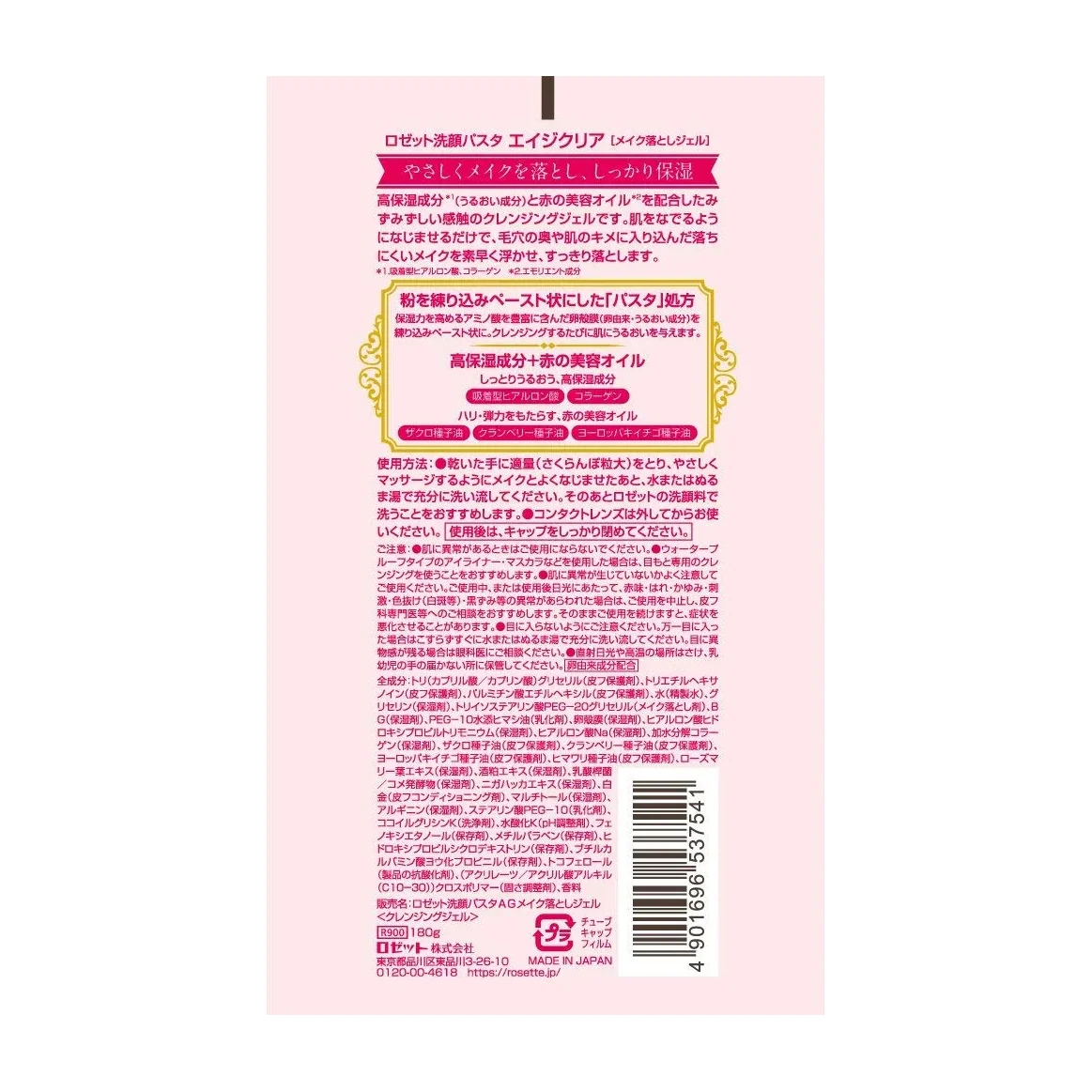
There's an honest moment when you read the ingredient list on a fourteen-dollar Japanese drugstore aging-care cleanser and realize the formulator put more thought into it than into many fifty-dollar luxury alternatives. Rosette's Face Wash Pasta Aging Clear is one of those moments. The variant layers ingredient choices that you'd more typically find on a premium aging-care cleanser at a Tokyo department store counter — eggshell membrane, three hyaluronic acid forms, hydrolyzed collagen, fermented sake and rice extracts, four berry and fruit seed oils — onto the brand's familiar soap-based foam architecture at the affordable drugstore tier.
The formulation tells a story about what aging-care cleansing actually needs. The standard Rosette Face Wash Pasta variants (Sea Mud Smooth, Acne Clear) lean on the brand's triple-clay absorbent system for visible matte finishing and pore-clearing. The Aging Clear takes a different path — instead of clay-based absorbents, it loads up the humectant and antioxidant layer to support skin that's lost some of its natural moisture-retention capacity. Talc and kaolin are still present further down the INCI, but they're not the formulation centerpiece the way they are in the other variants. The center of this variant is the humectant treatment layer.
Eggshell membrane is the standout unusual ingredient at this price tier. Eggshell membrane is the thin protein layer between the eggshell and the egg contents — naturally containing hyaluronic acid, collagen, glucosamine, and various proteoglycans. In oral supplement contexts it's been studied for joint health and connective tissue support; in topical applications it functions primarily as a humectant film-former with some emerging research suggesting skin-conditioning benefits. The inclusion at the drugstore tier isn't transformative — at rinse-off concentrations and contact times, the benefits are modest — but it's the kind of thoughtful ingredient choice that distinguishes this from generic drugstore aging-care formulations that rely on hyaluronic acid alone for the aging claim.
The hyaluronic acid story here is layered. Hydroxypropyltrimonium hyaluronate is a cationic (positively charged) form of HA with improved adhesion to the negatively-charged skin surface — it sticks where standard HA washes away. Sodium hyaluronate is the conventional form, providing surface hydration. Hydrolyzed collagen functions in a complementary humectant role rather than as a transformative collagen-supplementation ingredient (topical collagen molecules are too large to penetrate to the dermis where they would matter for collagen biology). Together, the three humectant forms create a more sustained hydration layer than any single ingredient delivers in a cleanser context.
The four-seed antioxidant oil layer is more interesting than it might initially appear. Punica granatum (pomegranate) seed oil contains punicic acid, a conjugated linolenic acid with documented antioxidant and anti-inflammatory properties. Vaccinium macrocarpon (cranberry) seed oil and Rubus idaeus (red raspberry) seed oil both carry tocopherol and tocotrienol vitamin E forms alongside their characteristic fatty acid profiles. Helianthus annuus (high-linoleic sunflower) seed oil provides the linoleic acid that's essential for skin barrier ceramide synthesis. The combined antioxidant exposure during cleansing isn't going to deliver transformative anti-aging effects in a rinse-off context, but the daily exposure adds up to a small but real treatment layer beyond what generic aging-care cleansers offer.
The sake lees and rice ferment filtrate pair speaks to the Japanese aging-care tradition specifically. These fermented Asian ingredients have decades of use in Japanese aging skincare — sake lees contains kojic acid (a tyrosinase inhibitor with documented brightening properties), amino acids, and various small molecules; rice ferment delivers similar amino acid and vitamin content. Western aging-care formulations are catching up to the fermented ingredient story, but Japanese formulators have been working with these ingredients for thirty-plus years. Rosette's century-long brand heritage shows up here — the inclusion isn't trend-following, it's brand consistency with the broader Japanese skincare lineage.
The small platinum inclusion is the kind of unusual touch that signals Japanese skincare formulation tradition. Trace amounts of platinum (the metal) appear in some Japanese skincare products for purported antioxidant properties — the evidence base is preliminary but has its supporters. At the concentrations used in cosmetic formulations, the contribution to skin biology is minimal, but the inclusion reflects an authentic Japanese formulation tradition that distinguishes Rosette from Western drugstore alternatives.
In practice, the cleansing experience differs meaningfully from the standard Rosette variants. The foam is slightly softer and more cushioned due to the higher humectant load. The post-rinse skin feel is distinctly softer with a small but real humectant residue from the multi-form hyaluronic acid and the seed oil layer. The fragrance is subtle but present with a slightly warmer undertone than the Sea Mud Smooth — designed to signal the mature-skin positioning. Users transitioning from harsher aging-care cleansers will notice the gentleness immediately.
The limitations are real but smaller than for other Rosette variants. The saponified-soap base is still alkaline; the immediate toner-step follow-up that the line generally requires is less strictly necessary here due to the humectant cushioning but still beneficial. The fragrance excludes fragrance-sensitive users. The fatty acid content disqualifies fungal-acne sufferers. And the anti-aging claim — which is honest at the formulation level — depends on combining this cleanser with leave-on aging-care actives for meaningful results; the cleanser alone won't deliver transformative anti-aging.
The value calculation is excellent. At fourteen dollars for 120g — a one-to-two-dollar premium over the standard Rosette variants for the meaningfully deeper formulation — this is one of the best-value aging-care drugstore cleansers globally. Compared to Western drugstore aging-care cleansers (Olay Total Effects, RoC, Neutrogena Healthy Skin) at similar pricing with generally less deliberate formulation, Rosette offers superior ingredient depth. Compared to mid-tier Asian-beauty aging-care cleansers, Rosette is competitive on quality at often lower pricing. Compared to luxury aging-care cleansers (SUQQU, Tatcha), Rosette delivers most of the formulation depth at one-quarter to one-sixth the cost.
The demographic this product specifically serves is mature-skin users on a sensible budget, K-beauty and J-beauty enthusiasts building aging-care routines without paying luxury prices, users transitioning from harsher aging-care cleansers, and anyone running an active-heavy aging routine who wants a humectant-supportive cleansing step that doesn't add to the irritation load. For this user, the Aging Clear variant is one of the genuinely excellent drugstore aging-care cleansers available globally.
The honest summary: a thoughtfully formulated, exceptionally well-priced Japanese drugstore aging-care cleanser that delivers meaningful ingredient depth at a fraction of luxury-tier cost. Doesn't replace leave-on aging-care actives but supports the routine that does deliver real results. The Rosette brand heritage and the depth of the formulation justify the small premium over the standard line variants. Worth a place on the bathroom shelf for the right user.