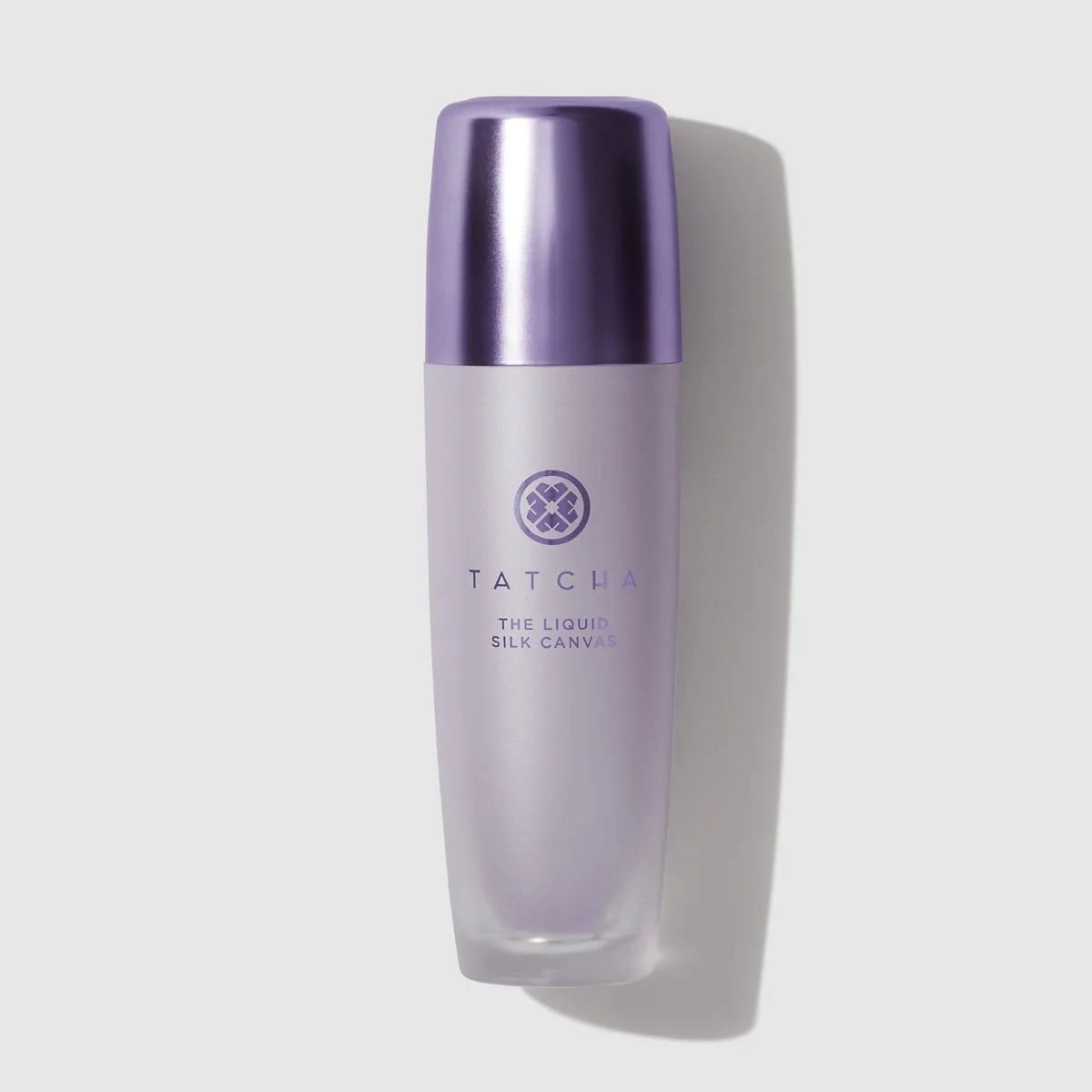
There is a quiet revolution happening in the first ingredient of this primer. Where every other primer on the market lists water or dimethicone as its base, the Tatcha Liquid Silk Canvas lists Saccharomyces rice ferment filtrate. This means that the liquid carrying all the smoothing silicones and silk proteins to your face is not inert water but an active, nutrient-rich ferment — the same Hadasei-3 complex that Tatcha charges $110 for in pure form as The Essence. Whether this makes a meaningful difference to your skin during a day of wearing primer is debatable, but as a formulation philosophy, it is undeniably more thoughtful than the industry standard.
The Liquid Silk Canvas is the lighter sibling of Tatcha's cult-favorite Silk Canvas balm, which launched in 2018 and became one of those products people talked about in slightly breathless tones on beauty forums. The original balm was thick, almost putty-like, and created an almost porcelain-smooth finish that some users loved and others found too heavy for daily wear. The liquid version, launched in 2020, translates that technology into a serum-like fluid that feels closer to a lightweight moisturizer than a traditional primer.
The triple-silk technology is the headline act. Three forms of silk protein — at different molecular weights and in different physical states — work different levels of the smoothing problem simultaneously. Silk powder provides immediate optical blurring, scattering light across pore openings and fine lines to make them less visible. Sericin, the protein that makes silk cocoons water-resistant, forms a thin moisture-retaining film that keeps skin hydrated under layers of makeup that would otherwise be drying. Hydrolyzed silk, broken into smaller peptide fragments, absorbs into the surface layers to condition from within.
The silicone system is sophisticated. Dimethicone provides the primary slip and fill, but it is reinforced by polymethylsilsesquioxane (spherical silicone particles for soft-focus blurring), dimethicone/vinyl dimethicone crosspolymer (an elastomer that gives the smooth, bouncy feel), and trimethylsiloxysilicate (for long-wearing resistance to sebum and sweat). This isn't a one-silicone primer — it is a carefully engineered matrix designed to create different types of smoothing at different scales.
Caesalpinia spinosa fruit extract from the tara tree adds a botanical film-forming layer that complements the silicone matrix. This natural polymer provides the flexible grip that helps the primer adhere to skin and anchor makeup, without the tight, mask-like feeling that synthetic film formers can create. Kappaphycus alvarezii extract, a red algae, contributes additional film-forming and hydrating properties.
In practice, the primer performs exactly as advertised. A pea-sized pump dispenses a milky liquid that spreads easily and sets within seconds to a velvety, semi-matte finish. Pores visually diminish. Texture smooths. Foundation applied over it glides on more evenly and lasts noticeably longer — we are talking an extra three to four hours of wear without touch-up compared to foundation applied to moisturized-only skin. The finish is natural enough that the primer can be worn alone on minimal-makeup days for a refined, polished look.
The drawbacks are familiar ones for Tatcha products in this tier. Fragrance — parfum, citral, limonene, linalool — is present and accounted for, along with isopropyl alcohol. For a product worn on the face for 10-14 hours daily, this fragrance load is a meaningful concern for anyone with sensitivity. The primer is oil-free but not silicone-free, which matters for users who avoid silicones by preference or because their skin reacts poorly to them. And at $55 for 30g, this is a premium-priced primer in a category where excellent drugstore options exist.
The silicone-heavy formula also introduces compatibility constraints. Water-based foundations may pill or separate when applied over the dimethicone matrix. The primer works best with silicone-based foundations or powder products — a limitation worth testing before committing to the full-size bottle.
The value proposition comes down to what you want from a primer. If you see it as a functional cosmetic step — something to smooth skin and extend makeup wear — then $55 is a steep ask when effective silicone primers exist at every price point. If you see it as a hybrid skincare-and-cosmetic step, then the ferment base and triple-silk conditioning add value that cheaper alternatives cannot match. The primer will not treat your pores, clear your skin, or replace targeted skincare. But it will make your skin look better for the twelve hours you are wearing it, and the Hadasei-3 base means it is at least trying to be kind to your skin while it does so.
The Liquid Silk Canvas sits in a specific niche: it is for the person who already has their skincare routine dialed in and wants the primer step to complement rather than contradict that effort. It is thoughtfully formulated, beautifully textured, and genuinely effective at its primary job. The fragrance is the single most frustrating inclusion in an otherwise intelligent formula — remove it, and this would be one of the best primers on the market. As it stands, it is one of the best primers for people whose skin can tolerate it.