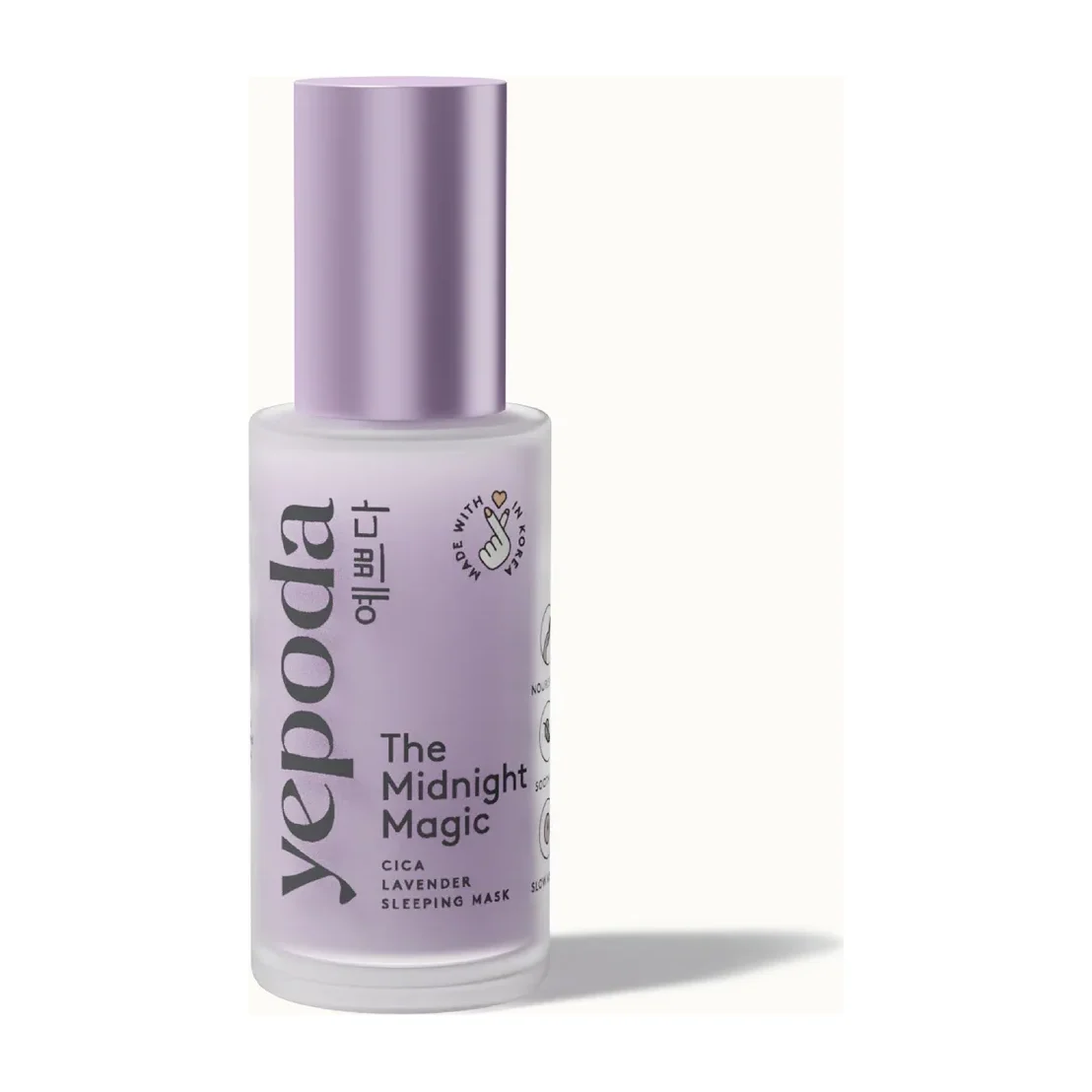
For many people outside Korea, the sleeping mask is a puzzling category. A night cream is already the last step of the evening, so what does a mask designed to be slept in add? When Yepoda, the Berlin brand founded in 2020 with Korean-made formulas, launched The Midnight Magic as part of its first range in November 2021, that was the question it had to answer for European customers. Nearly five years and about 2,800 reviews later on the brand's German site, its answer has clearly found an audience.
The honest answer is that a sleeping mask is usually a richer, more occlusive night cream. Its job is to sit on the skin overnight and slow water loss more than a lighter cream would, so that dry or stressed skin has longer to recover. The Midnight Magic fits that definition well. Shea butter is third on the list, a generous amount for a facial product, and it is joined by cetearyl alcohol, jojoba oil, grapeseed oil and rice bran wax. Together they form a cushioning layer that partly absorbs and partly stays on the skin through the night.
What makes the formula more than a heavy cream is its approach to centella asiatica, the plant known as cica. It appears twice. First, centella leaf water replaces much of the plain water as the second ingredient, giving a mildly soothing base. Then, further down, come purified centella compounds: madecassoside, asiaticoside, asiatic acid and madecassic acid. These triterpenes are the active components associated with centella's calming and wound-healing reputation, and including them as isolated ingredients gives the cica claim more substance than leaf water alone would.
The supporting ingredients are well chosen. Ceramide NP, a skin-identical lipid, helps reinforce the barrier. Panthenol and allantoin are well-established soothing ingredients that support recovery from irritation. Glycerin, sodium hyaluronate and a xylitol-based humectant complex draw water into the skin beneath the occlusive layer. Green tea extract, dipotassium glycyrrhizate and vitamin E add antioxidant and calming support, and the familiar Yepoda botanical blend of neem, turmeric, holy basil and others appears in small amounts.
Then comes the lavender. Yepoda includes lavender oil to give the mask a relaxing bedtime scent, and the label declares linalool, limonene and geraniol, three fragrance allergens. This is the formula's main contradiction. A product built around calming centella and barrier repair is likely to appeal to people whose skin is sensitive, irritated or compromised, which is exactly the group most likely to react to fragrance. In a leave-on product worn for eight hours, fragrance exposure is not trivial. Many people will enjoy the scent and have no problems, but those with eczema, rosacea or a fragrance allergy should be cautious.
In use, the mask is pleasant. One or two pumps cover the face. The texture is rich but spreads easily and partially sinks in, leaving a soft film rather than a greasy slick. By morning, dry or dehydrated skin feels noticeably softer and more supple, and reviewers particularly praise it in cold weather and when using retinoids, which tend to dry the skin. It works well as the final step over a retinoid, buffering irritation.
There are a few ways to get more from it. Applying it over a damp hydrating serum rather than dry skin traps more water under the shea layer. On very dry nights, a slightly thicker coat on the cheeks and around the mouth, where skin tends to flake first, helps more than spreading the same amount evenly. And for people who find the full face too rich, using it as a spot treatment for dry patches, around the nose after a cold or on wind-chapped cheeks, is a perfectly good way to use a bottle.
Timing matters too. Applying it at least twenty minutes before lying down lets more of it absorb and leaves less on the pillowcase.
The pump bottle deserves credit. Many sleeping masks come in jars, which expose the contents to air and fingers every night. Yepoda's glass pump keeps the formula cleaner and more stable, and it is refillable.
Oily and acne-prone skin should approach it carefully. The richness that makes it so comforting for dry skin can feel heavy and may contribute to congestion in people prone to breakouts. Using it two or three nights a week, or only on dry areas, is a sensible compromise. The combination of plant oils and fatty alcohols also makes it unsuitable for fungal acne.
At $28 for 50 ml on Yepoda's US store, with refills at $25 and a mini at $16, The Midnight Magic is fairly priced for a well-formulated overnight mask. A bottle lasts around three months of nightly use. The formula is more thoughtful than many sleeping masks at this price, particularly with its isolated centella compounds and ceramide.
So does it do anything a night cream does not? Not fundamentally. It is a rich, barrier-supporting night cream with an excellent cica profile and a glass pump. For dry, normal and winter-stressed skin, especially alongside retinoids, it does that job very well. For sensitive skin, the lavender undermines the calming concept, and a fragrance-free option would be the better choice.