Lip Care: The Barrier That Physically Can't Hold Water
Lip skin loses moisture about three times faster than your cheek and has no oil gland to replace it — which explains most of the reapplication loop, and none of the part your balm is causing.
Read the preview
Why do chapped lips keep needing more balm? Lip skin loses about three times the water your cheek does, with no oil glands to top it up. A humectant-only balm can leave lips drier, and menthol, camphor and flavour oils often make things worse. Most lip skin cancers start on the lower lip — yet balm showed no protective effect. The Dermington Gazette seals the deal.
The tissue was never finished
Most skin on your face is covered by a stratum corneum of fully keratinised, flattened, dead corneocytes glued together with a lipid mortar — the arrangement that makes skin waterproof. Lip vermilion is not that. It is the only place on the face where oral mucosa is permanently exposed to open air, and it never quite completes the transition.
When researchers measured 303 healthy women's lips against their own cheeks in winter, transepidermal water loss was almost three times as high on the lip, and high-frequency conductance — a proxy for how much water the surface is actually holding — came out at roughly one third of the cheek value. Under the microscope the reason was visible: the surface cells were larger and parakeratotic, meaning they retained nuclear remnants instead of finishing keratinisation. The authors put it plainly. The incomplete corneocyte formation is responsible for the poor barrier function and water-holding capacity.
Stack a second deficit on top. Vermilion has no sebaceous glands and no sweat glands, so it produces no sebum to slow evaporation and no natural moisturising factor delivered by sweat. Every other dry patch on your body has some endogenous resupply. Your lips have none.
That is the whole physiology of the problem, and it is worth sitting with, because it reframes the reapplication loop entirely. A balm that lasts four hours on a forearm is being asked to work on tissue leaking water three times faster with nothing behind it. Reaching for it again is not a failure of discipline. It is arithmetic.
Why the humectant-only balm makes it worse
There are two ways to raise water content in skin, and only one of them works reliably here.
Humectants — glycerin, hyaluronic acid, sugars, urea — bind water and hold it in the outer layer. That works beautifully where there is a competent barrier above to stop the water leaving again. On a surface already losing water three times faster than average, a humectant with nothing occlusive over it is drawing moisture up into a layer that immediately vents it. The lip feels plump for ten minutes and tighter afterwards, so you reapply, and the cycle acquires a name it does not deserve.
Occlusives are the honest workhorse for this site. Petrolatum reduces water loss dramatically as a physical film, and it is inert, non-sensitising and cheap, which is why it remains the reference occlusive that everything else is measured against. A plain petrolatum-and-panthenol ointment like Aquaphor Lip Repair is not an unimaginative choice; it is the choice that matches the anatomy. Overnight, when there is no eating, drinking or talking to abrade the film, is when occlusion earns the most — a thick ointment such as O'Keeffe's Lip Repair Night Treatment or a ceramide-loaded sleeping balm like COSRX Lip Sleep Balancium Ceramide Lip Butter Sleeping Mask is doing real work for eight uninterrupted hours.
On the much-repeated claim that lip balm is addictive: there is no good evidence for a physiological dependency, and the mechanism people describe — occlusives switching off your lips' own oil production — cannot happen, because there is no oil production there to switch off. What is real is a loop with two ordinary causes. One is the humectant-without-occlusive problem above. The other is that the balm itself is irritating you, which is where this gets more interesting.
If your lips are also flaking, worth resisting the urge to sand them. An acid lip treatment such as The Ordinary PHA 5% Exfoliating Lip Serum is formulated gently, and PHAs are the mildest acid class — but on a barrier this compromised, exfoliation is a step to earn after the surface is intact, not a way to get there. The same sequencing logic that governs a barrier repair routine applies to lips, just with less margin.
The ingredients that chap you back
Open a drugstore lip balm and there is a decent chance of finding menthol, camphor, phenol or a flavour oil near the top of the list. These deliver a cooling, tingling sensation that reads as 'working'. What they are actually doing is stimulating sensory nerve endings and, with repeated use on an already-compromised surface, driving irritant contact cheilitis — a low-grade inflammation that keeps the tissue from healing while feeling, moment to moment, like relief.
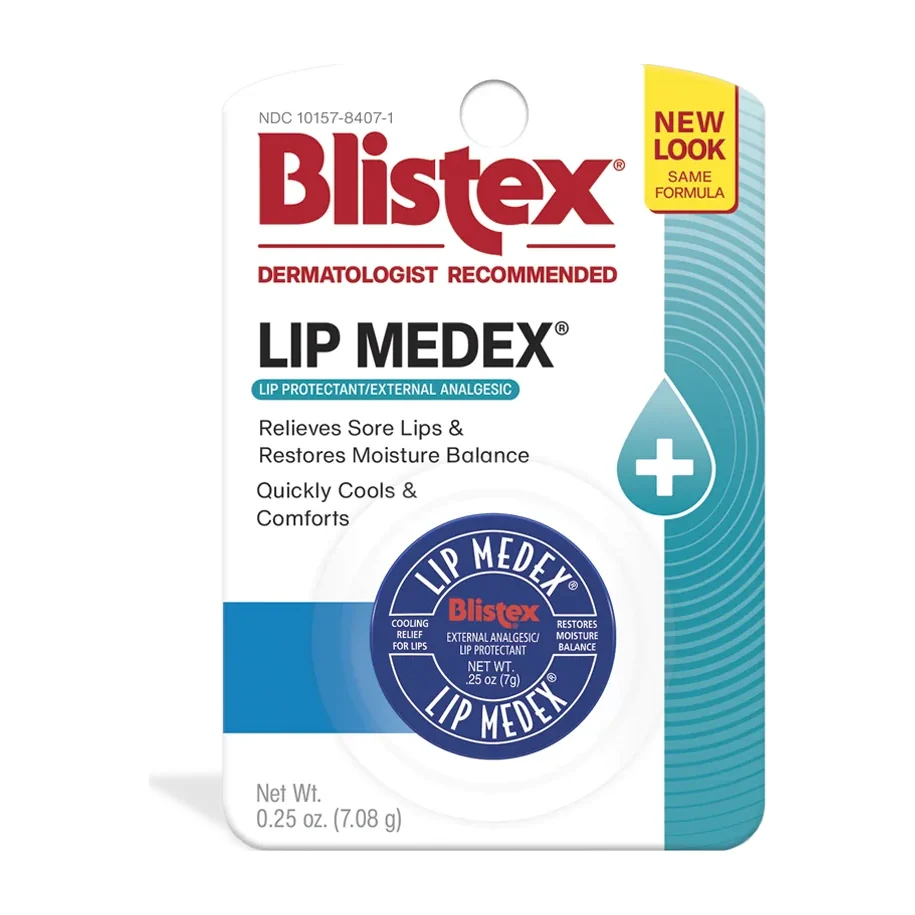
This is a real trade-off rather than a scandal. A classic medicated balm such as Carmex Classic Medicated Lip Balm pairs a genuinely effective petrolatum-and-lanolin occlusive base with camphor, menthol and salicylic acid; Blistex Lip Medex runs the same play. For occasional use on a cold sore or a wind-burnt weekend, plenty of people do fine. As a daily balm applied fifteen times a day on lips that will not heal, the counter-irritants are working against the base.
The allergic version is less common and more consequential. Allergic contact cheilitis has a well-characterised suspect list from patch-test series: lanolin, propolis, propyl gallate, fragrance mix, Balsam of Peru and flavourings, with peppermint oil documented as the culprit in a case series where the same balm also contained several other plausible sensitisers. If both lips are affected equally and symmetrically, an ingredient is a stronger hypothesis than weather.
The pattern to recognise is a chapping that is getting worse under treatment rather than better, especially if it extends slightly beyond the vermilion border onto the skin. The useful move is not a stronger balm — it is subtraction. Strip back to plain petrolatum for two weeks and see what happens. Run the suspect product's list through the Ingredient Decoder tool to find which of the usual sensitisers it contains, and if a pattern emerges across several products, the Patch Test tool walks through testing properly before you buy the next one.
There is a systemic dimension too. In 37 patients with chronic cheilitis measured against matched controls, lip water loss averaged 66.8 g/m²·h and was significantly higher than controls, while forearm readings showed no difference between groups — the barrier failure was specific to the lip. The strongest associations were allergic dermatologic disease (OR 4.5) and anaemia (OR 3.3), and 95% of the anaemic patients had iron deficiency. Persistent cheilitis that resists everything is sometimes not a lip problem.
The one site nobody protects
Ask someone applying sunscreen where they stopped and the answer is almost always the same: at the vermilion border. The lip gets the same UV as the nose and cheek, has less melanin protection, sits on a forward-facing plane, and is one of very few facial sites where the sun exposure is essentially never interrupted by clothing or hair.
The consequence is specific. Lip cancer is overwhelmingly a lower-lip disease — the lower lip is the affected site in around 80% of cases — and up to 95% of lip squamous cell carcinomas arise from pre-existing actinic cheilitis, the persistent scaly, blurred-border change that gets dismissed as chronic chapping for years. Reported malignant transformation rates for actinic cheilitis run from 10% to 30%. In a meta-analysis of risk factors, low skin phototype carried an odds ratio of 3.30, age over 50 an OR of 3.01, and high cumulative sun exposure an OR of 2.13.
And here is the finding that should be handled honestly rather than buried: in that same analysis, sunscreen use showed no relevant impact on actinic cheilitis risk (OR 1.03; 95% CI 0.63–1.69), and lip balm or lipstick use did not reduce risk either. That is not evidence that lip SPF fails. These are observational studies in which the people reaching for lip protection are disproportionately the people who already burn, already work outdoors, and already have sun-damaged lips — and lip products are eaten, drunk and licked off faster than any sunscreen on the body, so reported 'use' and actual protective coverage are very different variables. The reasonable conclusion is that lip SPF has to be reapplied far more aggressively than people do, not that it should be abandoned.
Which makes the practical question one of formulation and habit. A mineral, fragrance-free stick such as Vanicream Lip Protectant SPF 30 leans on zinc oxide and suits people who react to everything else. Aquaphor Lip Repair + Protect SPF 30 pairs a chemical filter set with the same petrolatum base as the plain version, and Ultra Violette Sheen Screen Hydrating Lip Balm SPF 50 pushes the filter load higher in a texture people will actually reapply. The Sun Safety tool covers how often reapplication genuinely needs to happen; on lips, treat the answer as 'more often than you think, and always after eating'.
When it isn't chapping at all
Cracking that stays strictly at the corners of the mouth and never involves the middle of the lip is a different diagnosis wearing the same symptoms, and no balm will resolve it.
Angular cheilitis is inflammation at the labial commissures, and it is usually infective rather than dry: Candida species are the most common organisms, frequently with Staphylococcus aureus or beta-haemolytic streptococci on top. The setup is mechanical — saliva pools in a deepened fold and stays there, macerating tissue and creating an environment yeast likes. Anything that deepens that fold makes it likelier, which is why it clusters in older adults, denture wearers, people with recent dental changes and habitual lip-lickers.
About one in five cases carries a nutritional signal — iron, riboflavin, folate, cobalamin or zinc deficiency — which is why recurrent angular cheilitis with no obvious mechanical cause is worth a blood test rather than a fourth tube of balm. Treatment is typically empirical and antimicrobial rather than emollient, often covering both yeast and bacteria at once, with a barrier ointment used to keep saliva off the healing tissue rather than to hydrate it.
The distinction to carry away is simple. Diffuse dryness across the whole vermilion, worse in cold and wind: chapping, and the sections above apply. Fissures, redness and crusting confined to the two corners, persisting for weeks: not chapping, and the balm aisle is the wrong aisle.
What a lip routine actually looks like
Almost nothing about effective lip care is elaborate, and the reason is that there is very little to work with — no glands to stimulate, no meaningful reservoir to build, no penetration depth to exploit. What is available is occlusion, protection, and the removal of things that irritate.
So: an occlusive as the default daytime object, reapplied without guilt, because the reapplication frequency is set by the tissue and not by a defect in the product. A genuinely thick one at night, when the film survives longest and repair is happening anyway — a ceramide or shea-heavy balm such as Cocokind Ceramide Lip Blur Balm or Paula's Choice Lip & Body Treatment Balm earns its place in that slot. An SPF version whenever you are outdoors for any length of time, reapplied after anything that touches your mouth. And a hard stop on anything that tingles if your lips are not healing.
If you have run that for a month and the chapping persists, that is the point at which it stops being a product question. Persistent cheilitis with a normal routine can point at contact allergy, iron deficiency, or actinic change — and if there is a rough, persistently scaly patch on the lower lip that never quite resolves, that is a lesion to have looked at rather than moisturised. That is not a scare tactic; it is the reason lip skin deserves more attention than the impulse-buy bin at the till suggests. Our assessment of lip care for dryness sorts the shelf on the criteria that actually matter here — occlusive strength, sensitiser load, and whether the SPF is real.
Each shelf lists every product in the catalogue built on the ingredient, graded live against your profile — the shelf stays current when a single pick would not.
- 206 products on the shelf Petrolatum (Petroleum Jelly) The reference occlusive — inert, non-sensitising, and the right tool for glandless skin.
- 2,407 products on the shelf Glycerin A humectant that needs something occlusive above it to work on lips.
- 3,404 products on the shelf Hyaluronic Acid Same humectant caveat, more acutely on a site with three times the water loss.
- 1,814 products on the shelf Ceramides The lipid class most useful in the overnight repair slot.
- 39 products on the shelf Lanolin (Wool Wax) Effective occlusive and a documented allergic contact cheilitis allergen — both are true.
- 124 products on the shelf Menthol Counter-irritant that reads as relief while sustaining low-grade inflammation.
- 18 products on the shelf Camphor The other half of the tingle in classic medicated balms.
- 544 products on the shelf Zinc Oxide The mineral filter in fragrance-free lip SPF for reactive users.
- 1,614 products on the shelf Panthenol (Pro-Vitamin B5)
- 863 products on the shelf Salicylic Acid (BHA)
Products named in this piece
Independently reviewed, with a verdict per concern — the real products behind this piece.



References
- Functional properties of the surface of the vermilion border of the lips are distinct from those of the facial skin — British Journal of Dermatology, 2004
- Analysis of clinical presentations, lip transepidermal water loss and associated dermatological conditions in patients with chronic cheilitis — Scientific Reports, 2022
- Allergic Contact Cheilitis From a Variety of Lip Balm Ingredients — Journal of Cutaneous Medicine and Surgery, 2018
- Risk factors for actinic cheilitis: A meta-analysis — Journal of Dental Research, Dental Clinics, Dental Prospects, 2021
- Actinic Cheilitis - From Risk Factors to Therapy — Frontiers in Medicine, 2022
- Treatment of angular cheilitis: A narrative review and authors' clinical experience — Oral Diseases, 2020
Every cited link is verified to resolve to the paper named. Where a source could not be independently confirmed, it is listed without a link rather than pointing you somewhere wrong.
Frequently asked
Is lip balm actually addictive, or is that a myth?
There is no evidence of physiological dependency, and the usual explanation — that balm switches off your lips' own oil production — is impossible, because lip vermilion has no sebaceous glands to switch off. The real loop is either a humectant-heavy balm evaporating off a leaky surface, or an ingredient in the balm irritating you.
Why do my lips feel drier after using a hyaluronic acid lip product?
Humectants pull water into the outer layer and rely on a competent barrier above to keep it there. Lip vermilion loses water about three times faster than cheek skin and has no sebum film, so a humectant applied alone often ends up net-negative. Layer something occlusive over it, or choose an occlusive-led balm instead.
Should I avoid balms with menthol and camphor completely?
Not necessarily, but not as a daily driver on lips that aren't healing. The cooling sensation is sensory nerve stimulation rather than repair, and repeated application on an already-inflamed surface sustains irritant cheilitis. Occasional use on wind-burnt lips is a different situation from fifteen applications a day for a month.
Does lip SPF actually prevent anything, given the research?
A meta-analysis found no measurable reduction in actinic cheilitis risk from sunscreen, lip balm or lipstick use — but those are observational data, where the heaviest users are the most sun-exposed people, and lip products are eaten and licked off far faster than body sunscreen. The workable reading is that lip SPF needs far more frequent reapplication, not that it is pointless.
How do I tell chapping from something that needs a doctor?
Diffuse dryness across the whole vermilion that improves with occlusion is chapping. Cracking confined to the two corners is likely angular cheilitis, usually infective. A rough, scaly patch on the lower lip that persists for months with a blurred border is the presentation of actinic cheilitis and should be examined rather than moisturised.
Why does the cracking at the corners of my mouth never respond to balm?
Because it usually isn't dryness. Angular cheilitis is typically a Candida infection, often with staphylococci or streptococci, driven by saliva pooling in a deepened fold. Roughly one in five cases also signals an iron, riboflavin, folate, B12 or zinc deficiency, so recurrent episodes deserve investigation rather than another emollient.