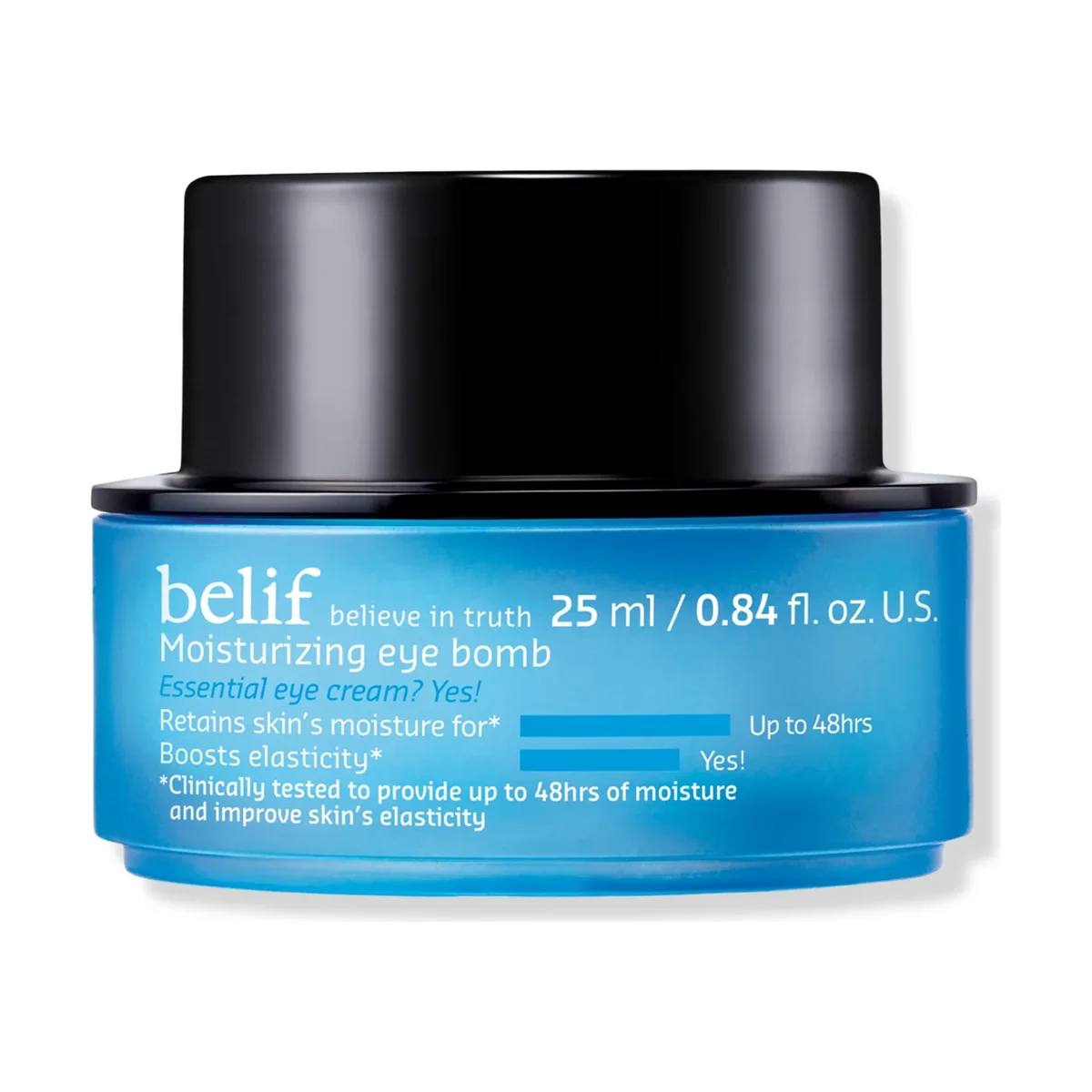
Most hydration-focused eye creams are minimalist by design. They lean on glycerin, hyaluronic acid, an oil or two, and call it a day — the goal is a comfortable cushioned hydration experience, and the formulation reflects that goal. There's nothing wrong with this approach. It works. But it leaves a real gap for users who want hydration plus some treatment work in a single product, especially around the eye area where the skin is too delicate for the retinol routines that handle fine lines on the rest of the face. belif's reformulated Moisturizing Eye Bomb sits in that gap. The original 2018 product was a hydration-first eye cream. The reformulated version keeps the hydration backbone and adds palmitoyl tripeptide-1 and palmitoyl tetrapeptide-7 — the Matrixyl peptide pair — for firming and fine-line work. It's a hybrid product now, and the hybrid identity is what makes it interesting.
The glycerin-forward formulating philosophy is the most distinctive structural choice. Glycerin sits second on the INCI list, immediately after water, which is unusually high for an eye cream. Most eye creams put their oils and emulsifiers ahead of the humectant, treating glycerin as a supporting actor. belif treats it as the lead. The result is a cream that delivers a continuous humectant load to the periorbital skin, drawing water into the upper layers and holding it there even after the cream has fully absorbed. This is the structural reason the entire Aqua Bomb line earned its 'hydration bomb' nickname — and it's the foundation that the more dramatic-sounding actives sit on top of.
Around the glycerin sits a thoughtful supporting cast. Ceramide NP reinforces the barrier of the delicate under-eye area, which is critical because eye skin has fewer sebaceous glands than the rest of the face and tends to lose water faster. Squalane provides skin-identical lipid emollience without occlusion. Shea butter adds a richer emollient layer. Sodium hyaluronate further down the list adds another humectant. Panthenol contributes hydration and soothing. The whole base is engineered to support the eye area's specific needs rather than being a face cream in a smaller jar.
The peptide work is what changes the product's character. Palmitoyl tripeptide-1 and palmitoyl tetrapeptide-7 are part of the Matrixyl family, which has accumulated meaningful clinical evidence over the past decade for fine-line and elasticity improvement. The published work isn't as deep as the evidence base for retinoids, but it's real, and the side-effect profile is dramatically gentler — peptides don't cause the irritation, dryness, or sun sensitivity that make retinol challenging for eye-area use. For users who want some anti-aging work in their eye routine but can't tolerate retinol around their eyes, this kind of peptide combination is a meaningful middle path.
And then there's the brand identity layer. belif was launched in 2010 by LG Household & Health Care as a K-beauty brand built on the apothecary traditions of Napiers Herbalists, a Scottish herbal pharmacy founded in 1860. The Six-Herb Complex — wood betony, plantain, yarrow, mallow, nettle, and calendula — runs through the entire product line and gives belif a coherent identity that's rare in K-beauty. Centella asiatica, oat kernel extract, and willow bark extract round out the soothing botanical roster. None of these are doing the headline work in this formulation, but they create a cohesive supporting context that makes the product feel like a real K-beauty cream rather than a decontextualized peptide carrier.
Texture-wise, the experience is satisfying. The cream is lightweight and cushioned, melts into the eye area in about thirty seconds, and leaves a satin finish that lays cleanly under concealer or eye makeup. The herbal-floral fragrance is the dominant immediate impression — a soft, recognizably belif scent that fans of the line love and that fragrance-sensitive users will need to consider carefully. The compact frosted jar is functional but slightly old-school for an eye cream; tube packaging would be more hygienic, since dipping a finger into a jar twice daily is a known contamination route.
A few caveats are real. The product contains added fragrance plus limonene and linalool — common contact allergens that put it out of reach for users with eczema, rosacea, or known fragrance sensitivities around the eye area. The price ($48 for 25 ml) is mid-range for K-beauty eye creams but not a bargain, and there's no larger size for committed buyers. The product is not designed to address dark circles or fluid puffiness directly — there's no caffeine, no vitamin K, no depuffing botanicals — so users with those specific concerns should look elsewhere. And the milk-and-honey-free, mostly plant-based formulation is not certified vegan, so vegan readers should check the latest belif vegan documentation.
For someone asking whether to buy this, we'd say yes if you have hydration-focused eye area concerns plus mild fine-line work to address, you want a K-beauty cream with real heritage and identity, and you don't have known fragrance sensitivities. Skip it if your eye area is reactive to fragrance, if dark circles or puffiness are your main concern, or if you'd rather have a cleaner peptide eye cream without the added scent.