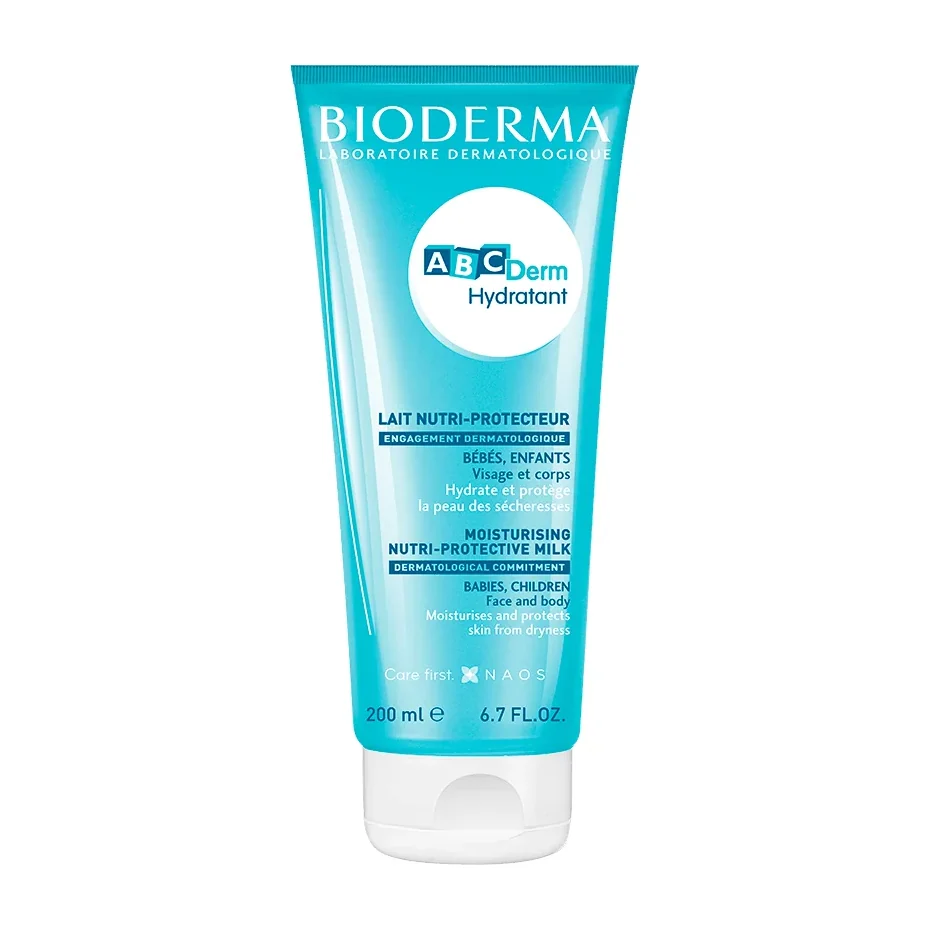
Somewhere near the bottom of this ingredient list, past the emulsifiers and the gums, sit ceramide NP, ceramide AP, phytosphingosine, cholesterol and ceramide EOP — the lipid set that adult moisturisers charge forty dollars for and print on the front of the box. Here they are in a baby milk sold by the half-litre for thirty. That is the first thing to know about ABCDerm Moisturizing Milk, and it deserves the emphasis, because the category it sits in is mostly glycerin, oil and good intentions, and this is not that. Infant skin spends its first year finishing the construction of its own barrier, and the lipids it is laying down are exactly these — so a lotion that supplies the matrix rather than merely oiling the surface is, on paper, the right idea in the right place. Bioderma calls the complex Lipigenium and borrowed it from its eczema range. It is a genuinely good piece of formulation.
The rest of the base is conventional and well chosen. Glycerin is second on the list, mineral oil third, then sunflower and canola oils — an occlusive-plus-humectant pairing with a dose of linoleic acid, the fatty acid infant skin uses to build the very ceramides the formula also supplies. What makes it all feel like a milk rather than a cream is the emulsifier system: sucrose stearate and sodium lauroyl lactylate organise the emulsion into liquid-crystal layers that resemble the skin's own bilayers, which is how the ceramides travel to the surface intact and why the lotion sinks in within a minute with no film, no tack and no damp sleepsuit. Anyone who has tried to dress a wriggling baby in a greasy lotion will understand that this is not a small virtue.
In use it behaves exactly as a good daily lotion for normal infant skin should. A generous squeeze after the bath covers a baby head to toe, spread with almost no rubbing, and are absorbed before the nappy is on. Dry winter cheeks settle within a few days; shins and forearms that flake in central heating stop flaking within a week. Bioderma's eight-hour hydration figure is an in-house corneometer reading, but on normal skin the milk does keep things comfortable from the evening bath to the next morning's wipe-down, which is the practical version of the same claim. The 200 ml tube lasts five or six weeks of once-daily use and is the bag size; the 500 ml pump is roughly half the price per millilitre and the one to keep at home.
Now the ninth ingredient. Fragrance sits at position nine on this list, above the acrylate thickeners, above the tocopherol, above every ceramide and the cholesterol — a higher placement than in the range's cleansing water, and high enough that the powdery French-nursery scent lingers on the skin after application rather than vanishing. The tradition behind it is real: French baby care has smelled this way for generations, and the brand's paediatric tolerance testing and two decades of mass use have produced no signal of harm. But the consensus of paediatric dermatology in most of the world is fragrance-free emollients for infants as a default, on the simple logic that a scent brings no benefit to the skin and fragrance mix is the leading cosmetic contact allergen at every age, with leave-on products the most exposing format. On a lotion applied over the entire body of a baby twice a day, that logic is hard to argue with. It is doubly frustrating because everything else on this list is what a careful formulator would choose for an eczema-prone infant, and the one thing that disqualifies it for that baby is the one ingredient the lotion does not need.
So the recommendation splits along the line the ninth ingredient draws. For a healthy baby with normal or mildly dry skin and no atopic history, this is a quietly excellent everyday lotion — better lipids than nearly anything at the price, fast to absorb, practical to use, and a scent that many parents actively love. For a baby with eczema, inflamed cradle cap, or a parent or sibling with atopy, the same formula unscented would be close to ideal, and since it is not, an unscented ceramide emollient is the safer everyday choice, with this milk kept as a maintenance option once the skin is settled and the fragrance has been tolerated on a patch. Adults with dry, non-reactive skin, incidentally, can borrow the tube with a clear conscience; as a body milk it outclasses most adult lotions at the price.
The review record, scattered across US retailers in modest numbers and larger in Europe, says what the formula predicts: soft skin, fast absorption, a bottle that lasts, and — from a minority — surprise or unease at a scent on a dermatological baby product. Both reactions are reasonable. The lotion underneath is one of the better things in the nursery aisle; whether the scent on top is charming or disqualifying depends entirely on whose skin it is going on.