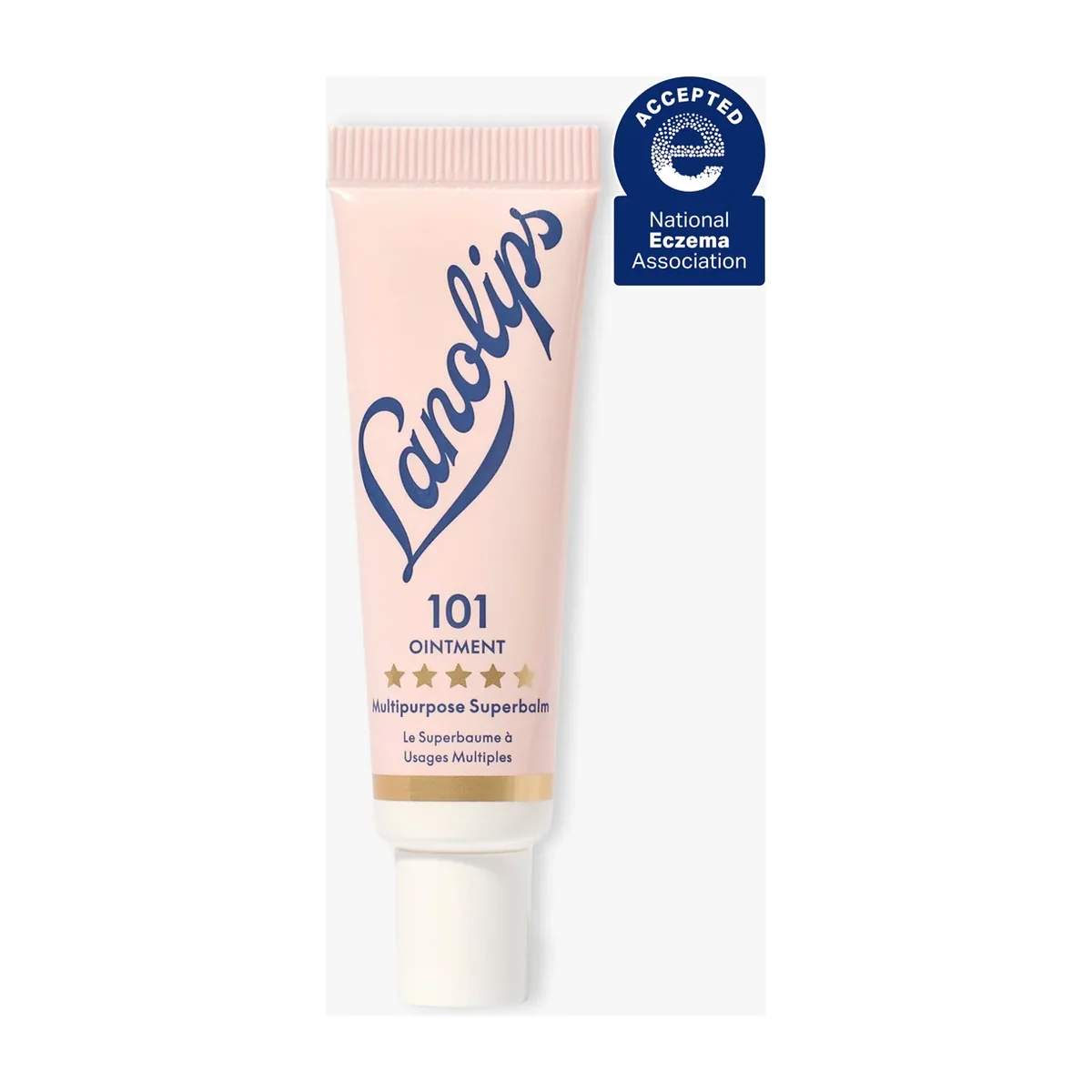
Lanolips 101 Ointment Multi-Balm Fruities, an ultra-pure Aussie lanolin multi-purpose lip and dry-skin balm in fruit flavours
Strong choice for Dryness
What makes this different

It's built around ultra-pure medical-grade Aussie lanolin — an occlusive that mimics skin's own lipids and outperforms petroleum and wax balms for chapped lips — in a fun fruit-flavoured, multi-use form, from the brand that made lanolin balm a cult object.

Lanolips

Lanolips 101 Ointment Multi-Balm Fruities Review

Cult Lanolin Lip Balm Lip Care balm indie Paraben free Cruelty free

Lanolips' 101 Ointment Multi-Balm Fruities is the cult Aussie lanolin balm in a fun, fruit-flavoured form — and the lanolin genuinely earns the devotion. As an occlusive that mimics skin's own lipids, it softens chapped lips and dry patches better than most petroleum or wax balms, lasts a long time, and multi-tasks all over the body. The only real caveats are the added flavour and lanolin's allergen potential.

Price $13.50 0.35 oz / 10g · more sizes
Shopper rating 4.6 ★★★★★ 5,000 reviews
On the market 2017 Made in Australia
Buy at Amazon ♥
Verdicts

How well it fits each concern

One verdict per concern. Open a row for the reasoning; the receipt has every source.

The scaleRecommendedGoodSupportingEarly evidenceNot for thisAvoidhow it works

Strong choicefor DrynessLanolin is an approved or monograph active for dryness; this balm carries it high in the ingredient list.Receipt§ 347.50 Labeling of skin protectant drug products (indications for § 347.10 actives, incl. lanolin) (opened Jul 27, 2026) · concentration not declared; studied range 1–30% · row checked Jul 27, 2026 · rule R2, same reading on 905 products · open the receipt

The case for it

  1. Lanolin is an approved or monograph active for this concern.
  2. It is present at an effective concentration, declared or high in the ingredient list.
  3. The formula carries no trigger this concern is sensitive to, with the cautions noted.

Limited evidenceStandard tolerabilityNo reviews read yet

Cautions: fragrance.

Same rule for everyone. “Strong choice” is the verdict on 1,475 of 45,446 concern verdicts across the catalog; rule R2 decided 905 of them. Unchanged since September 5, 2026, engine 5.2.0.

Brand or formulator? Disclose a concentration or correct a fact →

The full receipt: rule, row, sources, dates →All dryness products →

Avoidfor Compromised Skin BarrierThis formula carries fragrance — a known trigger for compromised skin barrier — so it is not a fit however good its actives are.Receiptread from the ingredient list: fragrance · rule R1, same reading on 1,307 products · open the receipt

The case for it

  1. Lanolin has no evidence row yet for this concern — it is in the research queue.
  2. The formula carries a known trigger for this concern, which decides the verdict before any efficacy question.

Not from a trial rowCarries a triggerNo reviews read yet

What would change this: Removing the trigger named above would let the actives be judged on their own.

Same rule for everyone. “Avoid” is the verdict on 1,912 of 45,446 concern verdicts across the catalog; rule R1 decided 1,307 of them. Unchanged since September 5, 2026, engine 5.2.0.

Brand or formulator? Disclose a concentration or correct a fact →

The full receipt: rule, row, sources, dates →All compromised skin barrier products →

Also listed for Winter Skin — the actives here (Lanolin, Botanical Extracts, Sunflower Oil, Vitamin E) are in our research queue for that concern; there is no verdict until their evidence rows are written. That is a gap in our table, not a mark against the product.

As a lip balmNot judged: what a lip balm is for — seals and protects, sun protection where it matters — cannot yet be measured from the ingredient list (only no sting-and-repeat ingredients, low allergen load can).

A verdict is Dermington’s assessment of how well a product’s ingredients fit a concern — never a claim about what the product treats. Evidence dots and collected reviews sit beside it and are never blended in. Rules 0.5.1 · evidence table ev-2026.10-r231 · engine 5.2.0 · how we decide · this product’s receipt

Reader poll · Town SquareQuestion 1 of up to 3

Have you used 101 Ointment Multi-Balm Fruities?

One tap counts. A couple of optional follow-ups come next.

No account neededOne answer each, change it any timeCounted only in anonymous totalsHow the Square counts →
Assessment

Pros & cons

What it does well 6

  • Ultra-pure lanolin outperforms petroleum balms for chapped lips
  • Mimics skin's own lipids to seal in moisture longer
  • Long-lasting; little reapplication needed
  • Genuinely multi-purpose for lips and dry patches
  • Short, natural ingredient list
  • Fun, light fruit flavours; cruelty-free

Where it falls short 4

  • Lanolin is an allergen for a minority of users
  • Tacky, thick texture isn't for everyone
  • Added flavour, so not fragrance-free
  • Pricier than a basic drugstore lip balm
Review

The full review

Most cult skincare products earn their following through novelty or a clever active. Lanolips earned its through the opposite: a relentless focus on one old-fashioned, unglamorous ingredient that happens to work exceptionally well. Founder Kirsten Carriol grew up on a sheep farm, and the whole brand — founded in 2008 — is a love letter to lanolin, the waxy substance shorn from wool that has quietly softened farmers' and shepherds' hands for centuries. The 101 Ointment is the hero, and the Fruities range simply adds playful natural flavours to the same formula. The question worth answering is why a balm this simple inspires such loyalty, and the answer is genuinely about the ingredient.

Lanolin is, by occlusive standards, special. Its molecular structure closely resembles the lipids in human skin, which means it doesn't just sit inertly on top like petroleum jelly — it integrates with and reinforces the skin's own barrier, sealing in moisture more effectively and holding it there longer. It's also amphiphilic: it can hold water as well as seal it in, which is why it softens rather than merely coats. For chapped, cracked, weather-beaten lips, that translates into faster, more durable relief than most wax- or petrolatum-based balms deliver. The ingredient's pedigree is medical as much as cosmetic — lanolin's clinical track record includes decades of use for cracked nipples in breastfeeding, about as demanding a chapped-skin application as exists. Lanolips uses an ultra-pure, medical-grade Australian lanolin to minimize the impurities that made cheaper, older lanolin grades irritating, and rounds the formula out with just a few supporting ingredients: lightweight safflower and sunflower oils to soften the naturally tacky texture and make it spreadable, vitamin E as an antioxidant, and the fruit extract and natural flavour that give each variant its taste.

That short, focused ingredient list is a feature, not a limitation. There's nothing here to irritate beyond the lanolin itself and the flavour, and the balm does exactly what it sets out to do. In use, it's a thick, slightly sticky balm squeezed from a simple tube that warms with body heat and glides into a glossy, protective layer; lips feel softened and sealed immediately. The tackiness — the most common complaint — is actually the mechanism: it's why a single application lasts so long without the constant reapplication that thinner balms demand. And it genuinely multi-tasks, soothing dry patches, cuticles, elbows, knuckles, even taming flyaway hairs. Used as the last step over a lip treatment, it's a textbook occlusive seal.

Its limitations are few. Lanolin is a known contact allergen for a minority of people; if you're allergic, you should avoid it, and the unsure should patch test, though most tolerate it very well. It's not vegan — lanolin comes from sheep's wool (humanely shorn, and the brand is cruelty-free, but animal-derived nonetheless), so vegans need a plant-based balm. The added fruit flavour means the Fruities aren't fragrance-free; the flavour-averse should choose the original unflavoured 101 Ointment. And the texture is unapologetically thick and tacky, which not everyone loves. On the reassurance side, it's pregnancy-safe — fitting, given lanolin's nursing-care history.

There's a practical economy to a multi-balm that's easy to overlook. Because one tube handles lips, cuticles, dry knuckles, elbows and flyaways, it quietly replaces several single-use products, and because lanolin is so substantive, you reapply far less than with a thin wax balm — a swipe lasts. For a travel bag or a desk drawer, that versatility plus longevity makes it more useful per dollar than its small size suggests, and it's a big part of why people who try it tend to keep a tube everywhere. The thousands of reviews accumulated across the 101 range tell the story plainly: users consistently praise the deep softening and how rarely they need to reapply, while the complaints are the predictable trio — the tack, the flavour, the size — plus the occasional genuine lanolin allergy.

The flavour question is the one genuine fork in the road. The original 101 Ointment is unflavoured and the safest pick for anyone fragrance-sensitive; the Fruities trade a little of that gentleness for a pleasant taste and scent that makes the balm more enjoyable to reapply, which for habitual lip-balm users genuinely matters. Neither is wrong — it's a preference. If you'll use it more because it tastes like strawberry, that's a real benefit; if your lips react to flavour, the plain version is right there.

Value is solid. At $13.50 for 10g, it's a touch pricier than a drugstore lip balm, but a tube lasts months given how little you need and how long each application holds, and you're getting a genuinely superior occlusive plus the multi-use versatility. Larger sizes exist for the committed. What it all comes down to is a simple, effective, cult-favorite lanolin balm that out-moisturizes the petroleum competition, made fun with natural fruit flavours, and never more needed than in the depths of winter. If you have chapped lips or dry patches, aren't allergic to lanolin, and don't mind a tacky texture and a light flavour, it's an easy, well-deserved recommendation — one of those rare cult products that's beloved because it simply works.

The science

Lanolin's effectiveness as an occlusive is well-established and explains the product's performance. Derived from sheep's wool, lanolin is a complex mixture of long-chain waxy esters, alcohols and fatty acids whose composition closely parallels human stratum corneum lipids and skin-surface sebum; this similarity allows it to integrate with the skin barrier and reduce transepidermal water loss highly effectively, with research and clinical use (including for cracked nipples in breastfeeding) supporting its soothing and barrier-protective role. It is also amphiphilic, able to hold water as well as seal it in, which contributes to its softening effect on chapped lips. The supporting safflower and sunflower oils provide linoleic-acid-rich emolliency and improve spreadability, while tocopherol offers antioxidant protection for the oils. The formulation's short, natural ingredient list keeps irritation risk low, with two relevant exceptions: lanolin itself is a recognized contact allergen in a minority of individuals (wool-alcohol sensitivity), and the added flavour/aroma introduces some sensitization potential, including limonene in certain variants. Ultra-pure, medical-grade lanolin as used here has lower impurity-related irritation risk than older, less-refined lanolin. Overall the science strongly supports it as a superior occlusive lip-and-skin balm, with allergy the main caveat.

The clinical view

Dermatologists widely regard lanolin as one of the most effective occlusive moisturizers available, frequently recommending it for chapped lips, dry skin and conditions like cracked nipples, precisely because its lipid composition mimics human skin and seals moisture so well. They note that modern ultra-pure, medical-grade lanolin (as used here) has substantially reduced the irritation associated with older, less-refined grades. The principal clinical caveat is lanolin allergy: it is a recognized contact allergen for a minority, so dermatologists advise those with known wool-alcohol sensitivity to avoid it and the unsure to patch test. The added flavour is a minor additional consideration for fragrance-sensitive lips. For most people seeking effective relief for chapped lips and dry patches, lanolin balm aligns well with dermatological recommendations.

Formula

Key ingredients

  1. Lanolin (Ultra-Pure Medical Grade)

    The whole point of the product and the bulk of the formula; lanolin is an exceptional occlusive whose structure closely mimics human skin lipids, sealing in moisture and softening chapped lips and dry patches better than most petroleum or wax balms.

    Regulator-recognised for Dryness · established mechanism
  2. Safflower + Sunflower Seed Oils

    Lightweight, linoleic-rich plant oils blended in to soften lanolin's naturally tacky texture and add conditioning fatty acids, making the balm easier to spread and more comfortable on the lips.

    Not yet assessed
  3. Fruit Extract + Natural Flavour

    The 'Fruities' twist — a fruit extract and natural flavour giving each variant its taste and light scent; a sensory feature rather than a skincare active, and the main thing to note if you're flavour- or fragrance-averse.

    Not yet assessed
  4. Vitamin E (Tocopherol)

    An antioxidant that protects the plant oils from oxidation and adds a touch of free-radical defense, rounding out a deliberately short, natural formula.

    Not yet assessed
Full ingredient list 9 ingredients ShowHide

Lanolin, Aroma (Flavour), Helianthus Annuus (Sunflower) Seed Oil, Carthamus Tinctorius (Safflower) Seed Oil, Fruit Extract (e.g. Fragaria Vesca/Strawberry, Pyrus Malus/Apple, Pyrus Communis/Pear depending on variant), Tocopherol (Vitamin E), Limonene (variant-dependent)

Safety & formulation facts

  • Pregnancy safe
  • Not fragrance free
  • Alcohol free
  • Not oil free
  • Silicone free
  • Paraben free
  • Sulfate free
  • Cruelty free
  • Not vegan
  • Not fungal-acne safe
Potential irritants LanolinAroma/FlavourLimonene
Common allergens LanolinFlavourLimonene
Compatibility

Skin types & routine

Routine step occlusive
Time of day Morning & night
Best season fall & winter
Finish glossy, protective, softening

Layering

Swipe over lips as needed, or dab onto dry patches, cuticles, elbows or flyaways as a multi-use balm. As an occlusive, it seals best as the last step over any lip treatment or moisturizer.

When to expect results

Immediate softening and relief of chapped, dry lips; ongoing comfort and protection with regular reapplication, especially in cold or windy weather.

Pairs well with lip-caremoisturizer

A routine built around it

Morning

  1. Cleanser
  2. Moisturizer
  3. SPF
  4. THIS PRODUCT (lips)

Night

  1. Cleanser
  2. Treatment
  3. Moisturizer
  4. THIS PRODUCT (lips)
Guidance

How to use it, and who it's for

How to use

Swipe it over your lips whenever they feel dry or chapped, reapplying as needed — though you'll likely need it less often than thinner balms because it lasts. As a multi-balm, dab a little onto dry patches, cuticles, elbows, knuckles, or use a touch to tame flyaway hairs. It works as an occlusive sealing step, so on very dry lips you can layer it over a lip treatment or balm to lock everything in. It's safe for frequent use; the main precaution is to avoid it if you have a known lanolin allergy, and to patch test if you're unsure.

Is it worth the price?

At $13.50 for 10g, the Fruities multi-balm is modestly pricier than a drugstore lip balm, but it delivers genuinely superior occlusive performance from ultra-pure lanolin plus real multi-use versatility, and a little goes a long way — a tube lasts months, lowering the effective cost. Larger sizes and the original 101 Ointment offer similar value. You're paying for the quality of the lanolin and the brand's sourcing rather than a complex formula, which is fair given how well it works. For anyone who battles chapped lips or dry patches and isn't lanolin-allergic, it's strong value; those wanting the cheapest possible balm or a vegan option will look elsewhere.

Who should buy it

Anyone with chapped, dry or weather-beaten lips, or dry patches anywhere, who isn't allergic to lanolin and wants a genuinely effective, long-lasting, multi-purpose balm with a fun natural flavour. It suits all skin types and is a particular winter and travel staple.

Who should skip it

Anyone with a known lanolin (wool-alcohol) allergy should avoid it, as should vegans, since lanolin is sheep-derived. The flavour-averse should choose the original unflavoured 101 Ointment, and those who dislike a thick, tacky balm texture may prefer a lighter formula.

Ready to try it?Lanolips 101 Ointment Multi-Balm Fruities · $13.50 · 0.35 oz / 10g
Details

The product, in detail

Texture
Thick, tacky balm that warms and softens on application
Scent
Light fruit flavour and aroma (variant-dependent)
Packaging
Squeeze tube
How long it lasts
Several months of regular lip use; the 10g tube lasts a long time
Once opened
Use within 12 months · track your toss-by date →
Size
0.35 oz / 10g · other sizes available
Made in
Australia
Launched
2017
Certifications
cruelty-free

What the first two weeks feel like

A thick, slightly sticky balm that warms with body heat and glides into a glossy, protective layer; lips feel immediately softened and sealed. The fruit flavour is pleasant and light; the tacky lanolin texture is part of why it lasts so long.

The story behind it

Why it exists

Lanolips founder Kirsten Carriol grew up on a sheep farm and built the brand around lanolin's legendary skin-softening properties. The 101 Ointment is its hero, and the Fruities range adds playful natural flavours to the same multi-purpose balm.

About Lanolips Established Brand (5–20 years)

Lanolips is an Australian brand founded in 2008 by Kirsten Carriol, built entirely around ultra-pure medical-grade lanolin as a natural alternative to petroleum balms. Its credibility rests on a single, well-sourced hero ingredient and a cult following rather than clinical research.

Brand founded 2008 · This product since 2017

Myth vs. reality

What people get wrong about it

MythLanolin is greasy and no better than petroleum jelly for chapped lips.

RealityLanolin's molecular structure closely resembles human skin lipids, so it integrates with and seals the skin barrier more effectively than inert petrolatum, holding moisture in better. The main downside isn't performance but that a minority of people are allergic to it.

FAQ

Questions people ask

What makes Lanolips' lanolin different from petroleum balms?

Lanolin's structure closely mimics human skin lipids, so it integrates with and seals the skin barrier more effectively than inert petrolatum, holding moisture in better and softening chapped lips faster. Lanolips uses an ultra-pure, medical-grade Aussie lanolin to minimize impurities.

Can I use it for more than lips?

Yes — it's a multi-balm. Beyond chapped lips, you can dab it on dry patches, cuticles, elbows, knuckles or even flyaway hairs. As a rich occlusive, it's useful anywhere skin is dry or chapped.

Is it safe if I have a lanolin allergy?

No — if you're allergic to lanolin (a known though uncommon contact allergen), you should avoid this and lanolin balms generally. If you're unsure, patch test first; for most people lanolin is very well tolerated.

Why does it feel tacky?

That tackiness is the lanolin, and it's part of why the balm lasts so long without constant reapplication. The added plant oils soften the texture somewhat, but the slightly sticky feel is normal and means the protective layer is staying put.

Does the 101 Ointment Multi-Balm Fruities contain any animal-derived ingredients?

No — lanolin is derived from sheep's wool, so the product isn't vegan (though it is cruelty-free and the lanolin is obtained from shorn wool without harming the animal). Vegans should choose a plant-wax or plant-oil balm instead.

Does the fruit flavour contain a lot of fragrance?

It's a light natural flavour and aroma rather than a heavy perfume, but it does mean the Fruities aren't fragrance-free. If you're flavour- or fragrance-averse, the original unflavoured 101 Ointment is the better pick.

Reviews

What shoppers tend to say

Recurring themes our editors read across retailer reviews — summaries in our words, not quotations, and not a substitute for a patch test.

Common praise

  • Deeply softens chapped lips
  • Long-lasting, doesn't need constant reapplication
  • Multi-purpose for dry patches
  • Fun, light fruit flavours

Common complaints

  • Tacky lanolin texture
  • Lanolin allergy for some
  • Flavour not for everyone
  • Small size for the price
Notable endorsementsCult Aussie lanolin balmMulti-use lip and dry-skin balmNatural alternative to petroleum balms
Next stepCheck it against what you already useClashes, spacing and the right order, with everything on your shelf.