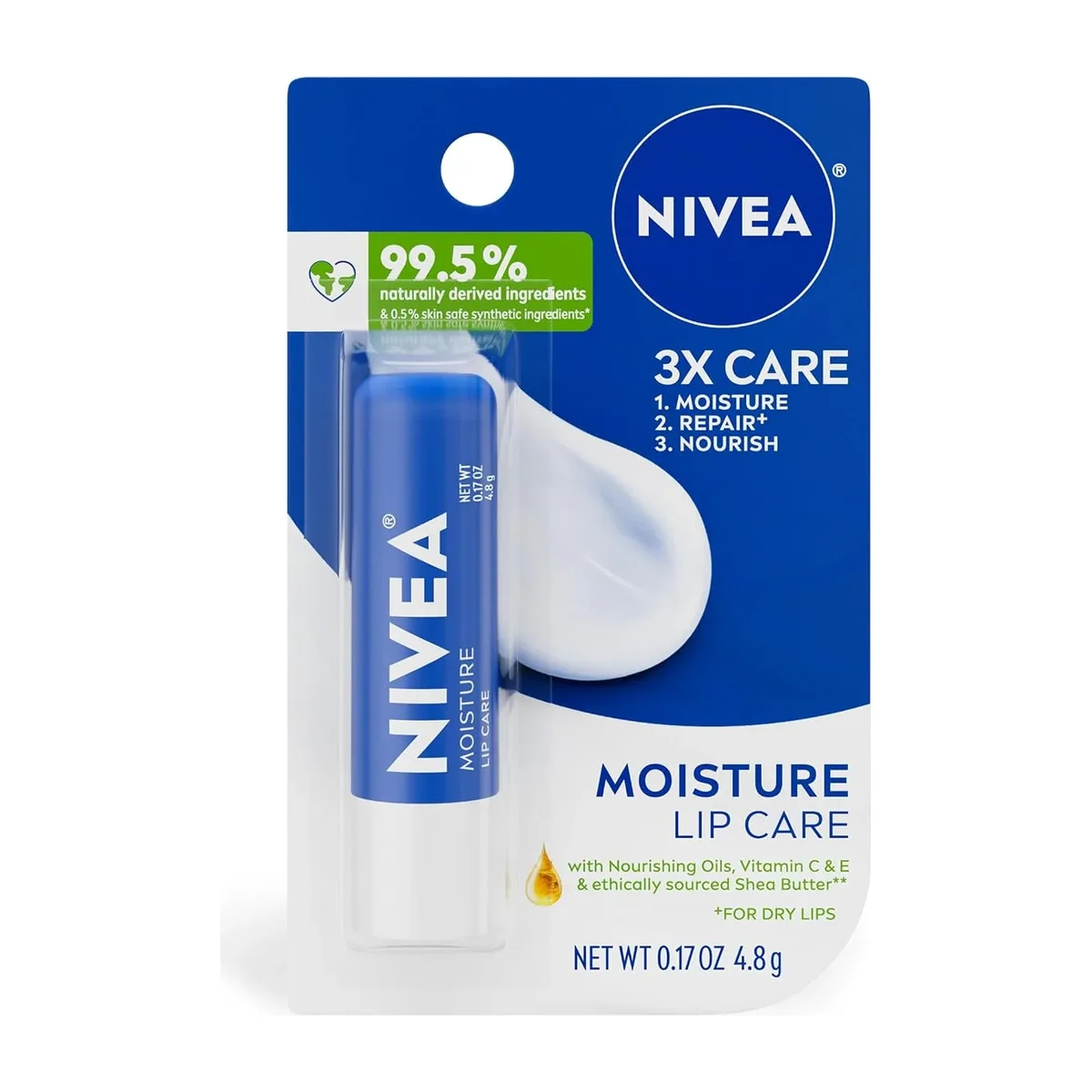
Somewhere along the way, the expectation that a lip balm should be 'clean' filtered all the way down from boutique beauty brands to the racks at the checkout counter, and mass-market giants had to answer it. This stick is Nivea's answer: the familiar cheap balm, but reformulated to be 99.5% naturally derived, free of added fragrance, preservatives, silicones, and dyes, built on sunflower oil instead of mineral oil and dosed with a little vitamin C and E. The interesting question with any product like this is whether the cleanup is real and beneficial or just a relabeling exercise — whether stripping out the extras actually makes a better balm or simply a more marketable one. In this case, the honest answer leans positive, with a couple of caveats worth understanding. Start with what changed and why it matters. The single most consequential difference between this and Nivea's classic balms is the removal of added fragrance. The brand's original lip balms carry perfume plus declared allergens like limonene and linalool, which are among the more common causes of lip irritation and allergic contact cheilitis. Lips are a sensitive, constantly-licked, food-contacting surface, and a meaningful number of people react to fragranced balms with exactly the dryness and peeling they were trying to soothe. By going fragrance-free, this version sidesteps that entirely, and that's not a cosmetic distinction — it's the reason this is the balm to reach for if your lips are reactive. The myth that fragrance-free means weaker is backwards here; the conditioning never came from the scent, so removing it costs nothing in performance and removes a real irritant. The base itself is a sensible plant-oil emollient system. Sunflower seed oil leads, a light, linoleic-acid-rich oil that conditions and supports the lip barrier and gives the stick its non-greasy feel. Shea butter is the richer anchor doing the real chapped-lip softening, with castor, avocado, and jojoba oils rounding out the feel and beeswax and candelilla wax providing the protective, moisture-sealing structure. Then come the vitamins. Tocopherol is the genuine, non-esterified form of vitamin E, and it's doing double duty: antioxidant support for the lips, and, crucially in a preservative-free formula, a natural protector keeping those unsaturated plant oils from going rancid. Ascorbyl palmitate is an oil-soluble vitamin C derivative that pairs with it for antioxidant 'nourishment.' This is where a little skepticism is healthy: the vitamins are present at modest cosmetic levels, and the 3-in-1 'moisture, repair, nourish' framing oversells what is, functionally, a nice antioxidant garnish on a good emollient balm. Don't buy this expecting vitamin C to brighten or transform your lips; buy it expecting a clean, well-formulated moisturizer with a small antioxidant bonus. In use, it's genuinely pleasant and, for the right person, a clear upgrade. It glides on smooth and comfortable, absorbs to a soft non-greasy finish, and the absence of any fragrance hit is the standout first impression for anyone used to scented sticks — there's just a faint natural note from the oils and a subtle flavor. It softens flaky, tight lips immediately and improves chapping over a day or two of regular use. It works as a standalone everyday balm, a smoothing base under lipstick, and a simple overnight repair layer. For sensitive lips that can't tolerate the brand's fragranced options, this is the obvious pick in the lineup, and that's its real reason to exist. The caveats are straightforward and shared with most plain balms. There's no SPF, so it offers zero daytime sun protection for an area that's frequently sun-damaged — pair it with an SPF lip product if you're outdoors. It wears off and needs reapplying, like any balm. And the preservative-free, antioxidant-stabilized approach, while appealing, means the vitamin E is partly there to keep the oils fresh rather than purely to benefit your lips, so don't over-read the wellness framing. It also contains beeswax, so it isn't vegan, and there's a sliver of mildly comedogenic emollient that essentially never matters on lips but is worth a complete accounting. On value, it's the same easy story as the rest of Nivea's lip range: a few dollars for a stick that lasts a couple of months, widely stocked, with no premium attached despite the cleaner positioning. You're paying drugstore money for a fragrance-free, plant-oil balm, which compared to the boutique 'clean' lip balms charging three or four times as much for a similar idea is a genuine bargain. The clean-beauty cleanup here didn't come with the usual clean-beauty markup, which is the most pleasant surprise of all. So did the cleanup improve the balm? For sensitive lips, unambiguously yes — removing the fragrance makes this meaningfully better-suited to reactive skin than the scented originals, at no cost to moisturizing performance. For everyone else, it's a clean, comfortable, cheap everyday balm with a modest antioxidant touch, which is a perfectly good thing to be as long as you don't expect the vitamins to do treatment-level work and you cover sun protection separately. It's the thinking person's pick in a crowded lip rack, and the rare case where 'clean' actually earned its place on the label.