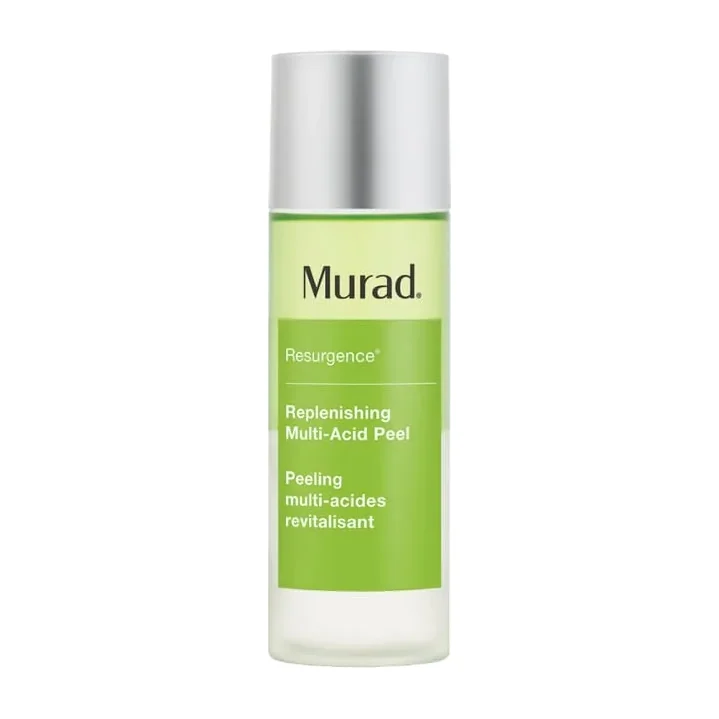
Murad Replenishing Multi-Acid Peel in glass bottle with bi-phase formula visible
Good choice for Dullness
What makes this different

The bi-phase design is what sets this peel apart from standard acid treatments. Most peels deliver acids alone and leave your skin stripped. This formula suspends the acids in a lipid phase (jojoba oil, moringa oil, triolein) so that exfoliation and nourishment happen simultaneously. The inclusion of tranexamic acid as a brightening and anti-pigmentation agent in a peel is also unusual — it prevents the post-inflammatory hyperpigmentation that aggressive peels can sometimes cause.

Murad

Murad Replenishing Multi-Acid Peel Review

Multi-Acid Resurfacing Pioneer Exfoliants liquid dermatologist developed Paraben free Vegan Not cruelty free

A genuinely innovative take on the daily peel format — the bi-phase design that exfoliates and nourishes simultaneously is more than a gimmick. Five acids (including the strategic addition of tranexamic acid) deliver comprehensive resurfacing, while jojoba oil and holy basil keep things from getting punishing. The fragrance-free formula shows welcome restraint.

Price $86.00 3.3 fl oz / 100 mL
Shopper rating 4.2 ★★★★★ 400 reviews
On the market 2019 Made in United States
Buy at Amazon ♥
Verdicts

How well it fits each concern

One verdict per concern. Open a row for the reasoning; the receipt has every source.

The scaleRecommendedGoodSupportingEarly evidenceNot for thisAvoidhow it works

Good choicefor DullnessGlycolic Acid is a reference standard by mechanism for dullness; this liquid carries it high in the ingredient list.Receipt1 source on the row · concentration not declared; studied range 4–10% · row checked Jul 17, 2026 · rule R5, same reading on 9,843 products · open the receipt

The case for it

  1. Glycolic Acid is a reference standard by mechanism for this concern — an established physical action, not a trial result.
  2. It is present at an effective concentration, declared or high in the ingredient list.
  3. The formula carries none of the triggers this concern is sensitive to.

Limited evidenceGentleNo reviews read yet

Same rule for everyone. “Good choice” is the verdict on 10,340 of 45,446 concern verdicts across the catalog; rule R5 decided 9,843 of them. Unchanged since September 5, 2026, engine 5.2.0.

Brand or formulator? Disclose a concentration or correct a fact →

The full receipt: rule, row, sources, dates →All dullness products →How dullness is treated →

Good choicefor Rough TextureGlycolic Acid is a reference standard by mechanism for rough texture; this liquid carries it high in the ingredient list.Receipt2 sources on the row · concentration not declared; studied range 4–10% · row checked Jul 17, 2026 · rule R5, same reading on 9,843 products · open the receipt

The case for it

  1. Glycolic Acid is a reference standard by mechanism for this concern — an established physical action, not a trial result.
  2. It is present at an effective concentration, declared or high in the ingredient list.
  3. The formula carries none of the triggers this concern is sensitive to.

Limited evidenceGentleNo reviews read yet

Same rule for everyone. “Good choice” is the verdict on 10,340 of 45,446 concern verdicts across the catalog; rule R5 decided 9,843 of them. Unchanged since September 5, 2026, engine 5.2.0.

Brand or formulator? Disclose a concentration or correct a fact →

The full receipt: rule, row, sources, dates →All rough texture products →How rough texture is treated →

Promisingfor AgingGlycolic Acid has trial-level evidence for aging but no guideline or regulatory standing yet — promising, short of a recommendation; the other actives here are not yet assessed for it.Receipt4 sources on the row · concentration not declared; studied range 5–10% · row checked Jul 17, 2026 · rule R9p, same reading on 4,872 products · open the receipt

The case for it

  1. Glycolic Acid has at least one trial behind it for this concern but no guideline or regulatory standing yet.
  2. It is plausibly present at a working level, though the concentration is not declared.
  3. The formula carries no trigger this concern is sensitive to, with the cautions noted.

Moderate evidenceStandard tolerabilityNo reviews read yet

Cautions: a photosensitising active — use sun protection.

What would change this: A declared concentration would move this to a firmer reading of the dose.

Same rule for everyone. “Promising” is the verdict on 4,872 of 45,446 concern verdicts across the catalog; rule R9p decided 4,872 of them. Unchanged since September 5, 2026, engine 5.2.0.

Brand or formulator? Disclose a concentration or correct a fact →

The full receipt: rule, row, sources, dates →All aging products →

Not for thisfor Large PoresThe actives here have been researched for large pores and the evidence does not support the claim.Receipt3 sources on the row · concentration not declared; studied range 5–10% · rule R10, same reading on 489 products · open the receipt

The case for it

  1. Glycolic Acid has been researched for this concern and the evidence does not support it.
  2. It is plausibly present at a working level, though the concentration is not declared.
  3. The formula carries none of the triggers this concern is sensitive to.

Not from a trial rowGentleNo reviews read yet

What would change this: A declared concentration would move this to a firmer reading of the dose.

Same rule for everyone. “Not for this” is the verdict on 489 of 45,446 concern verdicts across the catalog; rule R10 decided 489 of them. Unchanged since September 5, 2026, engine 5.2.0.

Brand or formulator? Disclose a concentration or correct a fact →

The full receipt: rule, row, sources, dates →All large pores products →

Promisingfor HyperpigmentationGlycolic Acid has trial-level evidence for hyperpigmentation but no guideline or regulatory standing yet — promising, short of a recommendation; the other actives here are not yet assessed for it.Receipt2 sources on the row · concentration not declared; studied range 5–10% · row checked Jul 17, 2026 · rule R9p, same reading on 4,872 products · open the receipt

The case for it

  1. Glycolic Acid has at least one trial behind it for this concern but no guideline or regulatory standing yet.
  2. It is plausibly present at a working level, though the concentration is not declared.
  3. The formula carries no trigger this concern is sensitive to, with the cautions noted.

Moderate evidenceStandard tolerabilityNo reviews read yet

Cautions: a photosensitising active — use sun protection.

What would change this: A declared concentration would move this to a firmer reading of the dose.

Same rule for everyone. “Promising” is the verdict on 4,872 of 45,446 concern verdicts across the catalog; rule R9p decided 4,872 of them. Unchanged since September 5, 2026, engine 5.2.0.

Brand or formulator? Disclose a concentration or correct a fact →

The full receipt: rule, row, sources, dates →All hyperpigmentation products →How hyperpigmentation is treated →

Strong choicefor AcneSalicylic Acid is an approved or monograph active for acne; this liquid carries it, though the concentration is not declared.Receipt§ 333.310 Acne active ingredients. (opened Jul 27, 2026) · concentration not declared; studied range 0.5–2% · row checked Jul 27, 2026 · rule R3, same reading on 570 products · open the receipt

The case for it

  1. Salicylic Acid is an approved or monograph active for this concern.
  2. It is plausibly present at a working level, though the concentration is not declared.
  3. The formula carries no trigger this concern is sensitive to, with the cautions noted.

Moderate evidenceStandard tolerabilityNo reviews read yet

Cautions: fungal-acne triggers.

What would change this: A declared concentration would move this to a firmer reading of the dose.

Same rule for everyone. “Strong choice” is the verdict on 1,475 of 45,446 concern verdicts across the catalog; rule R3 decided 570 of them. Unchanged since September 5, 2026, engine 5.2.0.

Brand or formulator? Disclose a concentration or correct a fact →

The full receipt: rule, row, sources, dates →All acne products →How acne is treated →

A verdict is Dermington’s assessment of how well a product’s ingredients fit a concern — never a claim about what the product treats. Evidence dots and collected reviews sit beside it and are never blended in. Rules 0.5.1 · evidence table ev-2026.10-r231 · engine 5.2.0 · how we decide · this product’s receipt

Reader poll · Town SquareQuestion 1 of up to 3

Have you used Replenishing Multi-Acid Peel?

One tap counts. A couple of optional follow-ups come next.

No account neededOne answer each, change it any timeCounted only in anonymous totalsHow the Square counts →
Assessment

Pros & cons

What it does well 7

  • Innovative bi-phase formula simultaneously exfoliates and nourishes
  • Five-acid complex (glycolic, lactic, malic, salicylic, tranexamic) targets multiple skin levels
  • Tranexamic acid prevents post-peel hyperpigmentation — a built-in safeguard
  • Fragrance-free — a welcome departure from other Murad products
  • Clinically shown to accelerate cell renewal by 33% in 7 days
  • Generous 3.3 oz bottle size makes the per-use cost reasonable
  • Holy basil and bisabolol provide anti-inflammatory balance to the acids

Where it falls short 6

  • Multiple acids still carry irritation risk despite the buffering oils
  • Oily residue from the lipid phase may bother some users
  • Not suitable for sensitive, rosacea-prone, or barrier-compromised skin
  • Requires shaking before each use — inconvenient and easy to forget
  • May cause purging in first 1-2 weeks for congestion-prone skin
  • Premium price at 6 despite the large bottle
Review

The full review

There's an uncomfortable truth at the heart of the chemical peel category: most of them are designed to do damage. Controlled damage, productive damage, dermatologist-sanctioned damage — but damage nonetheless. You apply acid, it dissolves the bonds between skin cells, those cells shed, and hopefully the new ones underneath are brighter and smoother. The recovery period is the price you pay for the results. Murad's Replenishing Multi-Acid Peel looks at this paradigm and asks a reasonable question: what if the peel could rebuild while it resurfaces?

The bi-phase formula is the mechanism for this ambition. When you pick up the bottle, you see two distinct layers — a clear aqueous phase loaded with acids sitting beneath a golden lipid phase of jojoba oil, moringa oil, and triolein. Shake them together and they form a milky emulsion that delivers exfoliation and nourishment in the same moment. It's an elegantly simple concept that has real implications for how your skin experiences the product.

The acid complex itself is comprehensive. Glycolic acid leads with the smallest AHA molecular size for efficient penetration. Lactic acid follows with its dual exfoliating-humectant properties. Malic acid adds gentle exfoliation with antioxidant benefits. Salicylic acid provides the oil-soluble BHA that penetrates pores where AHAs can't reach. The reflex to treat AHA-plus-BHA as automatically harsher misreads what's happening: they work at different depths, and a blend at moderate concentrations is not the same thing as one acid pushed to its limit. And then there's tranexamic acid — not traditionally found in peels — which prevents the inflammatory pigmentation response that aggressive exfoliation can sometimes trigger. This last inclusion is particularly clever: it's essentially a built-in safeguard against one of the most common side effects of regular peeling, and it matters most for the deeper skin tones where post-inflammatory pigment is the real risk of any resurfacing routine.

The replenishing side of the formula is equally considered. Jojoba seed oil's wax ester structure integrates with the skin's own lipids rather than just sitting on top. Holy basil — an adaptogenic herb with anti-inflammatory and antioxidant properties — calms the skin's stress response to the acids. Bisabolol adds additional soothing. Hyaluronic acid provides humectant hydration, backed by a genuinely thoughtful natural-moisturizing-factor stack: urea, trehalose, betaine, taurine, inositol, and yeast amino acids, all of them molecules the skin already uses to hold water. Turmeric, neem, and moringa extracts contribute their own antioxidant profiles. The message is clear: this peel is designed to leave your skin better off than it found it, not just smoother but less stressed.

In practice, the experience supports the theory. Shake the bottle, apply to clean skin in the evening, and there's a definite tingle — this is a real acid product, not a cosmetic pretender. But the tingling passes within a minute or two, and your skin doesn't feel the raw, stripped sensation that pure glycolic peels often deliver. The oil phase sits comfortably on the skin, and you layer your serum and moisturizer over it.

The next morning's results are the real payoff. Skin looks noticeably brighter, smoother, and more refined. That "just had a facial" glow becomes a regular occurrence with consistent use. Murad's clinical data claims a 33% acceleration in cell renewal within 7 days, and the visible results track with that claim — texture improvement is rapid and cumulative, with the fuller picture arriving over four to six weeks.

The fragrance-free formulation deserves specific praise. For a product containing multiple acids that already have irritation potential, omitting fragrance demonstrates genuine formulation wisdom. It is exactly the restraint the category needs and rarely shows.

The limitations are inherent to what this product is. Multiple acids mean multiple opportunities for irritation, and sensitive skin types will likely find even the buffered formula too intense. The leave-on format means the acids continue working until your skin's own buffering systems neutralize them — there's no rinse-off safety valve. Starting slowly, two or three nights a week, is essential, and some users will experience purging in the first couple of weeks as accelerated turnover brings existing congestion to the surface. Keep it away from retinol and benzoyl peroxide on the same night, wear sunscreen without fail the following morning, and understand that leave-on acids are off the table during pregnancy. The oils also rule it out for anyone managing fungal acne.

The oily feel after application isn't for everyone. The lipid phase leaves a noticeable film that some users find pleasant and nourishing while others describe it as residue. If you prefer your skincare to absorb completely to a matte finish, the bi-phase texture may require adjustment — and remembering to shake the bottle every single time is a small daily tax the format extracts.

At $86 for 3.3 ounces, the per-use cost is actually quite reasonable — you need only a small amount each application, and the generous bottle size means it lasts three to four months with regular use. For a treatment product, that's competitive with many less sophisticated acid toners and peels, though the review pool remains modest and the sticker price will still make people flinch.

The Replenishing Multi-Acid Peel represents what happens when a dermatologist-developed brand takes the time to solve a real problem rather than just reformulating the same concept. The bi-phase approach is genuinely innovative, the acid complex is thoughtfully comprehensive, and the fragrance-free execution shows a maturity that some of Murad's other products could learn from.
The science

The multi-acid approach in this peel leverages the different molecular properties and mechanisms of each acid type. Glycolic acid (the smallest AHA at 76 Da molecular weight) penetrates the stratum corneum most efficiently, disrupting corneocyte cohesion through chelation of calcium ions in corneodesmosomes. Research in the Journal of the American Academy of Dermatology has established glycolic acid's efficacy for photoaging, texture improvement, and hyperpigmentation at concentrations above 5%.

Lactic acid contributes exfoliation through a similar mechanism but with an additional humectant effect — research published in the International Journal of Cosmetic Science has shown that lactic acid increases ceramide production in the stratum corneum, actively supporting barrier function while exfoliating. This dual action makes it the ideal complement to glycolic acid in a formula designed to exfoliate without stripping.

Salicylic acid's lipophilic nature allows it to penetrate the sebaceous follicle, where it dissolves the keratin plugs that form comedones. A comprehensive review in Clinical, Cosmetic and Investigational Dermatology confirmed its efficacy for acne and pore congestion at concentrations between 0.5% and 2%.

The inclusion of tranexamic acid in a peel context is supported by research showing that chemical exfoliation can trigger melanocyte activation through keratinocyte-derived inflammatory signals. Tranexamic acid's ability to inhibit the plasmin pathway reduces this inflammatory melanocyte stimulation, theoretically preventing the post-inflammatory hyperpigmentation that can result from aggressive chemical exfoliation.

The bi-phase delivery system exploits the principle that lipid-based vehicles can modulate acid penetration rates, providing a more controlled and gradual delivery of the acid actives compared to purely aqueous formulations.

The clinical view

Dermatologists appreciate the multi-acid approach for its ability to address different layers and aspects of skin simultaneously — AHAs for surface exfoliation, BHA for pore clearing, and tranexamic acid for pigmentation prevention. Skin-care clinicians commonly mention that the bi-phase formula with nourishing lipids represents a clinically sound approach to daily-use exfoliation, reducing the barrier disruption that limits how often patients can use acid treatments. The fragrance-free formulation is a responsible choice for a product already containing multiple potential irritants. This peel is commonly recommended for patients who want the benefits of regular chemical exfoliation without the recovery downtime of professional-grade peels.

Formula

Key ingredients

  1. Glycolic Acid

    The primary AHA in this multi-acid peel, glycolic acid's small molecular size allows it to penetrate the stratum corneum effectively, dissolving the bonds between dead skin cells to accelerate turnover. In this bi-phase formula, the glycolic acid is suspended in the aqueous phase and activated when shaken with the lipid phase, allowing the jojoba oil to simultaneously nourish as the acid exfoliates.

    Established mechanism for Rough Texture · established mechanism
  2. Tranexamic Acid

    An unusual but strategic inclusion in a peel formula. Tranexamic acid addresses the hyperpigmentation that chemical exfoliation can sometimes trigger by interrupting inflammatory melanocyte signaling. In this peel, it acts as a safety net — brightening while preventing the post-inflammatory pigmentation that aggressive exfoliation might otherwise cause.

    Limited for Hyperpigmentation
  3. Lactic Acid

    A gentler AHA that complements glycolic acid with additional humectant properties — lactic acid draws moisture into the skin while exfoliating. In this multi-acid blend, it ensures the peel delivers hydration alongside resurfacing, reducing the dryness that pure glycolic peels can cause.

    Established mechanism for Rough Texture · established mechanism
  4. Salicylic Acid (BHA)

    The oil-soluble BHA in this multi-acid blend penetrates into pores where AHAs cannot reach, dissolving sebum plugs and preventing congestion. While the glycolic and lactic acids work on the skin's surface, salicylic acid targets the pore lining — making this peel effective for both surface texture and below-surface congestion.

    Established mechanism for Rough Texture · established mechanism
  5. Holy Basil (Ocimum Sanctum) Leaf Extract

    An adaptogenic botanical that provides anti-inflammatory and antioxidant action to counterbalance the irritation potential of the multi-acid complex. Holy basil's inclusion reflects the "replenishing" philosophy — this peel is designed to rebuild as it resurfaces, rather than simply stripping the skin.

    Not yet assessed
  6. Jojoba Seed Oil

    The lipid phase of this bi-phase formula, jojoba oil provides emollient nourishment that buffers the acid activity. Its wax ester structure mimics human sebum, helping to replenish the skin's lipid barrier as the acids dissolve surface cells — a simultaneously exfoliating and nourishing approach that sets this peel apart from pure acid formulas.

    Not yet assessed
Full ingredient list 36 ingredients ShowHide

Water (Aqua), Caprylic/Capric Triglyceride, C13-16 Isoparaffin, Glycolic Acid, Simmondsia Chinensis (Jojoba) Seed Oil, Triolein, Glycerin, Sodium Hydroxide, Propylene Glycol Caprylate, Lactic Acid, Malic Acid, Tranexamic Acid, Salicylic Acid, Sodium Hyaluronate, Bisabolol, Tocopheryl Acetate, Ocimum Sanctum Leaf Extract, Melia Azadirachta Leaf Extract, Melia Azadirachta Flower Extract, Amino Esters-1, Amber Powder, Coccinia Indica Fruit Extract, Solanum Melongena (Eggplant) Fruit Extract, Curcuma Longa (Turmeric) Root Extract, Corallina Officinalis Extract, Moringa Oleifera Seed Oil, Urea, Yeast Amino Acids, Trehalose, Inositol, Taurine, Betaine, Caprylhydroxamic Acid, Propanediol, 1,2-Hexanediol.

Safety & formulation facts

  • Not pregnancy safe
  • Fragrance free
  • Alcohol free
  • Not oil free
  • Silicone free
  • Paraben free
  • Sulfate free
  • Not cruelty free
  • Vegan
  • Not fungal-acne safe
Potential irritants Glycolic AcidLactic AcidSalicylic AcidMalic Acid
Compatibility

Skin types & routine

Routine step treatment
Time of day Night
Best season All year
Finish dewy, lightweight, non-greasy

Layering

Shake well to combine the bi-phase formula. Apply to clean skin as your exfoliation step, then follow with hydrating serums and moisturizer. No need to rinse. Use in the PM and always wear SPF 30+ the next morning. Start with 2-3 times per week and increase frequency as tolerated.

When to expect results

Immediate brightening and smoother texture noticeable after first use. Cell renewal increased by 33% within 7 days per clinical testing. Significant improvement in overall radiance, pore appearance, and skin texture over 4-6 weeks of consistent use.

Pairs well with hyaluronic-acidceramidesniacinamide
Don't combine with retinolbenzoyl-peroxide

A routine built around it

Morning

  1. Gentle cleanser
  2. Vitamin C serum
  3. Moisturizer
  4. Sunscreen SPF 30+

Night

  1. Gentle cleanser
  2. Murad Replenishing Multi-Acid Peel (shake and apply)this product
  3. Hydrating serum
  4. Night cream with ceramides
Guidance

How to use it, and who it's for

How to use

Shake the bottle vigorously until the two phases combine into a uniform milky liquid. Apply a thin layer to clean, dry skin in the evening. No need to rinse — the formula is designed to be left on. Follow with hydrating serum and moisturizer. Start with 2-3 times per week and increase frequency as tolerated. Always wear SPF 30+ the following morning. Avoid using on the same evening as retinol or other strong actives.

Is it worth the price?

At $86 for 3.3 fl oz, the upfront cost is significant, but the per-use economics are favorable. At 2-4 applications per week using approximately 0.5-1 mL per application, a single bottle lasts 3-4 months — roughly $0.70-.00 per treatment. For a multi-acid peel with tranexamic acid, jojoba oil, and clinical-grade botanical actives, this compares well to weekly professional treatments or to purchasing multiple separate acid products. The generous bottle size reflects thoughtful consumer value for a treatment product.

Who should buy it

Those looking for a comprehensive daily exfoliant that addresses dullness, texture, pore congestion, and uneven tone simultaneously. Ideal for users who want the benefits of regular chemical peeling without the harshness and recovery time of traditional peels, and for anyone who appreciates the fragrance-free approach.

Who should skip it

Sensitive, rosacea-prone, or eczema-affected skin types. Those currently using prescription retinoids or other potent acid treatments — adding this peel risks over-exfoliation. Anyone who dislikes the oily feel of bi-phase products. Not suitable during pregnancy due to salicylic acid content.

Ready to try it?Murad Replenishing Multi-Acid Peel · $86.00 · 3.3 fl oz / 100 mL
Details

The product, in detail

Texture
Bi-phase liquid that separates into aqueous (acid) and lipid (oil) layers. When shaken, creates a milky, lightweight liquid that applies easily. Slightly oily feel from the jojoba and moringa oils.
Scent
Fragrance-free. Mild, neutral scent from the natural botanical extracts.
Packaging
Glass bottle with dispensing cap. The transparent bottle allows you to see the two phases separate, reminding you to shake before use.
How long it lasts
3-4 months with use 3-4 times per week
Once opened
Use within 12 months · track your toss-by date →
Size
3.3 fl oz / 100 mL
Made in
United States
Launched
2019

What the first two weeks feel like

Shake the bottle until the two phases are fully mixed — you'll see the clear and oily layers combine into a milky liquid. On application, expect a tingling or warming sensation from the acids. This is normal and should subside within a few minutes. Skin may look slightly flushed. The next morning, expect noticeably smoother, brighter skin. Start with 2-3 times per week to assess tolerance.

The story behind it

Why it exists

The Replenishing Multi-Acid Peel was born from Murad's clinical observation that the most effective peels often left patients's skin dehydrated and sensitized for days afterward. The bi-phase approach was designed to make daily-use peeling possible by embedding the acids in a replenishing oil matrix — turning the traditional "strip now, recover later" peel philosophy on its head.

About Murad Legacy Brand (20+ years)

Murad was founded in 1989 by Dr. Howard Murad, a board-certified dermatologist and trained pharmacist who has treated over 50,000 patients. The brand pioneered clinical-grade skincare sold directly to consumers and maintains a strong reputation in professional dermatology settings.

Brand founded 1989 · This product since 2019

Myth vs. reality

What people get wrong about it

MythChemical peels are too harsh for regular use and should only be done monthly.

RealityThis peel was specifically designed for frequent use — the bi-phase formula with nourishing oils and soothing botanicals like holy basil allows most skin types to tolerate it 3-5 times per week. The key is that it exfoliates and replenishes simultaneously, reducing the recovery time that traditional peels require.

MythMixing AHAs and BHAs together is dangerous and causes over-exfoliation.

RealityAHAs (glycolic, lactic, malic) and BHA (salicylic) work at different levels — AHAs on the surface and BHA within pores. When formulated together at appropriate concentrations with soothing ingredients, they provide comprehensive exfoliation without necessarily being harsher than a single acid at a higher concentration.

FAQ

Questions people ask

Do I need to rinse off the Murad Replenishing Multi-Acid Peel?

No — this is a leave-on daily peel. After shaking and applying, the formula is designed to be absorbed. Follow with your regular serum and moisturizer. The oil phase continues to nourish your skin as the acids work, so rinsing would remove the replenishing benefits.

How often should I use Murad Replenishing Multi-Acid Peel?

Start with 2-3 times per week in the evening. If your skin tolerates it well (no excessive dryness, redness, or sensitivity), you can gradually increase to daily use. The bi-phase formula with jojoba oil and soothing botanicals makes it gentler than pure acid peels, but listen to your skin and scale back if you notice irritation.

Can I use this peel with retinol?

Use caution when combining multi-acid peels with retinol — both accelerate cell turnover and the combination can overwhelm the skin. Alternate nights rather than using both in the same evening. If you're new to either product, establish tolerance with one before introducing the other.

Why do I need to shake the bottle before use?

This is a bi-phase formula — the acid-rich aqueous phase and the nourishing lipid phase naturally separate when sitting. Shaking combines them into a milky mixture that delivers exfoliation and replenishment simultaneously. If you apply without shaking, you'll get uneven concentrations of acids and oils.

Will this peel cause purging?

Purging is possible in the first 1-2 weeks, especially if you're prone to congestion. The multi-acid complex accelerates cell turnover (33% faster in clinical testing), which can bring existing clogged pores to the surface faster. This is temporary and differs from a breakout — purging appears in areas where you typically get congestion and resolves within 2-4 weeks.

Reviews

What shoppers tend to say

Recurring themes our editors read across retailer reviews — summaries in our words, not quotations, and not a substitute for a patch test.

Common praise

  • Skin feels noticeably smoother and softer after first use
  • Healthy, radiant glow develops within days
  • Fragrance-free — a welcome change from other Murad products
  • Bi-phase formula feels nourishing rather than stripping
  • Effective at reducing blemishes and congestion

Common complaints

  • Can burn or sting sensitive skin
  • Leaves a residue that some find unpleasant
  • Expensive at $86 for a peel
  • Requires shaking before each use — easy to forget
  • May cause purging in first 1-2 weeks
Notable endorsementsDeveloped by Dr. Howard Murad, board-certified dermatologistClinically shown to accelerate cell renewal by 33% in 7 days
Next stepCheck it against what you already useClashes, spacing and the right order, with everything on your shelf.