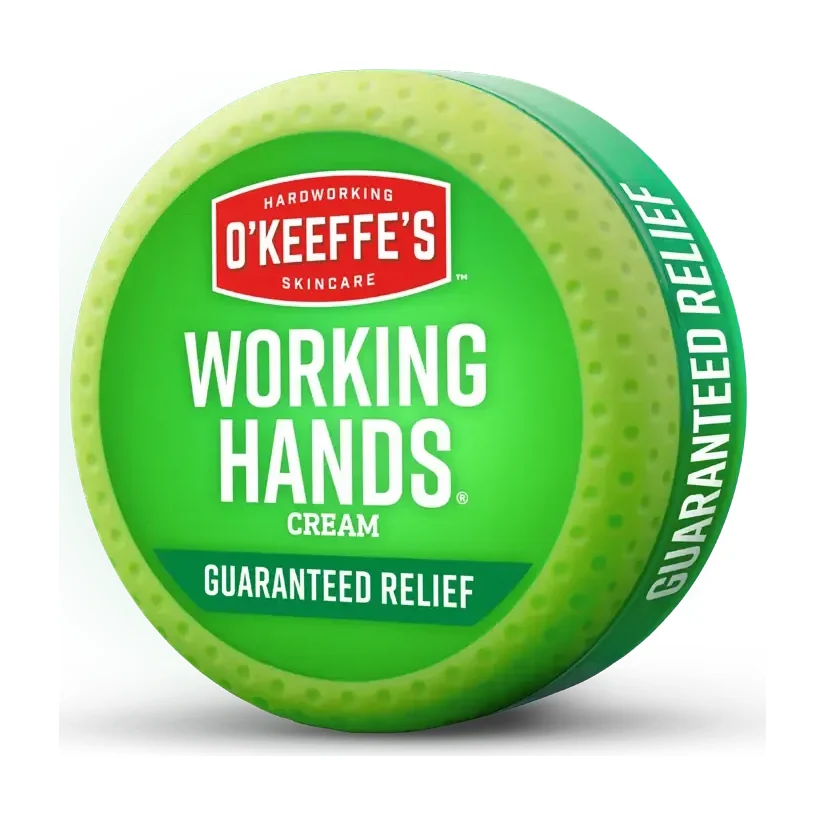
Before O'Keeffe's Working Hands appeared on an endcap at Sephora or earned a single beauty editor mention, it was already a legend in the aisles of Tractor Supply, Home Depot, and rural pharmacies across America. Farmers bought it by the case. Construction workers kept a jar in their trucks. Welders passed it around job sites like contraband. This was a hand cream that earned its reputation in places where hand cream is supposed to be a joke — and the joke was on every expensive, beautifully packaged hand cream sitting untouched on bathroom counters.
The origin story is almost too perfect to be real, but it is. In 1998, pharmacist Tara O'Keeffe watched her father Bill — a rancher, a diabetic, a man whose hands split open from years of wire, wood, and weather — try and fail with every cream on the market. So she went into her kitchen and made one herself. That formula, with minor refinements, is the same one sitting in the green jar today. Water, glycerin, stearic acid, sodium hydroxide, paraffin, hydroxypropyl methylcellulose, allantoin, and a handful of supporting ingredients. Thirteen total. Most hand creams list that many before they get past the emulsifiers.
The formula's strategy is elegantly direct. Glycerin — a humectant with more dermatological research behind it than most ingredients that cost fifty times as much — sits at the number two position, pulling moisture into skin that has been stripped raw by soap, sanitizer, detergent, cement dust, or whatever else the day threw at it. Paraffin and mineral oil form an occlusive cap over that moisture, preventing the evaporative loss that keeps cracked hands in a perpetual cycle of damage. Allantoin rounds out the functional trio, promoting cell turnover and soothing the irritation that comes with fissured skin. That's the whole thesis. Hydrate, seal, repair. Repeat.
What makes this formula genuinely innovative isn't what's in it — it's what isn't. There's no fragrance, which matters when your hands are cracked and raw. There's no greasy residue, which matters when you need to grip a hammer or a steering wheel sixty seconds after application. There's no elaborate texture play or silicone slip — just a dense, concentrated cream that spreads thin, absorbs fast, and gets out of the way. This was designed by a pharmacist for a rancher, not by a cosmetic chemist for an Instagram flatlay.
The practical performance is where Working Hands separates itself from the hand cream pack. The fast-absorbing, non-greasy texture is genuinely unusual in a product this occlusive. Most hand creams face a tradeoff: heavy enough to actually repair, or light enough to use and immediately function. Working Hands threads this needle by using a soap-cream base (stearic acid saponified with sodium hydroxide) that creates a unique texture — concentrated and slightly waxy out of the jar, but fast-thinning and quick-absorbing once warmed between palms. You can apply this and type on a keyboard, swipe a phone screen, or shake someone's hand within a minute.
For severely cracked hands, the overnight cotton glove method unlocks another level. A generous application sealed under gloves creates an extended occlusive chamber — essentially the same principle as a hydrocolloid wound bandage — that allows hours of uninterrupted glycerin penetration. Users consistently report that two to three nights of this transforms hands that have been splitting and bleeding for weeks.
The limitations are real but contextual. The ingredient list is simple to the point of austerity — no ceramides, no sophisticated lipid complexes, no antioxidants beyond what incidental protection the paraffin provides. For hands that need both repair and anti-aging support (think visible dryness plus age spots and crepey texture), a more sophisticated hand cream will address more concerns simultaneously. The preservative system uses diazolidinyl urea, a formaldehyde releaser that, while common and considered safe at regulated concentrations, may give pause to the ingredient-conscious. And the jar format, while iconic, means dipping fingers into the product — the tube and pump versions solve this.
The value proposition is almost absurd. At under nine dollars for a 3.4 oz jar that lasts months, with larger sizes available for even better per-ounce economics, Working Hands costs less per application than virtually any hand cream on the market, including generic store brands. The 6.8 oz value jar typically runs around twelve dollars — roughly the price of one tube of many boutique hand creams. Nielsen sales data confirms what hardware store managers have known for years: people come back for this product more reliably than almost anything else on the shelf.
There's something honest about a product that doesn't pretend to be more than it is. Working Hands doesn't claim to reverse aging or protect against blue light or deliver spa-grade luxury. It claims to fix your cracked, dry hands. It has been doing exactly that, in exactly the same green jar, for nearly thirty years. Some products earn loyalty through innovation. This one earns it through reliability.