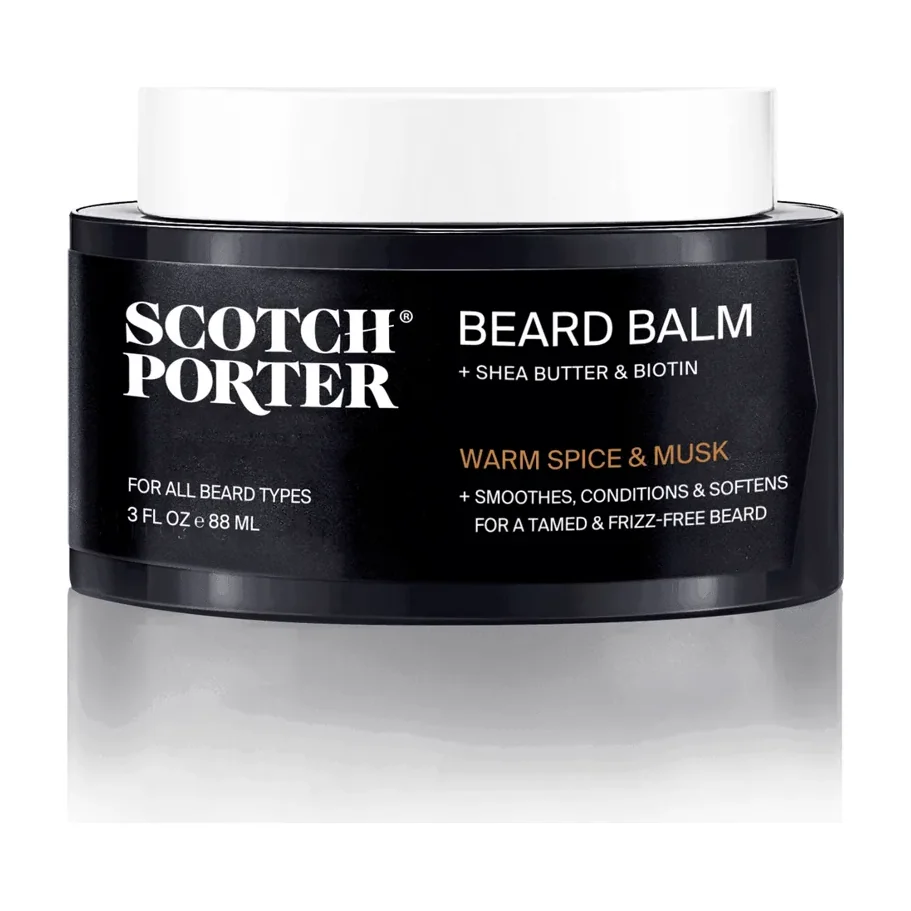
When the beard-care boom hit in the mid-2010s, most balms were essentially styling wax in disguise — heavy on beeswax, engineered to sculpt and hold, and frankly not very pleasant for the skin hiding underneath. Scotch Porter, founded in 2015 by Calvin Quallis to bring genuinely well-made grooming to Black men and beyond, read the situation differently. The problem most guys actually had was not insufficient hold; it was a beard that was dry, wiry, and itchy. The Conditioning Beard Balm is the answer to that read, and the name is doing honest work: this is a conditioning product first and a styling one a distant second.
The formula bears that priority out. Shea butter sits second on the ingredient list, right after water, and it is the backbone — a rich emollient that softens coarse hair and conditions the skin beneath it. Around it is a blend of conditioning oils, each pulling its weight: castor for slip and shine, jojoba whose sebum-like profile moisturizes skin without feeling alien to it, and coconut and safflower for softness. The result is a soft, creamy balm that melts on contact, works in without greasiness, and leaves a beard noticeably softer and flatter almost immediately. If you have ever endured the maddening itch of a beard in its growing-in phase, the relief here is real and fast. Behentrimonium methosulfate, a mild cationic conditioning agent, helps detangle and neutralize static, which is why frizz settles down and the hair becomes more combable. Panthenol adds humectant moisture that penetrates the shaft. This is well-understood cosmetic chemistry doing exactly what it reliably does.
Then there is the Scotch Porter signature, and this is where expectations need managing. Biotin is delivered with phospholipids as a "liposome" complex, alongside a trio of traditional botanicals — burdock root, nettle, and horsetail. The brand leans into beard health and an "encourages growth" framing, but topical biotin has little evidence for actually stimulating hair growth, which is overwhelmingly governed by genetics and hormones rather than what you smear on the surface. Wrapping biotin in a phospholipid delivery system does not change the underlying lack of growth evidence. The botanicals are pleasant, soothing, traditional-use grooming ingredients sitting low on the list, contributing herbal character rather than proven actives. None of this is a knock on how the product performs — it conditions beautifully — but the growth angle is marketing, and you should buy this to soften your beard, not to grow one.
The rest of the honest accounting is straightforward. The fragrance is warm and assertive, a deliberate part of the Scotch Porter identity, but strong enough that fragrance-sensitive folks should patch test and the genuinely scent-averse should look elsewhere. The hold is light by design, so anyone wanting a sculpted, stiff style on a long beard will need a dedicated styling product layered on top — this tames and shapes, it does not lock anything in place. Coconut oil is comedogenic for some, so acne-prone skin under the beard may want to use it sparingly and concentrate the product on the hair rather than the cheeks, and it is not fungal-acne-safe. And at three ounces for eighteen dollars, daily users working through a longer beard will empty the jar in a couple of months. Over-apply it and the balm can feel heavy, so a little goes a long way.
Where it lands is as a genuinely good conditioning balm that has earned its flagship status honestly. It is naturally-derived, free of sulfates, silicones, and parabens, vegan and cruelty-free, broadly available, and — most importantly — it does the core job of softer, less itchy, more manageable facial hair reliably and pleasantly. With a deep, established review base behind it, this is a proven quantity rather than a roll of the dice. The immediate softening, shaping, and itch relief show up on first use, while the healthier-looking, more cooperative beard texture builds over a few weeks of regular conditioning.
Buy it to tame and condition a coarse or dry beard, go easy on the amount, and treat the biotin-and-botanical growth claims as flavor text rather than a feature, and it slots in as an easy daily staple. Just go in knowing what it is: a softener and a soother, not a sculptor and certainly not a fertilizer. Judged on the job it actually does — conditioning coarse facial hair and calming the skin beneath it — it is one of the more satisfying picks in a category that spent its early years overcomplicating a simple need.
Application technique makes a real difference with a conditioning-first balm like this one. Warm a small scoop between the palms until it melts to an oil, then work it through the beard from the skin outward, making sure it reaches the often-neglected skin underneath where most of the itch originates — that is where the shea and jojoba do their best calming work. Comb it through afterward to distribute it evenly and shape the hair, and resist the urge to reload; this is a softener, and a heavy hand leaves the beard looking greasy and weighed down rather than soft and flat. On a shorter or coarser beard a fingertip's worth is plenty, while a longer beard naturally drinks up more, which is why daily users on bigger beards burn through the jar faster. It suits normal, dry, and combination skin comfortably; acne-prone skin should keep the coconut-oil-containing balm mostly on the hair and off the cheeks. Treat it as a daily conditioning ritual rather than an occasional fix, and the cumulative payoff — a beard that stays soft, manageable, and itch-free rather than reverting to wiry dryness — is exactly what makes it the kind of grooming staple people repurchase without much thought.