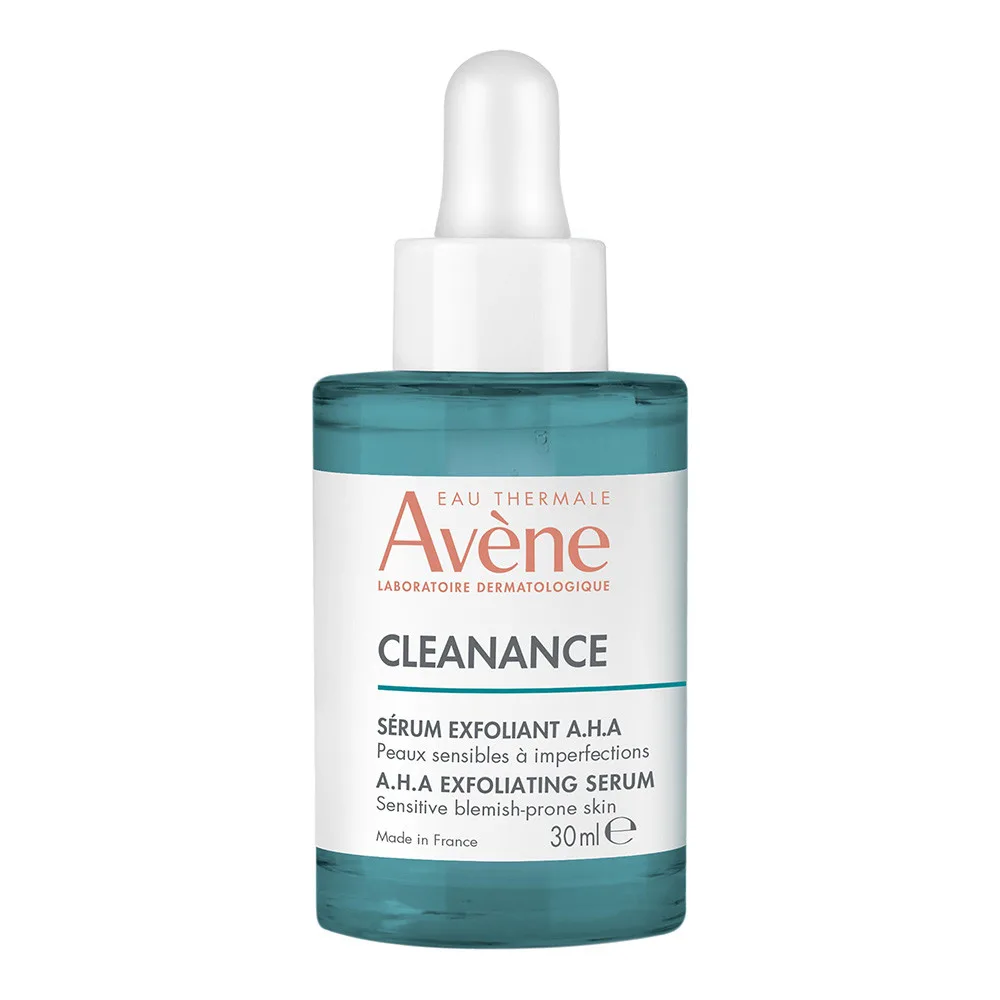
Avène Cleanance AHA Exfoliating Serum 30ml pump bottle on white background
Not yet assessed for Acne
What makes this different

One of very few AHA serums built around succinic acid as the primary chemistry rather than glycolic or lactic alone. Succinic adjusts the formula pH while delivering its own keratolytic action, paired with lactic acid for the standard AHA effect — the combination produces measurable exfoliation at substantially lower irritation potential than equivalent glycolic concentrations. The 10-ingredient formula and 99% natural-origin composition are technical statements rather than marketing claims.

Avène

Avène Cleanance AHA Exfoliating Serum Review

Gentlest AHA Workhorse Exfoliants serum pharmacy brand Paraben free Fungal-acne safe Cruelty free Vegan

An unusually well-tuned AHA serum for sensitive acne-prone skin — the succinic-and-lactic combination delivers measurable exfoliation with substantially lower irritation than glycolic alternatives, in a 10-ingredient fragrance-free formula that respects the biology it targets. Held back from a top score by drugstore AHA options at half the price and by a relatively low active concentration ceiling.

Price $38.00 30ml
Shopper rating 4.4 ★★★★★ 2,100 reviews
On the market 2021 Made in France
Buy at Amazon ♥
Verdicts

How well it fits each concern

One verdict per concern. Open a row for the reasoning; the receipt has every source.

The scaleRecommendedGoodSupportingEarly evidenceNot for thisAvoidhow it works

Unprovenfor BlackheadsLactic Acid has early or mechanistic evidence for blackheads — a reasonable bet, not a recommendation; the other actives here are not yet assessed for it.Receipt2 sources on the row · 2.43% declared, studied range 5–10% · row checked Jul 17, 2026 · rule R9, same reading on 4,156 products · open the receipt

The case for it

  1. Lactic Acid 2.43% has early or mechanistic evidence for this concern, not trial-backed standing.
  2. It is present below the studied range.
  3. The formula carries none of the triggers this concern is sensitive to.

Limited evidenceGentleNo reviews read yet

What would change this: A concentration inside the studied range would raise this a step.

Same rule for everyone. “Unproven” is the verdict on 4,156 of 45,446 concern verdicts across the catalog; rule R9 decided 4,156 of them. Unchanged since September 5, 2026, engine 5.2.0.

Brand or formulator? Disclose a concentration or correct a fact →

The full receipt: rule, row, sources, dates →All blackheads products →How blackheads is treated →

Supporting rolefor Rough TextureLactic Acid is a reference standard by mechanism for rough texture, but this serum carries it below the studied range — a supporting role at best.Receipt2 sources on the row · 2.43% declared, studied range 5–12% · row checked Jul 17, 2026 · rule R7, same reading on 227 products · open the receipt

The case for it

  1. Lactic Acid 2.43% is a reference standard by mechanism for this concern — an established physical action, not a trial result.
  2. It is present below the studied range.
  3. The formula carries none of the triggers this concern is sensitive to.

Limited evidenceGentleNo reviews read yet

What would change this: A concentration inside the studied range would raise this a step.

Same rule for everyone. “Supporting role” is the verdict on 7,796 of 45,446 concern verdicts across the catalog; rule R7 decided 227 of them. Unchanged since September 5, 2026, engine 5.2.0.

Brand or formulator? Disclose a concentration or correct a fact →

The full receipt: rule, row, sources, dates →All rough texture products →How rough texture is treated →

Unprovenfor HyperpigmentationLactic Acid has early or mechanistic evidence for hyperpigmentation — a reasonable bet, not a recommendation; the other actives here are not yet assessed for it.Receipt4 sources on the row · 2.43% declared, studied range 8% · row checked Jul 17, 2026 · rule R9, same reading on 4,156 products · open the receipt

The case for it

  1. Lactic Acid 2.43% has early or mechanistic evidence for this concern, not trial-backed standing.
  2. It is present below the studied range.
  3. The formula carries no trigger this concern is sensitive to, with the cautions noted.

Moderate evidenceStandard tolerabilityNo reviews read yet

Cautions: a photosensitising active — use sun protection.

What would change this: A concentration inside the studied range would raise this a step.

Same rule for everyone. “Unproven” is the verdict on 4,156 of 45,446 concern verdicts across the catalog; rule R9 decided 4,156 of them. Unchanged since September 5, 2026, engine 5.2.0.

Brand or formulator? Disclose a concentration or correct a fact →

The full receipt: rule, row, sources, dates →All hyperpigmentation products →How hyperpigmentation is treated →

Also listed for Acne, Excess Oiliness and Large Pores — the actives here (Glycerin, Succinic Acid, Lactic Acid, Amino Acids) are in our research queue for those concerns; there is no verdict until their evidence rows are written. That is a gap in our table, not a mark against the product.

A verdict is Dermington’s assessment of how well a product’s ingredients fit a concern — never a claim about what the product treats. Evidence dots and collected reviews sit beside it and are never blended in. Rules 0.5.1 · evidence table ev-2026.10-r231 · engine 5.2.0 · how we decide · this product’s receipt

Reader poll · Town SquareQuestion 1 of up to 3

Have you used Cleanance AHA Exfoliating Serum?

One tap counts. A couple of optional follow-ups come next.

No account neededOne answer each, change it any timeCounted only in anonymous totalsHow the Square counts →
Assessment

Pros & cons

What it does well 7

  • Succinic-and-lactic acid combination delivers exfoliation without the irritation of glycolic at equivalent concentrations
  • Truly fragrance-free formula, rare for the French pharmacy AHA category
  • Glycerin at second-position prevents the dehydration cycle most AHA serums create
  • Avène thermal water base soothes sensitive acne-prone skin during exfoliation
  • 10-ingredient minimalist composition with 99% natural-origin actives
  • Glutamic acid adds sebum-modulation activity beyond pure exfoliation
  • Fungal-acne-safe formula extends the category reach

Where it falls short 5

  • Active concentrations gentler than glycolic alternatives — too mild for experienced AHA users
  • $38 for 30 mL above drugstore AHA serums at $7-15 with similar core actives
  • Pump dispenser delivers inconsistent dose volume across applications
  • Slightly tacky finish requires moisturizer layered on top to set comfortably
  • Avène's pregnancy guidance recommends consulting a dermatologist before use
Review

The full review

Most AHA serums reach immediately for glycolic acid. It's the most extensively researched alpha hydroxy acid, the smallest molecular size for deep penetration, the easiest to formulate around, and the closest thing to a category default. It's also the AHA most likely to sting, trigger flare reactions on sensitive skin, and create the kind of barrier disruption that makes one product session feel impressive but compounds problems over weeks of regular use. For sensitive acne-prone skin — a substantial portion of the acne market, particularly women managing hormonal breakouts on reactive or rosacea-adjacent biology — glycolic acid is the wrong tool, and the AHA category has historically underserved that demographic.

Avène Cleanance AHA Exfoliating Serum is the answer to that gap, and the answer hinges on an unusual ingredient choice. The serum's primary chemistry is succinic acid at 3% — a dicarboxylic acid that does three jobs in this formula. It adjusts the pH down to roughly 3.8, the range where the lactic acid stays active. It delivers its own mild keratolytic action through a mechanism distinct from the hydroxy acid pathway. And recent research suggests it has antimicrobial activity against acne-relevant bacterial populations, which matters in a formula targeted at the acne demographic specifically. Pairing succinic with lactic acid at 2.43% produces measurable exfoliation with a substantially lower irritation profile than glycolic at functionally equivalent concentrations.

The formula is structurally minimal. Ten ingredients total. The first five — Avène thermal water, glycerin, pentylene glycol, succinic acid, lactic acid — do nearly all the work. Glutamic acid contributes sebum-modulation through a different mechanism than the acids. Sodium hydroxide buffers the pH precisely. Sodium benzoate handles preservation. Xanthan gum provides texture. The 99% natural-origin composition isn't just a marketing claim — it's a technical statement that the formula does its work through a small set of well-characterized actives rather than a long supporting cast that adds complexity without function.

The Avène thermal spring water as the first ingredient is doing more than branding. In a serum with two acids active enough to drive exfoliation, the thermal water provides the calming foundation that lets the formula work on sensitive skin without the flare reactions that stronger AHA serums commonly trigger. Pierre Fabre has thirty years of clinical data on the water's anti-inflammatory and barrier-supporting effects, and its prominent inclusion here is consistent with how the brand approaches every active formulation — pair the active with the soothing context that lets it work on the target skin.

The glycerin position is notable. Second on the INCI, well above where most AHA serums place humectants. Most acid serums underweight hydration because the formulators focused on getting the active chemistry right and treated the supporting elements as secondary. The result is that traditional AHA serums dehydrate skin, which compounds irritation. The high glycerin position here corrects that. The serum exfoliates without dehydrating, which is the formulation choice most directly responsible for the comfort profile users report.

The texture is functional. A lightweight, slightly viscous serum that spreads thin and absorbs in about a minute. The finish sets with a slight tackiness that disappears once moisturizer goes on top. Fragrance is truly absent — no perfume top notes, just a faint mildly acidic scent from the actives themselves that fades immediately. The pump packaging protects the formula adequately, though several reviewers note inconsistent dose volume as a practical issue with the dispenser mechanism.

Its caveats are clear. The succinic-plus-lactic concentration ceiling is gentler than glycolic alternatives at comparable percentages. For sensitive acne-prone skin this is the point — but for experienced AHA users with resilient skin who want a more intense exfoliation, this serum will feel underwhelming. Paula's Choice 8% AHA Gel or The Ordinary AHA 30% + BHA 2% serve that demographic better. The $38 price for 30 mL also lands above drugstore alternatives like The Ordinary Lactic Acid 10% at $7 — a gap that buys the Avène thermal water, the succinic acid chemistry, and the brand's pharmacy positioning, but is meaningful for budget-conscious users.

The early review picture is consistent enough to validate the formulation case. Across approximately 2,100 reviews across US and European pharmacy retailers, the dominant positive themes are effective exfoliation without the stinging of glycolic serums, visible blemish improvement within weeks, lightweight comfort under moisturizer, and the fragrance-free composition. The dominant negative themes are texture tackiness, inconsistent pump dosing, and the gentler effect that some experienced AHA users find inadequate. The pattern matches what the formulation would predict — and importantly, the criticism category is small relative to the satisfaction category, suggesting the product is well-matched to the demographic that buys it.

For the specific case — sensitive acne-prone skin that can't tolerate glycolic — this is among the strongest options currently available. The formulation chemistry is genuinely thoughtful, the supporting active cast is well-chosen, and the fragrance-free composition extends reach to users that most pharmacy AHA serums lock out. For experienced AHA users with resilient skin, stronger glycolic-based alternatives will serve better. For users without the sensitivity concern, drugstore lactic acid serums at half the price cover the entry case adequately.

Where this lands: the answer to 'I want to exfoliate but every AHA serum I've tried makes my skin angry.' The succinic acid focus, the high glycerin position, the thermal water base, and the 10-ingredient minimalist composition all point to a formula designed for the niche it serves. The price reflects Pierre Fabre's clinical positioning and the specific chemistry, both of which are real but limited. For the demographic this is targeted at, the math works. For others, the same money is better spent elsewhere.
The science

The exfoliating mechanism of this serum rests on the combined activity of lactic and succinic acids. Lactic acid is among the most extensively researched alpha hydroxy acids, with documented effects on stratum corneum exfoliation through pH-mediated keratin bond loosening. Studies including work in the Journal of Dermatologic Surgery and Oncology have characterized its safety profile and efficacy across a range of concentrations and applications. The larger molecular size compared to glycolic acid limits depth of penetration, which is the structural reason for lactic acid's gentler irritation profile.

Succinic acid's role is less standard in the AHA category. As a dicarboxylic acid, succinic operates through a different chemical pathway than the hydroxy acids — its keratolytic activity involves direct interaction with stratum corneum proteins rather than pH-mediated loosening. Research support has been accumulating, with work in dermatology journals showing antimicrobial activity against Cutibacterium acnes, the bacterium implicated in inflammatory acne. Its inclusion here at 3% serves dual functions — pH adjustment to keep lactic acid active, plus its own exfoliating and antimicrobial contributions.

Glutamic acid's role on sebum modulation is the least extensively researched of the marquee actives. Some studies have documented effects on sebum composition and oxidation, though the evidence base is younger and less independent than for the established acids.

Avène thermal spring water has accumulated thirty years of clinical research support through Pierre Fabre's dermatological development program. Studies including work in the Journal of the European Academy of Dermatology and Venereology have demonstrated anti-inflammatory and barrier-supporting effects in reactive skin populations, and the water's silica-rich, low-mineral composition has been characterized in detail.

The overall formulation design — combining two acids with complementary mechanisms, providing pH buffering, maintaining hydration through glycerin loading, and using a thermal water soothing base — represents a thoughtful break from the glycolic-acid-dominant tradition of AHA formulation. The active concentrations are deliberately at the lower end of the effective range, trading peak exfoliation potency for sensitive-skin tolerability.

References 3 ShowHide
  1. Dual Effects of Alpha-Hydroxy Acids on the Skin. — Journal of the American Academy of Dermatology (1996)
  2. Lactic acid as a skin care active ingredient — Journal of Dermatologic Surgery and Oncology (1989)
  3. Eau Thermale Avène in the treatment of rosacea and atopic dermatitis — Journal of the European Academy of Dermatology and Venereology (2014)

The clinical view

Within dermatological practice, this serum has earned a position as the recommendation for patients who cannot tolerate glycolic-acid-based exfoliants — particularly sensitive acne-prone skin, rosacea-prone patients with comedonal congestion, and patients on topical retinoid therapy who need a gentle exfoliating alternative for off-retinoid nights. Clinicians often note the succinic acid focus and the high glycerin position as the formula's strongest features, both of which align with current thinking on how to deliver exfoliation without compounding the irritation that defines sensitive acne-prone skin. The serum is typically suggested for 2-4 nights per week use, alternated with retinoid therapy or used standalone as the active treatment for patients who can't tolerate retinoids. Dermatologists generally avoid recommending this product during pregnancy in line with the brand's own guidance, and redirect patients to azelaic acid or rinse-off AHA products as alternatives for that period.

Formula

Key ingredients

  1. Succinic Acid 3% 3%

    The unusual choice — a dicarboxylic acid that adjusts the formula pH and contributes its own mild keratolytic and sebum-modulating activity. Succinic acid is the differentiator here versus standard AHA serums, with research suggesting it has antimicrobial activity relevant to acne-prone skin and a milder irritation profile than glycolic at equivalent functional concentrations.

    Not yet assessed
  2. Lactic Acid 2.43% 2.43%

    The AHA workhorse — lactic acid is the gentlest of the established alpha hydroxy acids, with a larger molecular structure than glycolic that limits penetration depth and reduces irritation risk on sensitive skin. At this concentration paired with the succinic acid pH adjustment, the formula delivers measurable exfoliation without the stinging or barrier disruption that glycolic at similar percentages can produce.

    Established mechanism for Rough Texture · established mechanism
  3. Glutamic Acid

    Amino acid that contributes sebum-regulating activity through a mechanism distinct from the exfoliating acids — modulates sebum composition and oxidation rather than physically removing surface oils. A supporting active that extends the formula's case beyond pure exfoliation into the broader acne-prone-skin remit.

    Not yet assessed
  4. Avène Thermal Spring Water

    First ingredient and the brand's signature soothing foundation. In a serum with two acids active enough to drive exfoliation, the thermal water base provides the calming context that allows the formula to work on sensitive acne-prone skin without triggering the flare reactions that stronger AHA serums commonly cause.

    Not yet assessed
  5. Glycerin

    Sits second on the INCI — an unusually high position for an exfoliating serum and an intentional choice. Glycerin offsets the dehydration potential of the acid system and contributes to the comfort profile that lets this product work on sensitive skin. Most AHA serums underweight humectant content; this one corrects that.

    Not yet assessed
Full ingredient list 10 ingredients · pH 3.8 ShowHide

Avène Thermal Spring Water (Avène Aqua), Glycerin, Pentylene Glycol, Succinic Acid, Lactic Acid, Sodium Hydroxide, Glutamic Acid, Sodium Benzoate, Water (Aqua), Xanthan Gum.

Safety & formulation facts

  • Not pregnancy safe
  • Fragrance free
  • Alcohol free
  • Oil free
  • Silicone free
  • Paraben free
  • Sulfate free
  • Cruelty free
  • Vegan
  • Fungal-acne safe
Potential irritants Succinic AcidLactic Acid
Compatibility

Skin types & routine

Routine step treatment
Time of day Night
Best season All year
Finish lightweight, non-greasy

Layering

Use at night after cleansing and before moisturizer. Start with 2-3 nights per week and increase to nightly as tolerated. Avoid combining with retinoids, vitamin C, or benzoyl peroxide on the same night — alternate them across the week. Always follow with sunscreen the next morning since AHAs increase photosensitivity for up to a week after use.

When to expect results

Immediate smoothness on the morning after first application is the most consistent early sign. Visible blemish improvement and texture refinement register at 2-4 weeks of regular use. Pore-appearance and hyperpigmentation effects develop over 6-12 weeks of sustained use.

Pairs well with niacinamidehyaluronic-acidceramidesazelaic-acid
Don't combine with retinolvitamin-cbenzoyl-peroxide

A routine built around it

Morning

  1. Gel cleanser
  2. Niacinamide serum
  3. Moisturizer
  4. Sunscreen

Night

  1. Cleanser
  2. THIS PRODUCT (2-3x weekly)
  3. Hydrating serum
  4. Moisturizer
Guidance

How to use it, and who it's for

How to use

Apply 2-3 drops to clean skin at night, after cleansing and before moisturizer. Start with 2-3 nights per week and monitor for any irritation; build to 3-5 nights per week as tolerated. Avoid combining with retinoids, vitamin C, or benzoyl peroxide on the same night — alternate across the week. Always follow with a hydrating moisturizer to support the barrier through exfoliation. The morning after use, apply broad-spectrum sunscreen — AHAs increase photosensitivity for up to a week. Avoid the immediate eye contour and any open or active blemishes. Discontinue temporarily if any persistent stinging, redness, or barrier disruption develops.

Is it worth the price?

$38 for 30 mL puts this above drugstore lactic acid serums like The Ordinary Lactic Acid 10% ($7) but well below prestige AHA options like SkinCeuticals LHA Solution ($102). The premium over drugstore reflects the succinic acid chemistry, the Avène thermal water base, and Pierre Fabre's clinical positioning — all real but limited differentiators. For sensitive acne-prone skin that can't tolerate cheaper glycolic alternatives, the price difference is justified by what it buys — a formula chemistry that actually serves the demographic. For users with resilient skin who can tolerate glycolic, The Ordinary AHA serums deliver more exfoliation per dollar. The 30 mL size lasts approximately three months at 3-4 nights per week use, putting the per-application cost around $0.40 — reasonable for a daily-or-near-daily active product. The value math works for the niche; for general AHA use, cheaper alternatives serve.

Who should buy it

Sensitive acne-prone skin that can't tolerate glycolic acid alternatives. Rosacea-prone users with comedonal congestion who need a gentle exfoliating option. Patients on retinoid therapy who want an exfoliating alternative for off-retinoid nights. Users with hyperpigmentation alongside acne who want a single product addressing both concerns. Anyone introducing AHA exfoliation for the first time who wants a low-risk entry point.

Who should skip it

Experienced AHA users with resilient skin who want stronger exfoliation should look at glycolic-based serums or higher-percentage lactic alternatives. Pregnant users should consult a dermatologist before use per Avène's own guidance, with azelaic acid as a common alternative. Users with active eczema or compromised skin barriers should restore the barrier before introducing acids. Anyone whose budget can't support $38 for 30 mL can get most of the entry-level AHA benefit from The Ordinary's range at substantially lower cost.

Ready to try it?Avène Cleanance AHA Exfoliating Serum · $38.00 · 30ml
Details

The product, in detail

Texture
Lightweight, slightly viscous serum that spreads thin and absorbs in about a minute. Sets to a clean, slightly tacky finish that smooths under moisturizer.
Scent
Truly fragrance-free — no perfume top notes, just a faint, mildly acidic scent from the actives themselves that fades immediately on application.
Packaging
30 mL pump bottle in classic Avène pharmacy styling. Functional and protects the acid system from light degradation, though the pump can be inconsistent in dose volume.
How long it lasts
Approximately three months at 3-4 nights per week use, or six weeks with daily use.
Once opened
Use within 6 months · track your toss-by date →
Size
30ml
Made in
France
Launched
2021

What the first two weeks feel like

First application may produce a mild warming sensation that resolves within a minute — not a sting, but a noticeable awareness of the actives working. No visible reaction expected; if visible redness or stinging develops, reduce frequency to twice weekly until tolerated. The serum sets with a slightly tacky finish that disappears once moisturizer goes on top.

The story behind it

Why it exists

Avène launched this serum in 2021 as part of a wave of reformulation across the Cleanance line aimed at delivering active acne care without the harshness that historically defined the category. The succinic acid focus was the formulation team's answer to the question of how to deliver exfoliation comfortable enough for sensitive acne-prone skin — succinic has emerging research support for both keratolytic and antimicrobial effects in acne biology, and its inclusion alongside lactic acid was a deliberate departure from the glycolic-acid-dominant AHA category.

About Avène Legacy Brand (20+ years)

Avène was established in 1990 around the Avène thermal spring and built its credibility through Pierre Fabre Dermo-Cosmetique's clinical-grade sensitive-skin research; the Cleanance line has clinical data going back nearly three decades on acne-prone biology specifically.

Brand founded 1990 · This product since 2021

Myth vs. reality

What people get wrong about it

MythAll AHA serums work the same — pick whichever has the highest percentage.

RealityDifferent acids work through different mechanisms and at different penetration depths. Glycolic acid's small molecular size drives deeper penetration but also higher irritation potential. Lactic acid's larger structure limits depth and reduces irritation. Succinic acid works through a different keratolytic mechanism entirely. Choosing the right acid for your skin type matters more than chasing the highest percentage.

MythIf a serum stings, it must be working.

RealityStinging is a sign of barrier disruption or irritation, not a measure of effectiveness. Modern AHA serums like this one are designed to deliver measurable exfoliation without stinging — the absence of sting indicates a well-formulated product, not a weak one. Persistent stinging is a sign to reduce frequency or switch products.

FAQ

Questions people ask

How is Avène Cleanance AHA different from The Ordinary AHA serum?

Very different chemistry. The Ordinary AHA 30% + BHA 2% uses glycolic acid at high concentration with salicylic acid as a one-shot intensive treatment used weekly. Avène Cleanance uses lower-concentration lactic and succinic acids designed for more frequent use, with a gentler profile and lower irritation potential. For sensitive skin, Avène is the better choice; for experienced AHA users wanting a more intense weekly treatment, The Ordinary lands stronger.

Can you use Avène Cleanance AHA Serum every night?

Most users can build to nightly use over several weeks. Start with 2-3 nights per week, monitor for any redness or stinging, and increase frequency as tolerated. For sensitive skin or those new to acids, 3-4 nights per week is often the sustainable ceiling. Daily use is most appropriate for established AHA users with resilient skin.

Is Avène Cleanance AHA Serum pregnancy-safe?

Avène's specific guidance, like most AHA-containing products, is to consult a dermatologist before use during pregnancy. While the concentrations are low and topical AHA absorption is minimal, the conservative pregnancy approach is to use only rinse-off AHA products or to switch to azelaic acid as an alternative active. After delivery and during breastfeeding, the standard guidance is more permissive.

Can you combine Cleanance AHA Serum with retinol?

Not on the same night — the combined irritation potential is too high for most skin. Alternate the products across the week, using AHA on certain nights and retinol on others. For example, AHA Monday-Wednesday-Friday, retinol Tuesday-Thursday, and a rest night on Sunday. This delivers the benefits of both without compounding stress on the skin barrier.

Will Avène Cleanance AHA Serum help with hyperpigmentation?

Yes, gradually. AHAs work on hyperpigmentation through cell turnover and surface exfoliation, which lift the most superficial pigmented cells over weeks of consistent use. For aggressive pigmentation management, pair this serum with a daily niacinamide product and rigorous broad-spectrum sunscreen. Established hyperpigmentation responds to AHA exfoliation over 8-12 weeks; new post-acne marks respond faster.

How does succinic acid work in this serum?

Succinic acid is a dicarboxylic acid with three roles in this formula — it adjusts the pH to keep the lactic acid active, delivers its own mild keratolytic effect on the skin surface, and has emerging research support for antimicrobial activity against acne-relevant bacteria. The combination with lactic acid produces measurable exfoliation at lower irritation than glycolic acid would at functionally equivalent concentrations.

Reviews

What shoppers tend to say

Recurring themes our editors read across retailer reviews — summaries in our words, not quotations, and not a substitute for a patch test.

Common praise

  • Users consistently note effective exfoliation without the stinging of glycolic serums
  • Visible blemish improvement within weeks of regular use
  • Lightweight formula that absorbs quickly and layers well with moisturizer
  • Fragrance-free composition appreciated by sensitive-skin users

Common complaints

  • Some users find the texture slightly tacky on application
  • Pump dispenses inconsistent doses according to several reviewers
  • Stronger AHA users find the percentages too gentle for established skin
  • Price is high for a 30 mL bottle
Notable endorsementsFeatured in InStyle and Allure 2022 best-of-acne-products coverageFrequently recommended by dermatologists for patients who can't tolerate glycolic-acid serums
Next stepCheck it against what you already useClashes, spacing and the right order, with everything on your shelf.